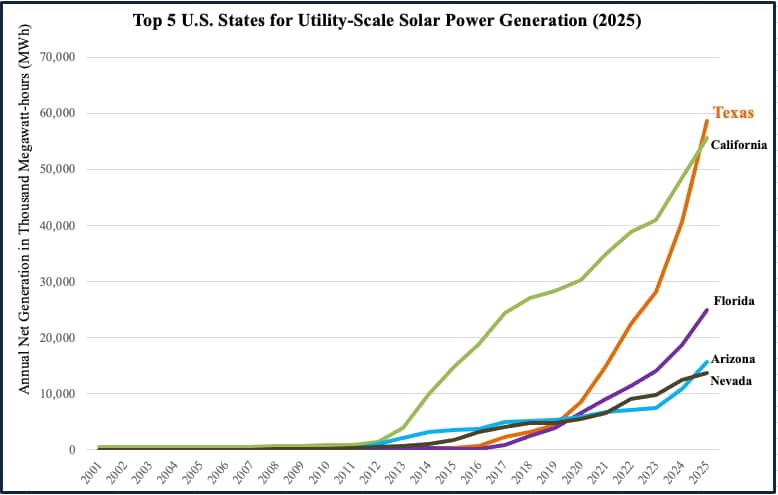
It's been cheaper than nuclear for a while now, it was only a matter of time.
Personally i'm waiting for the next iterations of Kesterite cells.
If we can get single cells to crack ~20% efficiency. With a tandem cell architecture, it's going to become the new standard overnight.
Durability of silicon cells or better, but orders of magnitude $ cheaper to produce, and without the need to use toxic agents as in perovskite cells.
We're movin' fast.
For over a decade we were stuck at ~12% efficiency. And in the last 4 years (probably with AI help) we've cracked 15% efficiency
https://interestingengineering.com/energy/chinese-researcher...
Few more years, and with a bit of luck, we'll all be around to see solar panels that cost 1/10th of what they do now.
More stoked for when the same is said for storage.
Solar is cool but solar that can make it through the night and a couple cloudy days is way cooler
> Solar is cool but solar that can make it through the night and a couple cloudy days is way cooler
The fun part is that we're still well before the point when this even matters.
Almost 60% of the US grid is still fossil fuels, with around half of that still happening during the day. Which means you can get down to ~30% fossil fuels without any storage at all because all you do is go from burning fossil fuels during the day and at night to burning fossil fuels only at night.
Yeah the US will lag behind on this.
Other countries are better positioned. e.g. UK has really spiky wind energy. Right this second more than half the grid is wind. Which is both cool and problematic for managing the grid.
Grid scale cheap storage would dramatic help manage that chaos
It doesnt make economic sense to serve the entirety of daytime electricity demand from solar without batteries. Youd have to tons of fossil fuel plants that turn off during the day and then back on every night. For solar to take the next step batteries are a requirement
It's not quite as bad as that, since you don't consume fossil fuel resources when plants aren't running, but this is mostly a benefit for oil/gas plants, not coal (since the coal is likely useless without the power plant consumer anyway)
Solar+A couple of hours of batteries is already economically viable. The storage problem that is still expensive is bridging days/weeks of insufficient sun and wind.
That's not really a problem. A spin up over a couple hours matches nicely with the slow sunset over a continent. The sun takes ~4 hours to go from a bit above the horizon in the east coast to a bit below the horizon on the west coast (solar panels make some power in twilight).
Wind also helps since wind makes more power at night, as does demand which is dramatically lower at night.
For coal, Great. Making coal economical is excellent. We should have banned it worldwide 20 years ago.
USA should explore Pumped Storage Hydropower more, it has same or better efficiency than battery storage and can use existing facilities like hydroelectric dams
That might work in The SouthWest of the USA, but the Northern bits dont get enough sun to get through the day, so you'll need fossil fuel plants all day night for the Winter. If they're there already its cheaper to use all day in the summer as well.
Hmm, how much of that is base load versus the dramatic rise of natural gas plants that respond to dynamic demands? Even in daytime, I think you need storage to get rid of those, right?
I don't know why this is downvoted. Solar and wind both essentially suck at anything other than baseline throughput. That doesn't mean they're useless, it just means that solar can't be our only solution unless we have, like... 30 breakthroughs tomorrow. We otherwise need something to handle spikes, which are both common and important, as well as periods when there is extended cloud cover even for typically-dark months.
Even if we handwave all the science needed to build batteries big enough to power cities for days, I don't think it's realistic to handwave the science needed to power a city for weeks. We don't even have enough oil for that.
"Power when it is inconvenient" is pretty much the basis for a modern society.
A week of low solar and low wind is a yearly or every-couple of years event that you definitely need to solve for a completely renewable grid.
That's every single winter where I live in the US. We don't have a word for it like the Germans do, though, we just call it January.
> Solar panels still work just fine when it is cloudy, just with a lower output.
I assume you never tried measuring the output of a solar panel when it's cloudy. It's 10-15% of a sunny day. Closer to not working than working.
Carbon capture makes little sense until fossil fuels have been replaced. I guess there are some Bio char technologies that might change the equation a bit, but watt for watt, you need to replace your carbon emissions first (generally speaking)
There are about 90 billion battery solutions - none of them are very efficient, cheap to manufacture, easy to manufacture/acquire materials for, and long-lasting all at the same time.
Typical non-informed incorrect opinion.
The overwhelming majority of generation and storage is best deployed at the point of use.
Grid scale anything, is a massive inefficiency.
The only reason grid and city scale is so prevalent in public discourse is because this is the only electricity the utility is paid for, and they are very actively impeding any other solution.
In the US, there is a very large inventory of flat roof industrial buildings, in the industrial parks that are using huge amounts of electricity. Covering all of those roofs with solar (especially here in the west US) would prevent a tremendous amount of grid scale generation, and implementing storage there would eliminate a large part of the transmission line upgrades the utilities are calling for.
The biggest problem in the US isn't technical, it's the governments desire to primarily support the solutions that are best at serving utility shareholder returns, instead of the technically superior solutions.
Good news: batteries on are a similar exponential curve. Just a decade or so behind.
Its important to qualify that:
A decade or so behind, in the US.
If the US didn't block import of Chinese tech, we could have electrified a decade ago.
The tech available at the current moment, is even more capable of replacing petroleum based electricity.
But our government is banning Chinese tech to serve our outdated industries instead of importing it to serve the population.
As any wise country would do when faced with superior technology, we should import it with the condition of technology exchange. Chinese manufacturers should be training US workers and industrial ownership how to produce cheap, efficient, sodium batteries.
This benefits the populous immediately, and the industries are able to advance into the current century's tech.
>>> As any wise country would do when faced with superior technology, we should import it with the condition of technology exchange.
If it were a matter of industrial protectionism against a country which was not hostile, not authoritarian, didn't rely on slave labor, etc., then I'd agree with you. Countries have other pressing reasons besides immediate economic advantage to prevent this sort of thing.
To greatly oversimplify: Japan fought against opening their markets, as did China, out of political and social concerns for the stability of their states, far more than economic ones.
All fine and dandy until your grid goes mysteriously offline the day after China moves on taiwan.
> But our government is banning Chinese tech to serve our outdated industries instead of importing it to serve the population.
It protects American companies who operate in the green energy generation and storage arena from Chinese competition.
It does that too, but it would be unbalanced to not also recognize it protects green energy companies in America from Chinese competition.
Not only does Chinese competition get blocked, but governments are incentivizing green energy. For instance, just recently it was reported that Tesla’s $10B solar factory could get 35 years of tax breaks in Texas (Oil Capital!!!)
https://electrek.co/2026/10/23/tesla-solar-factory-texas-35-...
Honestly, it's not even doing that. Thing that would really push the US ahead would be the tax breaks we had until a couple years ago.
[dead]
Usually solar and storage are a package deal these days for grid scale solutions. Mostly, storage is not really about providing long term storage but short term. It used to be that the sweet spot that makes the most economic sense was something like 2 or 4 hours of power (relative to the maximum output of the solar panels) but these days batteries are a lot cheaper and 8 hours or more is becoming fairly common. The point of storage is not really to cover for all the downtime when the sun doesn't shine but to give grid operators enough lead time to bring online extra generation or buy capacity on the open market and adjust their planning. Mostly a few hours is all they need to ensure the grid stays up and running through daily peak usage windows.
In aggregate, grid operators have a lot of other tools at their disposal via flexible pricing, flexible demand, and automated systems that can adapt to this to e.g. charge cars when there is a surplus of energy, turn on/off water boilers, etc. There's a lot of innovation around this topic in this space. This by the way is as much as making sure generated power doesn't go to waste than it is about ensuring there is enough power. They use batteries to time shift excess power to when they can utilize it.
Interconnected grids means that e.g. an operator in Denmark can import/export to and from the UK, Norway, Germany, etc. On a windy day they'll be exporting wind power. On a sunny day, they might add some solar to that mix. When there's no wind or sun in Denmark, they might pull in Scottish/German wind, Norwegian hydro, Swedish nuclear, etc. Batteries are being deployed all over the place at a pace that is only exceeded by the pace at which solar is being deployed. Whenever there's a surplus energy, batteries get charged up. It's very rare for all of the available generation to disappear all at the same time for long enough to drain all the batteries. And for those times of course fossil generation is still a thing as well, and will be for decades to come. There are a lot of gas based plants throughout Europe. As well as some nuclear plants of course. Singling out the EU market here but it's going to be similar elsewhere.
The point here is that there's no need to pair solar setups with days/weeks/months worth of storage. A few hours goes a long way.
Diurnal storage is solved by batteries. Longer term storage will very likely be solved. For several days, cheaper batteries (perhaps with lower specific power). For longer periods, either thermal storage or e-fuels.
Wood burning heat is perfect compliment to solar in remote areas.
My guess is seasonal will be handled with flow batteries. A big tank and cheap-ish electrolyte, with the expense being in the electrodes sized for whatever max power is required. Tanks good for multiple cubic meters worth of liquid storage aren't exactly difficult to find, nor to place in a garden.
Then again, I'm basing this opinion on a recent-ish video from NightHawkInLight: https://www.youtube.com/watch?v=eq7fR9ISuCw
Flow batteries might be ok for a week or so, but their market window has been shrinking as Li-ion has gotten cheaper.
The technology I'm most excited about is ultra low capex thermal, as being done by Standard Thermal. Capital cost per unit of energy storage capacity as low as $0.10/kWh(th), so it can work with seasonal storage and just a few tens of charge/discharge cycles over its lifespan.
Standard Thermal has raised $11M and is building in Germany, where they say they can deliver 365/7/24 solar resistive heat (400 C or perhaps 600 C) for half the cost of heat from burning natural gas there.
Flow batteries keep coming up again and again, but they just don't work well in practice. The power density of electrodes is too low to be practical, and this is a fundamental problem.
A regular 18650 cell has about 0.1 square meters of electrode surface. And you have thousands of these cells in a car battery, resulting in literal football fields of electrode area.
Agreed, e-fuels seem to be far and ahead the front-runner.
We can get to 95% using just short term storage. I suspect that most jurisdictions will just say "95% is good enough" rather than paying for ridiculously expensive long term storage.
We've got the nat gas capability already; keeping it around for the 5% is quite inexpensive, making the massive investment in long term storage for marginal benefit hard to justify.
OTOH, while the premium for e-fuels seems excessive, if you're only running that nat gas plant 2 days a year that premium is not so scary.
> Agreed, e-fuels seem to be far and ahead the front-runner.
For covering Dunkelflauten? Yes.
For seasonal storage with a prolonged discharge (so, low power/storage capacity ratio)? I think thermal storage wins there.
I'm not talking about district heating. I'm talking about high temperature storage for conversion back to electricity. Round trip efficiency could be around 40%, better than green hydrogen burned in combined cycle plants.
The temperature swing can be much greater than 100 C. Heat can be extracted as a wave passing through the store, then heat added back by reversing the flow. It would operate like a counterflow heat exchanger.
View another way: if we hook several piles in series, then lukewarm air from a first mostly discharged pile can be directed into later piles for more heating. In the continuous limit this is the concept I described above.
36000 tons... doesn't actually sound like that much? That's a ~30x30m cube of dirt.
But I have no reference for the cost of setting up such a storage and how it compares to battery or hydro.
Its also tricky to defend in war prone locations.
I think solar is amazing and we need more of it - but I can't stand this solar and storage go at it alone mentality. It's pretty thickheaded to discount the other forms of energy that we can use and will need.
I think I'd rather a solar panel array be bombed than a nuclear power plant.
Solar has the advantage that it can be widely distributed on buildings rather than in just a few centralized locations.
In practice, in Ukraine distributed solar power has been an increasingly important source of resilience in their power supply system.
There are legit reasons to push back against “solar and batteries everywhere” but I find it hard to credit resilience in a conflict situation as one of them.
I don't see how anything would be more resilient than solar.
Gravity just needs mass not fusion but your point remains.
Aren’t lead acid batteries great for this purpose? They have advantage over lithium in stationary setups because weight is not an issue and they can be “daisy chained” many many times. I’m unaware of more cutting edge alternatives and the way the electrical companies handle solar is confusing IME
Lead acid batteries don't much like being cycled heavily. Even the ones explicitly designed for it (the average car battery is not) have about a tenth of the lifespan of lithium ion.
LiFePO4 is probably the chemistry best suited to it ATM. Lasts a long time, more stable, pretty cheap, and just a bit less energy density than other lithium ion options. Sodium-ion is looking promising but only just entering the market AFAIK.
Does this mean LA would be a feasible option for longer-cycle storage, IOW keeping a reserve topped up most of the year for those duldrums weeks with little solar or wind?
For long term storage, the right batteries don't exist yet (commercially). The good options are going to be one of sodium ion, flow batteries, or thermal batteries.
In addition to the fact that it doesn't really work better for that either, it's just not as safe as lithium iron phosphate.
I think it still loses out to lithium-ion on cost/kWh, and batteries in general are still a bit expensive for storage on the timescale of months.
I dumped my 24V dual LA battery setup for a single 24V LFP battery for my inverter/UPS backup. LFP supposedly has a 10-15y life based on the 4-5000 charge cycles most cells claim. Sodium ion is on the way as well. My setup gives me about 10-12h of backup for critical loads (my PC, lights, fans).
I have a 5 kWp solar plant that produces ~25kWh per day, but it is grid-tied. I considered a hybrid setup with LFP battery back up, but decided to separate the two systems to avoid a single point of failure.
They're not great.
LiFePo4 however is excellent and reasonably low cost these days
"PO" not "Po" (I was wondering what Polonium was doing in here lol)
Whatever it is doing, it won't be doing it for very long ;-)
We can simulate storage with overcapacity and broader geographical distribution networks, even if storage doesn’t become as cheap.
Fortunately that doesn’t seem like it will be an issue since battery storage costs are also seeing an exponential reduction.
> More stoked for when the same is said for storage
Batteries have use in war and power. It will likely scale faster than PV. What we need is the second derivative, so production of the latter can be turbocharged just before battery production is about to break through.
Electricity is cheaper at night but only 20% of my consumption is at night, so I wouldn't mind if the situation was reversed.
I guess using electricity to heat during the night could be an issue, but we could also accept to let the temperature drop.
Around here late morning to mid afternoon (11 am to 4 pm) is now off-peak, alongside the old 10pm to 6 am.
There's also, like... winter. I'm fairly sure there's a calculation somewhere you could determine the number of deaths this will cause with pretty good accuracy.
Solar is never gonna be a complete solution. At the end of the day, we could do it more efficiently by just building suns here on earth for the panels, but of course then you've achieved fusion and you're already generating more than solar could ever hope to. We shouldn't hinge our future on half of a technology.
There's still sun during the winter; you just need more solar panels for the same amount of energy. Also, there tends to be more wind during the winter, so wind power makes a good complement to solar.
So the winter, by definition, will always generate less? or we're just like... covering up a bunch for half the year or something? I don't get your point.
My larger point is that solar is only ever going to be a piece of the puzzle at best. In space it might be quite nice, but otherwise it's kinda goofy to invest too much in.
Fusion, I hate to say it, is a pipe dream. Why? Because any fusion reactor loses a ton of energy to fast neutrons, which have the added negative of destroying the reactor. So-called aneutronic fusion (eg using He3) isn't zero neutrons. It's just fewer neutrons.
Stars don't have this problem because they're very large so there's only so far neutrons can go.
This is such a weird thing to assume is just impossible in physics, I don't quite know how to respond other than "yes, there are many unsolved problems in every energy sector, which is why it's an open question where we go from here"
The cheaper solar gets the more of a gold rush there has been to develop projects/technologies that take advantage.
It's encouraging- when one part improves usually the others follow.
Most of our chemistries are targeting things like cars and consumer electronics.
Ideally we see people like Form Energies, using iron-air (rust) batteries, for much easier to scale storage. https://www.technologyreview.com/2026/10/06/1145020/2026-cli...
https://www.iea.org/commentaries/global-battery-markets-are-...
- Battery energy storage has grown at an exceptional pace, with global installations increasing more than 20-fold in storage capacity over the past five years. This growth has been driven by falling battery prices, abundant supply and relatively short project lead times. As variable renewable generation expands in many markets, battery storage is becoming an important source of flexibility and resilience for power systems, while also representing a growing commercial opportunity for battery manufacturers.
- However, more than 90% of battery storage applications rely on LFP batteries that are almost exclusively supplied from China, which accounts for almost all global manufacturing capacity and the associated technical expertise. Korean producers are investing to scale up LFP battery production that can offer an alternative, but they face intense competition from established, lower-cost Chinese producers in an oversupplied market.
https://www.iea.org/commentaries/battery-storage-is-scaling-...
- Battery storage now accounts for around 18% of installed dispatchable capacity in Australia, compared with 7% in China, 5% in the United States and 4% in Europe – underlining how rapidly batteries are becoming an important part of the electricity systems in some regions.
https://www.ess-news.com/2026/06/02/global-battery-additions...
Battery storage is right behind the solar adoption curve. Net zero in five years? Probably not. Ten to fifteen years? Almost assured considering rate of change and the overall economics (assuming ~1TW/year of solar PV deployment and enough battery storage to soak up that low carbon generation while also providing grid services to replace thermal generation grid support [voltage, frequency, etc]).
(China is curtailing renewables equal to the annual combined generation of Spain and the Philippines every six months, and India about ~100-120GW/month due to not enough battery storage, for example)
I am desperate to find a battery inverter that can be used to supplement my existing grid-tied home solar setup. I only need about 5kW and 10kWh of batteries, but everything I can find is geared towards whole-home power at like 12kW. Way way more than I need. I understand I’m in the minority and there’s probably not a market, but I’d love to find something
Transparency: I live in a 240v land, I have a Siggen.[0]
Not sure whether other brands could be better but there seem to be various options that would suit. If you are in 120v land you may need to check if there are models to suit.
Its largely modular, inverter sits on top of modular batteries in 8-9kw chunks.
But they are app-infested. IE wants a wifi connection, app on your phone to their servers... etc etc.
I hate it, but the wife likes it. This is a recent thing so I am still working out if there are possible solutions for privacy and control over my own objects.
[0]https://solarbatterysupermarket.com.au/products/sigenergy-ba...
Unfortunately, the market is somewhat bifurcated between what Anker, Jackery, Ecopower provide and stepping up to Base Power, Powerwalls, and other bigger system components.
My recommendation would be to see if Ecopower storage and inverters are a good fit for your use case. If you're feeling adventurous, you could build your own battery pack, but I only recommend if you are knowledgeable and confident. This comes with substantial property and life safety risk, only proceed if you know what you're doing and understand the risk (I'll work on my high voltage EV battery packs, but only with a helper nearby holding a 2x4, for example).
Is there any practical way for US individuals to invest in solar? With the anti-solar attitude from the government, is now a good time given that's where the world is obviously headed?
I'm sure there are lots of ways. For example you could give people money to buy panels via https://ecoligo.com or similar services.
I understand the sentiment but I also think the modern electrical grid is one of the most impressive and valuable things man has created and I'd hate to see us give up on it.
Surely economic forces will overcome political ones eventually, right?
I think we’ll see a pivot from the right on solar soon, once they realize how cheap it is and how much money they can make. They’ll spin it as home-grown local jobs stuff but regardless it’s a win-win.
The ironical thing is nothing screams independent, rugged like having your own large single family home with your own power source which is even powering your EV. The US suburbia will become net positive if more people figure out wasting roof space does not make sense
I'm not rly convinced that roofs are the best places for solar.
1. Then you need small scale transformers 2. Lots of roofs have shadows on them a lot of the time, like from trees or other nearby buildings 3. Most roofs have to get replaced every 15 years 4. Roof installed solar is fixed in place
I think parking lots, rural empty land and the like are a better starting point that avoids all 4 of these issues.
I have solar on my roof btw.
I've now seen farmers replacing diesel trucks with Rivian trucks. A lot of them are starting to get it, and the Republicans are losing them as a result.
I had a staunchly Republican environmental science professor in college say that environmentalism IS conservatism and Republicans shot themselves in the foot by making it political. He gave example after example and I'm not sure I've ever heard a more convincing argument before.
Why are we waiting on political movements to latch on to a revolutionary technology? If they are against you saving money vote them out, regardless of party, lol
Parties are in power, not voters. Or rather, the parties hold the votes that count: those in the assembly.
You only vote once every couple years. Political movements mean less waiting.
There is a school of thought (ie ecomodernism [1]) that believes that all big problems will be solved when the economics change. I used to believe that.
Instead we have a captured system where it's cheaper to buy the politics of wealth extraction. Historically speaking this has always led to increasing wealth inequality that is ultimately resolved by war or revolution.
If the ultra-wealthy were smart, they'd declare victory because they've never had it so good and they'd seek to give back a little to placate the populace and stave off that war and revolution. But they don't. Greed has no bounds. So at some points, the guillotines are probably making a comeback. And a lot of people are going to die as climate refugees in the coming decades.
You underestimate how much money oil groups are pouring in lobbying. Energy could fall from the sky, it wouldn't change their mind... oh wait
The world has more than one country, and most have basically no access to oil. They will go deep into solar first. See, for instance, how the mix between the Venezuelan takeover early in the year, plus the Hormuz situation, put Cuba's energy access into jeopardy, and how that meant moving heavily into solar, as at least that remains available once purchased.
So even if a place like the US goes lighter on solar that is reasonable, Places like Spain, Italy or Morocco will go all in just to minimize dependence on a resource a third party can control. It's the ultimate counter to the Hormuz situation. Squeeze access to oil for long enough, and you accelerate the move away from it.
[dead]
The right's opposition to it is mostly rooted in the fact that historically the fossil fuel industry has been a major funding cornerstone of the right.
It goes all the way back to this kind of thing:
https://en.wikipedia.org/wiki/The_Fundamentals
The pamphlet from which we get the term "fundamentalism" was published by an oil industry tycoon.
So the right is incentivized to protect this industry even if it becomes obsolescent and is no longer the most economical or practical way to generate at least much of our energy needs (electricity).
While the right has often sounded pro-nuclear, in practice they tend not to be that enthusiastic about it when they actually get into office. Obama supported the first new nuclear plant in decades.
https://politifact.com/factchecks/2012/mar/02/barack-obama/o...
Fossil fuel interests seem to support "the enemy of my enemy". 25 years ago the best alternative was nuclear so they supported alternatives to nuclear. Now they support nuclear and hydrogen.
The oil and gas industry loves solar and wind. You need baseload generation capacity in those outlier days where there is cloud cover and the wind doesn’t blow.
That baseload capacity comes from natural gas power plants. By building solar and wind you are guaranteeing a market for their products in the future.
Not sure what religious fundamentalism has to do with any of this.
I'm not convinced. If the fossil fuel industry has such a grip on the right, how did these things make it into the 2008 Republican Party Platform [1]?
Climate change:
> By increasing our American energy supply and decreasing the long term demand for oil, we will be well positioned to address the challenge of climate change and continue our longstanding responsibility for stewardship over the environment.
...
> As part of a global climate change strategy, Republicans support technology-driven, market-based solutions that will decrease emissions, reduce excess greenhouse gasses in the atmosphere, increase energy efficiency, mitigate the impact of climate change where it occurs, and maximize any ancillary benefits climate change might offer for the economy.
...
> Because Republicans believe that solutions to the risk of global climate change will be found in the ingenuity of the American people, we propose a Climate Prize for scientists who solve the challenges of climate change. Honoraria of many millions of dollars would be a small price for technological developments that eliminate our need for gas-powered cars or abate atmospheric carbon.
Clean energy:
> Alternate power sources must enter the mainstream. The technology behind solar energy has improved significantly in recent years, and the commercial development of wind power promises major benefits both in costs and in environmental protection. Republicans support these and other alternative energy sources, including geothermal and hydropower, and anticipate technological developments that will increase their economic viability. We therefore advocate a long-term energy tax credit equally applicable to all renewable power sources.
Reducing demand for fossil fuels:
> Conservation does not mean deprivation; it means efficiency and achieving more with less. Most Americans today endeavor to conserve fossil fuels, whether in their cars or in their home heating, but we can do better. We can construct better and smarter buildings, use smarter thermostats and transmission grids, increase recycling, and make energy-efficient consumer purchases. Wireless communications, for example, can increase telecommuting options and cut back on business travel. The Republican goal is to ensure that Americans have more conservation options that will enable them to make the best choices for their families.
...
> We must also produce more vehicles that operate on electricity and natural gas, both to reduce demand for oil and to cut CO2 emissions.
> Given that fully 97 percent of our current transportation vehicles rely on oil, we will aggressively support technological advances to reduce our petroleum dependence. For example, lightweight composites could halve the weight and double the gas mileage of cars and trucks, and together with flex-fuel and electric vehicles, could usher in a renaissance in the American auto industry.
[1] https://www.presidency.ucsb.edu/documents/2008-republican-pa...
And what do the Republican party platforms from within the last decade have to say?
I don't see this happening for a very long time. Mines and oil and gas wells are huge wealth concentrators.
Oil wells decrease in production over time. It's called the decline rate. For wells in the Permian basin, the average decline rate is about 15%. So a 1000 barrel per day ("bpd") well produces ~850bpd in year 2, ~700bpd in year 3 and ~550bpd in year 4. That means you need to be constantly drilling wells. That's more wealth concentration opportunity.
1MW of solar produces 1MW in years 1 through 20.
Additionally, the fight for control over resources induces demand for weapons. Solar doesn't do that. This is summed up as No one goes to war over a solar panel [1].
Efficiency isn't the goal. Wealth extraction is.
[1]: https://www.theenergymix.com/no-one-goes-to-war-over-a-solar...
>> 1MW of solar produces 1MW in years 1 through 20.
I agree with your post, but the above statement is not technically accurate.
Panels do drop in production over time; A very rough rule-of-thumb is around 1% loss per year.
So after 20 years production is at like 80%. (Ymmv)
Of course this isn't really a big deal. The panels themselves are cheap and can be replaced very easily. Equally there is a market for 2nd hand panels as they still produce, and are ideal for places that are not space constrained.
[dead]
Nope. Big oil has spent big money on propaganda for a VERY long time. Something that almost all right wing pundits and podcasters are funded by.
For the right to actually embrace solar, you need either big money in solar to start it's own propaganda campaigns or you need big oil to collapse to the point where they can't afford paying propagandists. Right now, they are making record profits so don't count on that anytime soon.
The right wing prepers and homesteading communities are already fully on board with it, I think it won't be too long until the rest of the right jumps on board.
Just slap an American flag on it and call it "Patriot Solar."
Go religious. "Energy from heaven." or "The devil lives underground."
Associating religion with the right is such a shallow, annoying stereotype.
That works!
After all, it comes from the Star of America.
We're barreling toward a point where above a certain wealth level and below a certain population density individuals can get all their energy from the sun, store it with batteries you get in the mail from Temu/Amazon/Alibaba and connect it all together with stuff you can buy from a Home Improvement store. All done unilaterally. Very hard to sink the claws of regulation into that except after the fact (unpopular). That is a future that too many people would be happy to sacrifice a lot of pollution to prevent.
So I think the pivot you're talking about, which I agree with eventually happen, will be offset in at least significant part.
Of the top 10 states in solar generation in July 2026, 7/10 of them voted for Trump in 2024 [1].
The U.S. solar industry installed 43 gigawatts (GW) of new capacity in 2025, remaining the dominant source of new capacity added to the grid for the fifth consecutive year. Solar and energy storage represent 79% of new capacity installed in the first year of the Trump Administration [2].
[1] https://www.chooseenergy.com/solar-energy/solar-energy-produ...
[2] https://tedmag.com/report-u-s-added-43-gw-of-new-solar-capac...
freedom energy
Already happened, more or less - c.f. Texas
https://texas2036.org/news-analysis/growth-of-utility-scale-...
tl;dr: https://mlu3fafnp1cd.i.optimole.com/w:778/h:495/q:mauto/f:be...
Only Fox News boomers are against solar power. The rest of the right wing just doesn't want government slush fund handouts to vaporware companies like the Obama administration. If it's cheaper, great. Don't drag CO2 into the argument, just win on price and the right wing will happily adopt it.
> The rest of the right wing just doesn't want government slush fund handouts to vaporware companies
Maybe the voters don't, but the businessmen and politicians definitely do, maybe more so than democrats. Just in different sectors (military).
> just win on price and the right wing will happily adopt it
Obvious counterpoints: Trump's $700m "clean, beautiful coal" handouts, or Trump's $2B buyback of wind farm leases.
I'm talking about the voter base, not the crooks in Washington.
Nobody likes everything any politician does. The question is who is least evil.
Im sure theres an element of "private industry should profit off the sun because I'm a temporarily embarrassed millionaire and the government cant be trusted to run efficiently" vs "the government should build and maintain communal infrastructure so everyone can benefit and profit isnt extracted" with both sides thinking their version keeps things cheaper in the end for the customer.
Private industry should be able to profit off the sun and it's disturbing that you think asserting this is a dunk. Steinbeck's temporarily embarrassed capitalists quote (not "millionaires", that is a misquote of what he actually wrote in 'A Primer on the 30s' for Esquire magazine in 1960) was referring to well-off liberals involved in socialist activism in the 30s and having a naive, self-interested understanding of what policies would actually help the proletariat. The government often can't be trusted to run efficiently because the government is insulated from having to actually make a profit delivering services people want to pay for, and is often being used for other poltical ends by people who do not care about wasting taxpayer money. Communal infrastructure is often not something everyone benefits from because infrastructure that is legally required to serve everyone by law often has a bunch of compromises that make it practically unusuable for some group of people who can't do anything to change it because they are a numerical minority.
I don't think many people on the right have ever been against solar power. It's rather being pro all power and not wanting to remove a source to replace it. The demands to remove power sources come from the left. Build as much solar as you want, but don't shut down the nuclear plants.
The current US administration has forcibly shutdown solar, onshore and offshore wind projects. Explicitly, intentionally.
A bit of realism would help here. Yes, there's a left/NIMBY overlap to some degree, but the forces from the non-right camp seeking to limit power development comes from the NIMBY elements, not the left elements.
The problem is left and right are too broad. There are some one each side in every different option. There are oil barrons in the right and those who like solar because it is economical. Likewise the left has those who hate all electric and want to go back to the pre electric era, and those who want solar.
For more, see “Solar surpasses nuclear power globally for first time” with 464 comments from 9 days ago.
Judging by the source data:
https://ember-energy.org/data/electricity-data-explorer/?tem...
Solar's global peak month in (northern hemisphere) summer 2024 nearly equaled nuclear, the full calendar year 2025 slightly beat nuclear and now it's possible that the next yearly minimum month coming up this december will match nuclear. That's a lot of change in just 2.5 years.
Also, the graph shows the world needs more wind power as it counter cycles both solar and hydro supply.
Poland is going all on solar. People are enthusiastic about generating their own power, government had to step in and curb the enthusiasm.
I don't know anything about the polish electricity system but if supply or demand isn't very elastic then excess of either can lead to pretty huge price fluctuations and knock on effects thereafter.
bro the sun hardly rises above the horizon for 4 months of the year when power is needed the most.
Did they add a solar tax?
Is it? I keep hearing something like $30k. That might pay for itself over time, but it's hardly cheap.
Rooftop solar and grid scale solar farms are two completely different things. Rooftop solar requires a custom install for every home. Solar farms can leverage economies of scale to drive costs lower and lower.
If you have to hire Some Guy to do anything to your entire roof, it'll cost you $30k. The panels are basically free these days, the labor required to install them is not.
Come to Europe. Our discount stores will sell you a kit for €200-€300. Not 20k-30k, 200-300.
That's on the small side of things, of course, but we also have PV-covered carports for about the same as a non-PV-covered carport: https://www.kaufland.de/product/512021383/
The fact that solar panels are getting cheaper on a sqft basis than plywood or sheet metal means we are going to stat to shove them in lots of places we never expected to especially if micro inverters or optimizes become cheap as well. why not use solar panels on your fence if it is cheaper than any other options.
> why not use solar panels on your fence if it is cheaper than any other options.
I was considering this earlier in the year, as it happens.
The biggest issue I can see is that you would want a micro inverter or solar optimizer on every panel or every other panel to get decent output which would add a lot to the cost.
Just checked my local online store - non-structural plywood is still about 5-10x cheaper.
I don't think you realize how little power does apartment needs. Your average American/AU/NZ home is using 10x more energy.
I know exactly how little power an apartment needs, that's why I had the entire second paragraph.
[dead]
Solar panels cost less than $1/Watt. Then you need some brackets to hold them, some wiring, and likely an MPPT controller. The rest of that price is red tape specific to your locality.
They're so cheap that bars in Colombia had panels as their terasse awnings. Cheaper than cloth and makes power.
Cost per kW/mW is much lower at grid scale than home scale. For a home installation you are also paying for the roof mounting, running cabling through your house, inverter(s), and a transfer switch at minimum.
The cost of the panels themselves is becoming one of the cheaper parts of that project.
Vast majority of costs is in the installation and regulation, Australia home installation costs are a fraction of the cost of the USA and in Europe with plug in solar its a few hundred Euros for a couple panels and small inverter for a small setup
They're talking about grid scale solar, not home installations.
Home solar makes sense for the same type of homes that need to drill their own well. For everyone else, grid solar makes most economic sense.
The city grew around my house and now I have access to city water if I want. I stick with my well because it is cheaper. Even if I had to drill a new well, over 20 years it is cheaper than city water. Pipes and city scale treatments that I don't need are expensive.
It is amazing that solar, a ridiculous cheap and easy to install solution is winning the energy future. In the past, based mostly on playing SimCity, I would have thought that Nuclear and then Fusion was the future, but solar does seem to be winning and pretty thoroughly.
I guess this is in part because it only needs amazing factories and not complex deployed and maintained infrastructure that is at risk of blowing up.
Solar seems to fix the mould of a disruptive technology to a T.
Games like SimCity just embody the assumptions that are designed into them, and there's no reason to think the designer was any more prescient than anyone else.
After all, if they could predict the future, why did they design a game rather than get rich in the stock market?
The user probably isn't suggesting the designers of SimCity are prescient; it's just that the assumptions that are designed into these games are clear reflections of the social perspective at the time. Assumptions like these tend to have inertia through time, and the user is likely just pointing out their surprise at the change.
I am not saying that SimCity predicts the future, rather I had assumptions growing up in that period, probably similar to everyone else at the time, that Nuclear and Fusion were the future of energy. It is cool to see that shift so soundly to solar in just two decades.
It's useful to go back and figure out why you believed that. Treat it as debugging your thinking. Others were saying, even back then, that nuclear and fusion had predictable economic problems.
Fusion was predicted to be an economic nonstarter at least a decade before that.
https://news.ycombinator.com/item?id=20782346
(Needless to say, I don't have a high opinion of current fusion start ups.)
And fission already had the financial fiasco of the first nuclear build out in the US.
Solar could have been predicted to get really cheap, if one had heroically projected its experience curve into the future. A lot of people chickened out doing that, even Greenpeace.
They predicted they had a better chance of getting rich off the game as opposed to the stock market
Solar only works if you 1) live in a standalone house that 2) don't get tornadoes, typhoons, severe rainstorms or other disasters annually, and 3) they are installed on-prem, for off-grid capacities.
Games like SimCity often only supports ultradense Manhattan style cities and centralized solar plants through distribution networks. That combination doesn't work with solar technology. It should be like "Set up offgrid solar incentives program($1.5B)" buttons that reduces power draw proportionate to numbers of standalone houses that resets when disaster hits the parts of the map it was used on.
Interesting perspective. As someone who didn't even grow up in the US, I saw Sim City as a builder of relatively low density, hard zoning cities that had little to do with the high density I grew up in. The idea of commercial zones didn't even make sense to me, as in Spain, such thing doesn't exist. Need for traffic to get to the commercial zones made little sense.
Solar seems to be working just fine in Spain, a place where almost nobody lives in a stand alone house, or even a row house. You still put solar in the building, but then you have industrial solar in places wi5 little agricultural value, and wind turbines installed on top of hills. All of this could work just fine in any sim city I remember, as you are just dedicating space to power, which is fine.
I live in a place that gets typhoons, but there's probably only one big enough to rip my panels off every once in 5 years. Still, you never know which one it will be and I don't look forward to having to taken mine inside for false alarms.
I've seen plenty of solar in areas that get hit by hurricanes or tropical cyclones. If your panels get blown to bits, you just put up new panels once the storm is over (or you know, take them down when the storm is forecasted)
These[1] just keeps happening where I live. This year it was some flooded field ~40mi away from Tokyo station. You can't "just" pick them up as they continue to generate potential as broken panels continue to charge up potentials as long as there's light. IIUC you first carefully put tarps over them.
The situation is slightly different for rooftop solar installations, which are equally prone to flying debris as concentrated farms but somewhat less likely to be affected by disasters that the house it is on can withstand. But that would be for off-grid purposes and not for the grid, and my original comment that solar generation only works for on-prem off-grid applies.
On our boat[1] we have deployable solar that we need to take down every time it gets windy so I'm quite familiar with the process.
Plan it and it won't be a huge deal.
That said, I'm sure there are spots on this planet where solar isn't the best renewable option. Maybe small-scale wind power would be better where you are? On our boat we have both (and hydro for when we're sailing). Sadly these mechanical generators haven't yet received similar scale effects to their price as solar has.
That's a very narrow view of solar. Solar, like any other form of electricity, can be transmitted, even very large distances. There's no reason that places like the US Southwest can't generate a whole bunch of solar and export it to the national grid.
Plus below a certain cost threshold, the risk of damage still means the overall cost is lower.
Do you remember the microwave antenna power stations that power from solar satellites? The Moore-like drop of solar prices killed solar satellites, solar greenhouses with turbine chimneys, TW superconductor submarine cables circling the world etc.
Nuclear /could/ have solved this years ago but the spectacular and scary nature of failures like TMI or Chernobyl [0] really sunk any chance of that happening. Plus you had all the traditional nonrenewable energy providers intensely interested in stoking fears of that and the question of nuclear fuel storage.
[0] Yes pollution from normal everyday fossil fuel power generation causes more damage and deaths in the aggregate but it's a diffuse hard to attribute kind of damage which makes it far less, for lack of a better way to say it, real to people. eg: Did living downwind of that unupgraded coal plant really kill them or is their death because of something else.
Price probably played a pretty big role, too. The up front cost of a new nuclear plant is eye watering. Hard to compete against solar & battery these days which can be spun up in months and cost comparatively pennies.
That's also true, partially driven by a lot of hurdles and time spent fighting for approval due to the anti-nuclear push due to the things I mentioned, but it is also just expensive to build in the US because our labor and land is pretty expensive too.
I'm thinking more of the cycles of community approval that can drag on and delay the project rather than individual ongoing regulations.
I mean concrete is also just really expensive. A lot of the cost is labor, yes, but still.
And the price was escalating even before TMI and Chernobyl.
Nuclear has to be the most cultish topic on HN, I swear. Anything less than full-throated support for nuclear gets downvoted into oblivion and it simply doesn't matter how well-reasoned those views are.
To borrow the meme about LISP [1], if nuclear was so good, it would've caught on at any point in the last 80 years. And it hasn't for some good reasons:
- It's too expensive. As an example, Hinkley Point-C in the UK has a super high negotiated rate that only lasts 35 years for a plant that still needs a lifetime of 60 to justify the investment so who knows how expensive the power will be for those last 25 years;
- It takes too long to build, typically ~20 years;
- Fuel processing (to create the fuel rods) creates a lot of harmful waste (eg UF6) and it is not a solved problem;
- Processing of spent fuel is not a solved problem. There's this idea that you just stick it in a barrel and leave it for a thousand years doesn't match the reality. It typically needs active cooling for possibly decades, for a start;
- Failure modes for a single plant dwarf any other alternative. The standard counterpoint is global warming from fossil fuels but that's for the entire fossil fuel ecosystem. The clean up for Fukushima, for example, will likely take over a century and cost over $1 trillion;
- The taxpayer bears the burden for these failures because, in the US for example, the industry self-insurance fund is a couple of orders magnitude too small to cover it;
- Nuclear requires liability limits well below any such failure mode to make it remotely economical (eg the Price-Anderson Act liability limits);
- The ecosystem of building, maintaining, repairing, servicing, monitoring and regulating nuclear power plants as well as all the supply chains (eg transporting and storing fuel) takes a long time to scale up.
I really wish I understood why nuclear has this cult-like following. It's completely irrational.
Funny that you mention SimCity ... I used to play it (mostly the Nintendo SuperNES/SuperFamicom versions) and nuclear power plants would invariably explode at some point. I guess few people talked about climate change back then because the only drawback to the other power plant types was space usage ... reflecting on it, interesting how the assumptions formed the game ...
Well, it is where all energy on Earth originated/originates from :)
Geothermal is a thing :)
If I wanted to be pedantic (and I do), I could say that came from the proto-sun ;)
Another huge reason, I bet is that it's possible for me to have my own solar system, but not really possible to have my own little reactor.
> it's possible for me to have my own solar system
Finally, some much needed progress towards Sagan's apple pie.
If its any consolation, with your solar system you have a shared massive fusion reactor
The simplest form of a nuclear reactor is some small sphere of purified heavy metal put onto a cavity on a thick Be sphere and covered by another piece of the same metal. The reactor can be started up and shut down by lowering or lifting the top piece using a flathead screwdriver shoved between two pieces, which can kill anybody nearby if dropped and the pieces go ultra super critical. That has to be a lot simpler than even a basic solar cell by itself.
Surely this is satire. The reference to the screwdriver is what convinced me it is.
The nature of disruptive solutions is that they can be adopted easily at the bottom of the market - which means in this case people like you rather than at the centrally planned utility.
It needs mines, but those are easily forgotten about once the blood money is washed through a few hands.
Nuclear's problem, despite it's Champions assertion that it's now safe and properly engineered, is it's still inherently dirty and that dirt follows it through out it's life. It also probably has bloody mines, but every step on the path of using nuclear requires security and safety, and even when it's disposed, it still requires safety and security. It loses because no one trusts anyone along the entire value chain to not cut corners that leads to unsafe practices.
Nuclear waste materials aren't hard to dispose of, they just have extremely high abuse potential. That's why they have to be safely stored for million years away from civilization, so that they cannot be dug up by current and future terrorists.
I think there was some ex-French colony government that demanded France disclose details of nuclear waste burial sites for "safety" reasons, which France rejected. Which means it happens. That kind of thing is why nuclear wastes are supposedly and actually so "dangerous" and small private owned generators get "complicated".
Yeah, Nuclear is one of those solutions where in an ideal world it makes sense, but in the real world it is just too complex all around make it work.
It's not like solar panels don't use raw materials.
It's from 2022, so probably outdated.
> According to the US Department of Energy (DOE), about 12% of all silicon metal produced worldwide (also known as “metallurgical-grade silicon” or MGS) is turned into polysilicon for solar panel production. China produces about 70% of the world’s MGS and 77% of the world’s polysilicon. Converting silicon to polysilicon requires very high temperatures, and in China it’s coal that largely fuels these plants. Xinjiang—a region in China of abundant coal and low electricity prices—produces 45% of the world’s polysilicon.
> Reports indicate that some Xinjiang polysilicon plants have employed forced labor of Uyghurs, an intensely persecuted Muslim ethnic minority.
[0] https://blog.ucs.org/charlie-hoffs/mining-raw-materials-for-...
the opening sentence already set the stage my man. you misread it some how.
I guess since we know about the problem and someone wrote an article saying we should fix it, it's taken care of?
That doesn't change that you've made a total apples to oranges comparison by using the environmental cost of nuclear fuel to the cost of having a solar panel.
Both produce a finite amount of MWh for their lifetime. Both require mining. How much mining and human rights violations exist per unit of energy produced is the metric you're looking for.
That's complicated though. Easier to pretend like it's zero for one and non-zero for the other.
Solar is fusion. It is optically coupled to a free resource that was on the map from the beginning of the first turn.
Does anyone understand why you can't generally use solar when the power goes out? Is it just risk to line workers? (Couldn't you just auto-disconnect from the mains?) Is it just too variable to be useful enough on its own? Is my premise just wrong?
[edit]
According to HN you can totally do this and I'm just wrong.
So - short answer, it costs more and it doesn't happen that often. So contractors don't sell/install it.
Most solar installs work by tying into the existing main breaker of the home.
The cheapest way to do this is to leave the line feeding from the power meter to the main panel untouched. Instead you do anti-islanding detection at the inverters, and when they detect that mains is "down" they automatically cut off to prevent trying to backfeed power to your whole neighborhood during an outage (dangerous, not a good idea).
---
Second issue - there are many appliances that are NOT happy about being turned on and off at random times, and it can significantly impact their lifespan (ex - refrigerators, acs, computers, washers & dryers, etc).
So given the variability of direct solar, you don't want to accidentally destroy your ac unit by having it turn on and off 100 times as random clouds float by.
---
But! If you're willing to install even moderate battery capacity (and LFP is getting quite cheap as well). Then you can absolutely do this. It's just more complicated and more expensive.
You need to wire in a mains relay (~$1,000 depending on the unit) and install some battery capacity to prevent very frequent startup/shutdown, then go through some painful additional signage and labeling requirements (at least in most of the US) and also install some additional shut-down switches on the exterior of the home (ex - to automatically turn the inverters off, and to shutdown the battery system).
Then, yes, you can absolutely stay on solar power while the grid is down. In the same way that people are allowed to run whole-home generators to stay online when the grid is down.
Thanks for the detailed explanation. Can we connect? Email on my profile. I run a non-profit, I teach middle/high-school and college kids about building codes and the first thing I have them do is find out the county building code engineers[1] and ask them to update the code: require 240V outlets in the garage for EV charging. After they know how to do this, the next steps are to require 240V outlet for heat pump water heater, induction stove (solves indoor air pollution), heat pump HVAC. Everything can be electric. Finally, build the house with solar panels on the roof.
Home circuitry, load center need to be redesigned for V2X (vehicle to grid, home, load, etc), plug-in solar and batteries, solar/batteries replacing generators, etc. You seem to have thoughtful ideas about these and it would help to have someone knowledgable articulate how it should be done.
[1]The idea is that they can change the world right now by understanding what they want in their world (clean and free energy) and that they need to ask for those changes because buildings last ~100 years. The lowest hanging fruit is future-proof all construction and have it be ready for incremental changes without needing any labor or permitting work.
Thanks, that's a really useful explanation. It sounds like if you forgo using a battery, then you have to be comfortable scurrying around and unplugging some of your devices. (and as silly as that is, you might aggressively power-cycle a device into oblivion before you manage to get everything unplugged. (most people would probably just not settle that sort of plugging / unplugging.)
> It sounds like if you forgo using a battery, then you have to be comfortable scurrying around and unplugging some of your devices.
Pretty much. I vaguely remember a couple of "off-grid" devices that try to automate this for you (ex - you can set a priority on each breaker, and as supply dips, they get dropped in order of priority).
But functionally speaking, you just need to install a battery. Frankly - Batteries aren't discussed as much as solar, but the big breaking point we're hitting right now isn't just that solar has gotten incredibly, unimaginably cheap.
It's that BOTH batteries AND solar are getting very, very cheap. And the new generation of batteries are also considerably safer than the original lithium batteries.
Lithium Iron Phosphate batteries (LFP) are ~$60/kWh right now. I can buy them commercially in bulk in the US around ~$80 (pretty much all china production - full stop. Historically, I've bought EVE cells, but I'm now seeing direct BYD branded cells as well).
If sodium-ion can hit the same price points (and odds are looking better and better they'll both hit and then plow past as they bulk up production) then my read is that modern power plants are going to be very, very different.
They'll look a lot more like the connection structures we see for trees - a bunch of connected independent installs that can optionally cooperate as needed. Ex https://www.bbc.com/future/article/20260928-a-virtual-power-...
You can, especially when you also have an energy storage rack. The inverter has to support going into "island mode".
Where I live, on sunny days, the grid goes over 253V (230V nominal +10%), so in order for me to generate anything, my inverter disconnects itself from the grid.
The risk to line workers is overstated, they ground the lines before working on them. The reason solar doesn't work without the grid is because most solar installs don't [0] have batteries. And you can't practically power your house directly off panels if you don't have a battery to act as a buffer.
[0] It is becoming way more common now, though.
you can. there are auto-switches, these are used by diesel generators. The better question, is what happens when the power goes out at night.
When the power goes out at night I typically go to bed.
Do people commonly do this for regularly residential setups? I wonder if I've just been talking to the wrong people.
I think some inverters have a special island mode for off-grid operation, but it's not standard.
<subsidised, officially sanctioned by nearly every government, regulated to be easily deployed> technology overtaking <banned by several governments, mired in red tape, with a huge opposing lobby with deep pockets that's part of every group that should be supporting it> technology who would have thunk it.
The price coming down is great, more accessibility to more people. Have there been any significant breakthroughs in overall average efficiency/conversion? e.g. 30%+ Asking for my own selfish needs as I am in a place with reduce sunlight availability.
It really comes down to overcoming the Shockley-Queisser limit.
https://en.wikipedia.org/wiki/Shockley%E2%80%93Queisser_limi...
You can get around it with multi-layer, but each layer adds diminishing returns on improvements, while the cost keeps increasing.
The best way to handle places with less solar irradiance is to have more panels. The cost per panel keeps dropping, so the economics keep improving in that way.
Agreed adding more panels would work around the limitation. The reason I ask is that in theory there is room to reach upwards of 48%, the max being reached right now is around 32% and all the panels I can find that are mass produced are between 20% and 22% assuming one can even find the numbers, some companies are making the numbers hard to find. Anything above 22% appear to climb in cost exponentially.
With more panels my setup will be more of an eye-sore, require more and longer cables, combiner boxes and the setup becomes a bigger project. So I am just being a selfish ass but I had to ask where we are.
Multijunction solar cells (the ones that can get over 30% efficiency in theory or 25% in practice) are a completely different market. They generally go into satellites and research labs, not rooftops and power plants. That's why the numbers are hard to find.
I'm happy if we don't need more nuclear. We're already leaving the place in a sorry state, might as well not litter it with stuff that can kill you if you look at it too long...
If it displaces fossil generation, it's still a big win.
It won't.
The main problem with solar and wind is that they can't be dispatched on demand. The power is incredibly cheap, but you are completely at the mercy of the weather.
What is needed is a source of power which can make up for the freak moments where 1) there isn't any sun, and 2) there isn't any wind, and 3) it lasts long enough that batteries can't cover it, and 4) it has to be widespread enough that you can't make up for it with power from half a continent away.
This power source will only need to be used for a few hundred hours per year but it'll need to carry a significant load, so while its per-MWh running costs are basically irrelevant its one-time per-MW construction costs should be fairly low.
This does not at all describe nuclear power, which has incredibly high construction costs, near-zero running costs, and is expected to run 24/7/365 at 100%.
I'm optimistic about synthetic hydrocarbons for that use case. The infra is already in place for storage, delivery, consumption. You gotta waste some energy to get it, but if sun and wind is cheap most of the time, who cares?
New projects are decades from completion given the size of the any reactor, modular is unproven. We need clean power right now, actually 20 years ago
Build nuke and solar then. The more the merrier.
Nuke, storage, solar and wind. They all work together. You need redundancy, resiliency and dedicate quality power.
No reason for people to splinter the effort on clean reliable power.
If we only go after solar, wind and storage -- how are we ever going to get to long form space travel and continue to level up our technology for energy? How will we get to fusion?
A bit of a waste if the nuclear is obsolete by the time it comes online and we could have spent the money on renewables instead.
What? Construction crews are completely different - different tranches of money. Couldn't be more wrong about this.
> Money can only be spent once
Nope. One of the fundamental premises of money is that it circulates. The only way money could not be re-spent is if the money supply were to decrease.
The total volume of new power generation is going to be mostly determined by how much those capital holders value it. If there's more utility in power this year than last, we may see more new starts in generation projects, regardless of which type of generation those projects are doing.
Solar power is nuclear!
Before you get angry, remember what the sun is....
[dead]
Why do I keep getting $20k quotes to install it then in the US. We seem to be doing something incorrectly here. The underlying hardware seems cheap (through independent research) but the labor and add in fees seem to be making this expensive. At sub $10k prices for the panels + batteries I would get it yesterday.
From what I've heard from people who've done deep dives, most solar installers in the US are essentially financing scams. The component costs have come way down, it's still essentially screwing things into the roof + a few hours from an electrician.
The real money is convincing marks to take the financing for 20+ years.
If that were the only reason, you’d surely be able to find someone who undercut the bloated financed costs and do a straightforward labor and materials install. But no such cheaper options exist
> But no such cheaper options exist
None? Project Solar? The last time I seriously looked at doing rooftop panels, they were significantly cheaper than the door-to-door jerks.
To my understanding regulation explains most of the difference. And it will vary a lot from place to place -- your experience will depend largely on local government policy and what your grid provider requires in order to establish the connection. E.g. locally I'm kinda forced to go with one of the power company's blessed installers. Cha-ching! If I understand Australian regulations, they tend to be more uniform nationally, there is less bureaucracy to drive up costs.
Depends on many factors. If installers are able to fully fill their available time and crews with jobs at the current price and expanding is limited by the availability of new crews high prices could be a stable equilibrium until a) more crews become available/techniques improve to speed up install times or b) demand relaxes and they need to drop their price to find sufficient customers.
There's also other factors like the overall cost being beyond people's willingness to save for when financing is available or the extra value that financed installs can provide the underwriters when they're bundled and sold as a stable income stream like houses were in the mid 00s.
"If it can be done cheaper someone will" is based on a lot of simplifications and assumptions about the market in question.
Unless there are enough marks for everyone to scam. Then the focus is to extract the money instead of investing in crushing the competition.
Not necessarily. There are little-known monopolies like the eyewear, travel agencies, and cargo fuel (there are many more!) where price fixing like this happens.
This makes me want to start a solar company.
AI can't take my job then.
One indicator is that third world countries can seem to afford it.
"But no such cheaper options exist"
Untrue, at Sunspark we sold to both individuals and companies. If you can install the stuff yourself, buying it direct from the manufacturer is ungodly cheap (~330w panels at $80 a piece when I worked there almost decade ago.)
yeah, ive looked into DIY. As you say, even with tarrifs its pretty cheap to buy the panels and inverters. Which makes the installed cost even sillier, > $15k markup for a 2 day job.
I call this "the capitalism fallacy": it doesn't exist in the (my) market, therefore it's not possible.
The fallacy is that there are infinite market opportunities but a finite supply of entrepeneurs/business/money to exploit them. Therefore, there are an infinite number of market opportunities that will get passed up for one reason or another.
No, the cash prices are insane too. I paid cash for my system.
This is a good question - there are fairly high imposed tariffs on solar in the US[0] but I think the labor is the big part. Over here in the UK, solar installation would cost about $12k dollars, so quite a bit cheaper, but still not below $10k.
One thing that isn't super obvious from the article is that a lot of it is talking about industry solar panels rather than rooftop. The overheads of installation etc get a lot smaller if you're installing a whole bunch at once.
This isn't to say that installing solar panels on your house is a bad idea - they normally pay for themselves after something like 10 years from memory, so are similar to double glazing.
[0] https://www.energy.gov/cmei/systems/overview-trade-and-polic...
> they normally pay for themselves after something like 10 years from memory
I would guess this varies by locale, and people usually assume the time value of money to be zero when they make the claim. In much of the US, I think the payback time is more realistically in the 15-20 year range, which means you really only want to install panels when you install a new roof. Otherwise the lifetime of the roof will happen before break even on the panels.
> This isn't to say that installing solar panels on your house is a bad idea - they normally pay for themselves after something like 10 years from memory
I am with you, this would be better on a town or regional basis instead of on everyone’s roof. Our houses already have wires going to them and I can’t imagine my particular roof or garage is the best place to put panels and batteries. But I understand it’s a political / administrative issue which may well be not solvable easily in many places.
Rooftop solar costs 3x more per watt than utility scale. The only reason it would pay off is that you're able to avoid grid maintenance costs built into per-kwh pricing.
Which is gaming a particular kind of rate structure. They would not do nearly as well if grid maintenance charges were decoupled from consumption.
Rooftop solar (ideally with battery backup) allows you to be independent of the grid (yes, even if you're interconnected, if you do it properly), which means PG&E's garbage infrastructure can largely become irrelevant if your system is properly sized.
The regulatory overhead to grid-connect is a _significant_ portion of the price, both for the actual paperwork labor and because of the premium it imposes on the system components (you can't use inexpensive non-UL-listed panels)
Is this really a thing in the US? At least in Europe, rooftop solar like OP mentioned doesn't require grid-connection?
Only some states allow simple plug in roof top or balcony solar I believe. So depending on your area you might be required to do a grid hookup and lose access to it during outages.
Net metering hasn’t been allowed in my county in more than two years so that can’t be it.
I suspect a huge chunk of that is labor costs rather than materials.
Labor costs even more in Australia, yet total systems are installed for about 1/3rd - 1/4th the cost of the US. It’s not labor.
It is labor. It's code. The amount of labor required to do an installation to code in the US is easily 50% more, if not more than that. Australia also has standardized streamlined racking that works on much higher percentage of roofs, the US has a lot more custom construction.
>Labor costs even more in Australia
This is really surprising to hear. Are you sure about that?
yup. not just the minimum - skilled labor costs are very high too.
Many private utilities in the US have fought against residential solar, and are seemingly motivated to act against it as something against their long term interests. In California the amount of Public Utilities Commisssion retrograde policy is ridiculous.
Just dont expect net metering and get yourself some batteries. They are cheap now.
Don't confuse grid solar with on-prem
On-prem has a problem of distributed labour costs.
On-prem might eventually become cheaper, but my guess is that won't happen any time soon.
For the time being, centralized and at-scale installation is where you can get much, much lower labour per watt costs.
For the same reason you don't have a small coal power plant in your backyard - scale matters.
This makes me think of the Franklin Pot Belly stove we had in the middle of the living room growing up and the coal bin in my back yard having to go out there on cold winter mornings to bring a bucket in.
I diy installed a 13kw ground mount with a 32kwh battery for $18,700 before the tax rebate last december. 6 year payback at my current rate of $0.12 kwh after the rebate. Its a complete no brainer at this point.
6 years to recoup your costs on a depreciating asset is maybe not such a good investment that it becomes a no brainer. It's an OK investment, but the money can probably be invested better.
If you want to look at a place that is comparable to (parts of) the US that manages to do things about 3-4x cheaper, look at Australia. They seem to have stumbled on something that works ridiculously well. You can get a quote and stuff installed in something like a few weeks at most. It's done right and efficiently without a lot of bullshit.
Other places (like the EU and especially the US) have regulatory problems around anything to do with energy. This is mostly about ass coverage resulting in a lot of pressure for certification, related fees, grid operators insisting on a lot of overhead, building codes requiring a lot of faffing about for the business of wiring together what is essentially plug and play stuff, etc.
If you have an off grid shed, providing power to it is cheap and easy because you have none of that. You buy the hardware on amazon or wherever. It arrives, you wire it up. Job done. And if you are smart you might let a qualified electrician do it right for you or at least check your work (so your shed doesn't burn down and nobody dies from electrical shocks). But fundamentally it's not that hard and this stuff is mostly pretty safe and easy to work with. Especially compared to the things people burn down their sheds with traditionally (e.g. generators).
There's a lot of optimization potential here and most of that is completely non technical.
Self-installable plug-in solar is coming: https://www.energysage.com/news/plug-in-balcony-solar-panels...
From what I understand, the going price is AU$5K in Australia. (USD3500). A small portion of that is scale since solar roof is far more common in Australia, but most of it is "doing something incorrectly", as you suspect.
If you had this option in the United States, you would have people fighting in line to be first
Residential solar in the US is very expensive, $3-4/watt versus utility scale closer to $1/watt. The cheapest residential solar options are community solar if your state and utility supports it, or a ground mount system.
The biggest cost components are sales and marketing expenses and similar soft costs. Some of this can be driven down if you collectively buy through something like https://solarunitedneighbors.org/
(have installed 100kw+ of residential solar, ama)
"Residential solar in the US is very expensive, $3-4/watt versus utility scale closer to $1/watt."
Yea, if you go to an installer instead of buying from the OEM and installing yourself. I likely made your panels at SunSpark (We made panels for everyone, Renogy, Juinko Solar, Samsung, etc.) They were sold for $80 at 330w - 4.125 watts per dollar, or a quarter per watt.
Solar isn't expensive - you are.
> Solar isn't expensive - you are.
I am not a commercial system installer, I am a hobbyist enthusiast who helps others install to avoid commercial installers and their costs. Volunteer labor for everything (racking, panels, electrical), volunteer electrician signs off for any AHJ (authority having jurisdiction) requirements.
Most people cannot install the equipment themselves, which leads to the residential costs I mention. Is it expensive? Price is what you pay, value is what you get. If you cannot find someone to install for free, and cannot do it yourself, the price is the price. You can either choose to pay market rate after getting multiple bids, or choose to go without.
US Dept of Energy: Solar Photovoltaic System Cost Benchmarks - https://www.energy.gov/cmei/systems/solar-photovoltaic-syste...
Energy Sage: Solar panel cost in 2026 - https://www.energysage.com/local-data/solar-panel-cost/
(i am also a community outreach volunteer for https://www.gosolarapp.org for automating permitting and remote inspections across the US, which was incubated at NREL prior to being spun out as an independent non profit; this drives down permitting soft costs)
> It is the install on the roof itself which most people cannot do (because they lack roofing knowledge.) Every other thing is absolutely DIY by pretty much anyone with hands and eyes.
Literally the most important part is what most people cannot do. If you have the space, sure, ground mount. Most people do not have the space, nor are they going to be confident in putting penetrations in their roof deck to mount racking to hold the panels.
How can the numbers ever work? $15k pays my electric bill for a decade. I get that it amortizes beyond that, but it's a heck of a sunk cost that just doesn't make sense IMO.
I have a cabin in the woods, an hour from my house, my choices are either install a couple of solar panels on the roof, or have no electricity.
I'm looking forward to installing a couple of panels on the roof next year. Having power to charge my phone, or laptop, won't take much capacity, I'm not going to use much power other than that, maybe some music but nothing like cooking/heating, or similar heavyweight usage. (I have a wood stove for heating, and gas/alcohol stoves for cooking, along with on-site water.)
Especially if a once-in-a-decade freak hailstorm can take it out…
Solar panels are rated to handle 1 inch hail at 52mph (IEC 61215). Damaged panels can be easily replaced, and are typically covered by your homeowner's insurance.
https://www.energysage.com/news/solar-panels-withstand-hail/
- Every panel sold in the U.S. has to pass an industry-standard hail test, which fires ice balls at multiple points on the panel and requires no visible cracking, delamination, or more than a 5% drop in power output afterward. Companies like UL Solutions, an applied safety science company, test solar panels by dropping a two-inch solid steel sphere from 51 inches onto panels, simulating the impact energy of serious hail. Panels that survive without electrical hazards earn certification for real-world deployment.
- The proof is in the pudding—or in this case, the parking lot. When a severe hailstorm hammered the National Laboratory of the Rockies' (NLR) (formerly National Renewable Energy Laboratory (NREL)) Colorado campus in 2017, just one single panel out of more than 3,000 suffered damage. That's a 99.97% survival rate against Mother Nature.
Because your electric bill goes up every year as the utility keeps asking for return on equity (assuming investor owned utility, math might be different if you're in an electric coop). A solar PV system will produce power for 25 years at a minimum at a fixed cost. Like a mortgage that is fixed versus rent that is not.
It's the equivalent of a bond investment with potential subsidies at the utility, state, and federal level (solar is no longer subsidized, but batteries still are).
It is also cheaper to get it installed if you're already doing a roof replacement. Especially if you're getting built-in modules instead of retrofit, since they replace some of the roof surface instead of going over it.
Distributed solar is cute and it sometimes benefits some people but it is pointless for national policy to pursue it. As you pointed out, the cost structure of small distributed solar is dominated by office overhead, sales, management, insurance, litigation, etc etc.
[dead]
arghhh ‘quietly becoming’ I smell AI
It's just clickbait headline speak. Predates LLMs by a little bit. I think it's meant to make it sound like you're being let in on a secret or sometime to cast whatever is being reported on in a negative light by implying it's sneaky somehow.
Then theres something wrong with your nose.
I'd rather focus on the fact that neither coal or gas seems to go own.
https://ourworldindata.org/grapher/installed-solar-pv-capaci... (already out of date due to solar PV deployment velocity, the world crossed 3TW of cumulative deployed capacity earlier this year)
https://ourworldindata.org/grapher/solar-pv-prices
The World Crossed a Major Solar Milestone [3TW] - https://news.ycombinator.com/item?id=49151977 - August 2026
solar is not pilotable like nuclear though
it's a great source of energy mind you, but I kind of wince everytime people are trying to say it's better than nuclear (if you put the dangerosity of the raw material aside of course)
there are excellent storage capacities now, which helps a lot, but nuclear stays unmatched in producing vast amounts of electricity on demand (as long as we're not in a brutal heat wave to be fair)
Isn't targeting their nuclear plants the first thing that Russia did when they invaded Ukraine? And there are all of these refineries and pipelines being bombed around Iran. And sometimes an oil tanker or several gets stolen...
Centralized energy infra just isn't resilient enough against geopolitical problems to be worth investing in. Something about too much dependency on a thing attracts bad behavior to that thing.
By contrast, ain't nobody wasting a $50k missile on a $5k battery just so they can cut power to one building.
" but I kind of wince everytime people are trying to say it's better than nuclear"
Solar is the superior form of nuclear energy. You're using a big ass nuclear fusion reactor in the center of our solar system to generate energy, and you harvest that energy by capturing its photonic output.
As far as storing the energy for peak demand/nighttime usage, we've got literally hundreds of methods to do it, from pure mechanical to electrochemical.
I am not sure if I understand your comment lol
I could also say: Solar is the best energy source (if you put night aside of course).
I mean obviously the main drawback of nuclear fission is the waste and the potential impact of radioactivity.
No, the main drawback of nuclear is it costs too much.
If nuclear were just as expensive as it is now but had no waste or radioactivity it would still be struggling.
If it were 10x cheaper but still had the waste and radioactivity it would be going like gangbusters.
> If it were 10x cheaper but still had the waste and radioactivity it would be going like gangbusters.
Perhaps. While the amortisation of the costs of Chernobyl etc. over the global nuclear fleet are surprisingly low, the local economic impact was high enough that even governments are cautious about the risks.
e.g. the Chernobyl exclusion zone is about the size of Luxembourg, so I'd expect their government to have had… discussions… with the French government about the safety of the nearby reactor in Cattenom: were it to détoner while the wind was blowing the wrong way, Luxembourg may cease to exist.
(Low risk, but existential if it happens. Not everyone's as enthusiastic as powerful people seem to be today about AI).
To be fair nuclear is as expensive as it is mostly because of radioactivity. There'd be no need for all the heavy concrete, armed guards, and spent fuel disposal if the materials were innocuous.
I don't believe the parent commenter was setting aside the waste and potential impact of radioactivity as the risks associated with those are very very low. I think they were setting aside the literal mining and handling of the raw material before it even enters a reactor which is fair IMO. Also uranium mining is more often happening with in situ leach mining which removes a lot of the risk and environmental impact [1] - especially compared to lithium extraction!
Also to clarify, modern Gen III+ reactors have passive safety systems that make leaks/meltdowns virtually impossible [2], and the total volume of high-level waste is tiny, solid, and completely contained in dry casks with little chance of escape - however there are some concerns on the 100+ year timescale, I'll admit.
Also a fun fact, deaths per unit of energy of nuclear compared to solar are nearly identical.[3]
[1]https://world-nuclear.org/information-library/nuclear-fuel-c... [2]https://www.amacad.org/publication/nuclear-reactors-generati... [3]https://ourworldindata.org/safest-sources-of-energy?hl=en-US
Fission is unmatched in its ability to abandon projects after spending tens of billions of dollars. I don't see how any rational person can look at the history of nuclear and say "damn, this thing can drop electrons on short notice." That's just a ridiculous take.
Sadly nuclear also stays unmatched in cost. It was already way too expensive, and now it has even worse economics on modern grids full of cheap variable sources. It is terribly uncompetitive and that’s why you see roughly none getting built anymore
[dead]