I think the most important thing here is not absolute performance. It's that organizations now have access to a Fable-ish model without Fable's 30-day data retention requirement[0].
> "Consistent with prior Opus models, Opus 5 does not have data retention requirements for general access."[1]
On the Opus model release page, the reason why Fable doesn't have an ARC-AGI score is because of that retention policy[2].
0: https://support.claude.com/en/articles/15425996-data-retenti...
https://www.anthropic.com/news/claude-opus-5 - A blog post for those not wanting to go through a 190ish page pdf
I like how they highlighted Opus 5 as the best for “Agentic Coding” even though the number is slightly lower than Fable. Close enough for marketing, I guess!
At half the price and less likely to auto-downgrade, it sounds like a reasonable claim.
given that i couldn't even use fable without it downgrading to Opus, this is just a straight upgrade for me
The blog posts figure cites Frontier-Bench for its agentic coding score, and shows Opus 5 beating Fable 5 43.3% to 33.7%.
Best can describe multiple things.
Almost as good for half the cost is something I'm very comfortable describing that way.
Best marketing
Yeah I spotted this immediately too. I'm sorry. You're supposed to be a multi billion dollar company and you can't even highlight your chart honestly?
I think you're being overly cynical here. First, I don't see any claim that is the world's best model for agentic coding. Second, it is absolutely the best model in terms of coding performance vs. dollar, and it's raw performance seems very close to the frontier.
GPT 5.6 is far more token efficient at most tasks with similar performance. Especially so for Opus 4.8, still to be seen with Opus 5.
Where are you getting cheaper per dollar?
https://www.anthropic.com/_next/image?url=https%3A%2F%2Fwww-...
It seems roughly equal according to Anthropic's benchmarks
The first chart in the blog post shows a similar $/performance curve to GPT 5.6.
Where 5.6 has optionality to run much cheaper along the same performance curve at lower thinking levels.
There's a later chart that shows Opus 5 ahead, but seems like an esoteric benchmark rather than for common use. (Novel problem solving)
If they had a more efficient model at coding they would lead with that chart.
Here is one data point for cost:
https://artificialanalysis.ai/models?cost=intelligence-vs-co...
Here is another data point for output token efficiency:
https://artificialanalysis.ai/models?cost=intelligence-vs-co...
Token cost and token efficiency are two unrelated metrics, and anyways what really matters is neither in isolation - it's cost to complete a task.
It would still be the best model per dollar if the score was 2% lower instead of 0.1% lower. Would it be ok to still give it the highlight color then?
How big of a lie is too big? Especially when no lie needed to be told at all: many including myself would have noticed the tiny 0.1% deficit and been suitably impressed by the Opus 5 result.
I’ll admit this is a small deception by today’s standards. I’m one of those who believes in truth for truth’s sake.
Edit: typo
So highlight both then.
Also it scored worse on DeepSWE than chatgpt 5.6 sol
In my opinion, the frontier is passed what is really needed for coding. Fable is good as a supervisor.
Which numbers are you seeing? It does show that it's better than Fable 5 in most things related to coding?
I guess it's better as the model for the agent while fable is the better model for orchestration.
Recent releases have said something to the effect (paraphrasing here):
"Use <less expensive or older model> for everyday tasks and <other non-critical stuff>. Use <more expensive or recent model> for complex coding tasks, refactoring large code bases, etc.".
Then, the next model/release emerges and the previous "best for complex" gets demoted to "everyday".
Obviously, it's all relative. But, it does beg the question: was the previous model really good for complex coding tasks or no? I mean, how is it now suddenly only good for the "easy" stuff?
> I mean, how is it now suddenly only good for the "easy" stuff?
Because your expectations have changed.
Using the most expensive model for all of your agentic coding work hasn’t been good practice for a long time. Not unless you have infinite money to spend.
Fable is typically used for key planning, architecting, and review tasks.
I think this is a case where you don’t understand the use case, not that the marketing department is making mistakes.
They cost the same if you're already at $200/mo
Fable consumes your usage at a higher rate.
If you bought the $200/mo plan and you don’t use it much, using Fable for everything is fine.
I am not a tokenmaxxer per se but I blow through my weekly quota on my max plan in 3-4 days… fable would make that worse.
Eh, not really. Fable does a lot better on coding than Opus 4.8.
Just this past week Fable was able to figure out a couple of small issues for me where Opus was failing to.
Also both are still somewhat bad at UI implementation. Opus more so
I mean that certainly makes it best-in-class
Thanks for that, looks really good. I can see why they were constantly pushing back fable going out of the max sub with these benchmarks
I wonder why FrontierCodev1.1's data lists Opus 5 as better than Fable 5.
Edit: It was pointed out to me that Opus 4.8 got "21%" for successfully fully completing ~1-in-5 tasks, but also got "55.7%" for obtaining significant partial credit on some of the ~4-in-5 tasks it could not fully complete.
---------------
Why does Anthropic say here that Opus 4.8 scored 55.7% on OSWorld 2.0 benchmark, but the paper published by the authors of OSWorld 2.0 say they achieved a benchmark of ~21% with Opus 4.8? [0]
That's a huge gap, considering that the paper was published just 2-4 weeks ago.
I understand that the benchmark authors have an incentive to publish lower numbers (to show that the benchmark has potential longevity) and that Anthropic has incentive to publish higher numbers, but the other models seem pretty inflated as well. The benchmark authors shows GPT-5.5 at 14%, and Anthropic shows GPT-5.6 Sol at 62.6%.
Is there any reasonable explanation for this? Do all the other benchmark numbers need to be sanity-checked as well? Are SOTA benchmarks really this difficult to get consistent, replicable results within a reasonable range of tolerance/variability? Can these benchmarks be compared from one paper to another, or are they only valid to compare intra-paper results?
You're comparing the "score percentage" (e.g. out of the total number of partial points available, how many did the agent achieve) to the "completion percentage" (how many tasks does the model score 100% on). The paper says "Claude Opus 4.8 with maximum thinking and batched tool calls scores best but still completes only 20.6% of tasks at a 54.8% partial score", which is ~the same number that Anthropic reports here (55.7 vs 54.8).
That is—the agent scored 100% on 20% of tasks, but on average it got 54% of the "score" awarded in the exam. One number reflects partial progress, the other one doesn't. The authors of the benchmark prefer you to look at the lower number (because they want to show their benchmark as capturing useful gaps in capabilities and with a lot of room for improvement), the authors of the models want you to look at the higher number (because they want you to think of their models as capable)
In what world is 55.7 the same number as 54.8?
What variance is acceptable to publish without a retraction?
That seems like entirely reasonable variance to me for AI models. For my purposes, that absolutely counts as a solid "replication". I'd probably accept +/- 5 percentage points even.
D'oh, they are running the benchmark themselves. Reasonable.
[flagged]
Its slop all the way down.
I think some variance is to be expected since LLMs are typically non-deterministic, however that's a huge difference that I think warrants further explanation.
Opus 5 is considered the most intelligent model[0], while it's half the price of Fable 5[1], and Anthropic is still positioning Fable 5 as the most capable model[2].
Is it because maybe Anthropic engineered Opus 5 to work well on benchmarks and didn't do the same thing to Fable 5, or is there another reason?
[0]: https://artificialanalysis.ai/#intelligence
[1]: https://platform.claude.com/docs/en/about-claude/pricing
[2]: https://platform.claude.com/docs/en/about-claude/models/over...
Looking at all these releases it’s not a surprise that model routing is the fastest growing segment in AI right now.
There are 10+ LLM companies, each with dozens of models of different modalities, each model with multiple size variants, then different “thinking” levels, then agentic modes, “pro” modes, a “fast” option, standard vs flex vs batch execution. And of course each end combination has a different input/output/cache token price.
Companies that say “give me a prompt and I’ll route it to the most ideal and cost effective model and setting for you” are capturing a ton of value from a gap that model developers don’t seem to understand exists.
Model Routing will always be done better by models themselves. Plus routing loses context making it more expensive and less reliable.
Model Routing is just Bitter lesson. The models themselves will get better at this and frontier companies will simply give that capability
This doesn’t seem obviously true, eg an Anthropic model will never route to Kimi even if it were best suited for a particular task.
Because they're trying very hard not to understand it.
Otherwise the expensive-yet-powerful model probably won't see much revenue. How much money is there in bleeding edge scientific research? There's a lot, but there's even more existing capital in paying people people to do college level paperwork, and the bulk of those traffic gets routed to the cheapest model.
You mostly don't need super powerful AGI to replace the paper pushers, but the frontier labs are trying to position themselves as being uniquely capable of producing super powerful AGI, and also be the ones replacing office workers.
Not sure how it will work out for them, but I think model routing is going to poke holes in that narrative. That's why I think they're trying very hard not to understand model routing exists.
Who are the customers though? Honest question, I'd like to understand it.
For me, anything other than current best available SOTA for any task is unacceptable. The only routing rule I need is "the most powerful model I still have flat-priced quota available for". I mean, why settle for less?
There are two types of users: those who are able to use subsidized rates, and those who need to use API rates due to audit requirements, enterprise billing, etc.
Model routing for subsidized users takes the form of a "use Opus 5 subagents for implementation" type of system prompt. You lean into a single provider, build tooling around that, and your savings are far beyond anything multi-provider routing can get you.
Model routing for enterprises is far more complex - approaches like https://fireworks.ai/blog/kimik3-fable become necessary for cost control.
And you do not have flat priced quota for Fable 5, right? Because nobody has, as far as I know. So you'll probably not route any task to the "current best available SOTA".
Also: quota. Implies you do not have unlimited access even for flat prices. Which in turn implies that as soon as you hit the quota on the most expensive flat price plan, even you will suddenly discover the magic of economically sensible behavior.
Fable 5 is included in the Claude Max subscription. I've gotten close to the limits this week and last but haven't hit it yet.
It's very common to use a lesser model for a lesser task, resulting in same quality output. End result: save money while being faster. In many cases, it's a pure win-win.
But in other many cases you have to redo the work directly or indirectly, and you are more expensive (for now) than even the most expensive models, so sounds like a total lose.
I generally agree. Perhaps there's only a 5% chance that it would write better code or find a bug that it wouldn't have with a lesser model, but the economics of bugs is strong enough that preventing a single bug is worth hundreds of dollars.
Not everyone is you. Other people probably have a range of tasks that can accomplished with different models.
Certainly if I'm confident that I'm going to get what I need from a faster model, that's what I want to use, rather than wasting time grinding away for the sake of saying of the same answer came from a SOTA model.
Given that every chatbot does offer a range of models, it seems clear people do choose among options.
The mental effort in estimating what model would be better is so not worth it.
I just want to switch to Claude Code, tell it to turn a .csv into a BigQuery table then cmd+tab to something else while it runs. Thinking "oh this is probably an easy task, I can /model to Sonnet to save $0.0004" is silly.
because "less" can be so much faster?
not just that -- "less" ($$$) can also result in indistinguishable quality for some tasks/inputs. I'd argue this is the primary reason, secondary being speed.
I'm not a customer of those routing systems, but I quite often use different Claude models for different tasks. While most tasks were Opus 4.8, I often used 4.8 to make a plan, prompts, and package kit to setup Fable for a bigger project, then run it on Fable. Or, for broad single-task searches Sonnet with or without "Research []" turned on seemed to work best both faster, lower overhead, and less verbose answers (when I didn't want it).
OFC, YMMV
what's the threshold for model routing where you're willing to trust the router?
For coding my own work I don't trust the model router, and it would have to be shown to be to save a real dollar amount.
From a buying perspective it's a hard sell to save x but lose out on bugs you are probably introducing at an unquantifiable severity and frequency. How much is it worth to hedge your bets by doing every single inference request on the frontier model?
How much will it cost to go back later and fix things, but also the meta question of how to be able to decide on a hypothetical unknowable? (You'll never know how much better or worse your code was gonna be, it's untestable at a project level)
you trust the service provider but not the router?
weird, but ok
Openrouter should ideally kill in this space and make their model agnostic infra like memory, harnesses, chat applications.
OpenRouter is in acquisition talks with Stripe, fyi
I would expect routers to commodify like tokens.
OpenRouter sprang up overnight. I might need to replace some urls and access tokens should they decide to try and screw me.
I never signed up because I found the 5.5% fee on token usage to be a "screw you" tactic. Still do not understand why they are popular with the other options out there.
Their communication is confusing. They say "Opus 5 is not more capable overall than Fable 5", but their blog post proceeds to list how much better Opus 5 is than Fable 5 on __most__ benchmarks listed.
Then system card goes on to "Its AI R&D capabilities are comparable to those of Claude Mythos 5", which is supposed to be fable minus restrictions.
Easy enough to explain: they're benchmaxxing. Fable is intelligent but not benchmaxxed. Opus is less intelligent but benchmaxxed.
Yep , same with 5.6. Fable is still the best.
Capable in term of AI R&D, not capable in terms of hacking (which caused all the Fable drama.) But agree, confusing wording.
Maybe they don't want to say that to avoid the government scrutiny.
Isn’t it just hilarious that a model that seemed so superior to Fable but didn't get doomsay marketing from Anthropic got released without any issues? In theory, this was supposed to be AGI level according to Anthropic, yet here we are, just a normal Friday.
Go read the safeguards section in the report and you will realize why that is.
These models are heavily as safeguarded and that was the initial reason why they said they couldn't and haven't released Mythos because that model is the one without the safeguards.
OpenAI is did the same thing when they announced a model without safeguards broken into HuggingFace servers.
Yes, this makes a lot of sense, but it’s just very amusing to see. 2 months ago, the world was about to end, now not so much.
Have you been patching your systems for the past two months? It was crazy even if you completely forget the supply chain literal FUBARs and you must’ve been living under a rock to not see OpenAI (accidentally) pwning hugging face
Do you have an example of the "doomsday marketing" you're referring to?
Absolute masterpiece of a rebuttal. No notes.
feels almost like anthropic is desperate for ipo huh
i think we'll see one of the fastest deflations in history post anthropic/oai ipo
Fable established the frontier, this is just catching up.
I'm not sure what to make of this graph[0]. It shows medium as the most effective thinking mode by far for frontier code.
It's the only case that I saw going through the system card where more reasoning effort meaningfully negatively impacted the resulting eval. I know sometimes max efforts show a small dip, but this is substantial. I wonder why in the world that is?
I'm not sure about the answer here, but this can be caused by the scoring rubric used by given benchmarks. For instance, if a benchmark docks scores for running too many commands or using too much wall-clock time, higher efforts will get lower scores.
It is probably from randomness. The benchmark tasks nowadays are so long that you can't really afford to run a large number of samples of them per model & effort combination
I agree, very odd they did not comment on any theories for the degradation here. Dip and then rebound at max effort is pretty interesting too. Overthinking is bad, but you can overthink so much it starts to be better again?
apparently it got docked points for editing files out of scope
Do you have a source for this? That would explain it, but could be a bit of a concern on the general focus the model at higher thinking exhibits.
From the prompting guide<https://platform.claude.com/docs/en/build-with-claude/prompt...>:
> Claude Opus 5's default user-facing responses run longer than prior Opus models'.
The benchmarks do show Opus 5 as slightly more expensive than 4.8, although the scores are much higher.
This still feels like a step in the wrong direction, though, especially with OpenAI making so much progress with the efficiency of their models. Fable's token efficiency made it seem like Anthropic would start following OpenAI's approach but that doesn't seem to have carried over to their other models.
On a small, easily digestible task, I compared Fable to Opus and the cost of Fable was easily 2x despite being fewer tokens, and the output was not really better. Obviously, there are tasks where using Fable matters but honestly they're rather unusual. And for a lot of tasks I've found downgrading to Sonnet can be valuable because Fable and Opus are a lot more secretive about what they're doing, and it's impossible to "listen to them think" and stop them when they start making off-the-wall inferences/assumptions and going down bad paths.
I think in the long run tokens are probably the wrong thing; it's compute and cache memory that you need to be measuring, and when you look at it that way I suspect in most cases the models have pretty similar performance.
This is a comment about user-facing responses, which are seldom the thing you're worried about when thinking about token efficiency.
> especially with OpenAI making so much progress with the efficiency of their models
To be fair though, Sol tends to go off the rails sometimes. It's much less reliable than Fable in its outputs. It tends to be overzealous in its research/changes.
> This still feels like a step in the wrong direction, though, especially with OpenAI making so much progress with the efficiency of their models
Gemini also had modest increase before this - don't be surprised when OpenAI also has a "modest increase" with its next release. Cartel-like behaviour doesn't require direct communication when none of the participants are interested in participating in a margin-destroying price-war. All one needs to do is raise their price and watch how the competition react.
Such a scheme (and resulting high margins) would be imperilled by the existence of frontier open-weight models in the market, which may be why the reaction to Chinese models may be particularly shrill.
>Don't be surprised when OpenAI also has a "modest increase" with its next releases; cartel-like behaviour doesn't require overt coordination when none of the participants are interested in participating in a margin-destroying price-war.
No I will be surprised and I'll bet on the fact that prices will keep going down, just like it went ~50% down in the latest GPT 5.6 release.
This is part of why I switched to Grok 4.5
I don't need more powerful models, I need one that responds fast enough that my attention doesn't wander to other tasks. Grok 4.5 is so fast I can just use it in-band without swapping to other tasks.
Slower than Opus 4.8, which was already miserably slow, is indeed a step in the wrong direction.
Is that true? Sol responses are also longer than prior models.
Anecdata: my workflow has been working on the same personal projects for months now with Codex. I cannot anymore finish my daily/weekly code with 4.8 anymore.
I was dividing my work between Codex and DeepSeek. Now I barely use DeepSeek, or never because Codex quota is enough after Sol
I've had the same experience but at the same time I also find Sol's answers in conversation longer.
Which plan?
I hit Codex limits (20x account, never using /fast) on Sol Medium in about 2.5 days
The final user-facing responses are usually a tiny fraction of the total tokens used over the course of a given conversation turn. When you're doing any real work, reasoning and tool uses constitute the overwhelming majority of the tokens in / out... not the final user-facing response.
It's a step in the wrong direction but also token efficiency has become a focus relatively recently (just the past few weeks it seems like the zeitgeist has turned it's attention to efficiency) while work on this model probably started many many months ago. I would expect to see models released that focus on token efficiency in 6-12 months
Great that there's a new model but they could fix their existing infra. We're considering dropping our Claude Team sub cause it's unusable recently. Constant bugs, dropped sessions, issues switching models, http errors. It's becoming ridiculous
Funny that a company selling an AI software developer can't use it to fix their infra.
Fixing those issues still requires humans.
How many companies at the size of Anthropic can serve the amount of traffic and manage the amount of compute they have?
It doesn't matter. Front end code should not misbehave if servers can't keep up. At worst it should fail gracefully.
How many compagnies can manage a mostly stateless workload at "whatever-the-scale-because-it-does-not-matter-because-stateless" ? Lots of people can do that. Massive amount of people can do that.
HN users are world champions are trivializing difficult things with snarky comments
I mean, it's Anthropic‘s front end, Michael. What could it cost? 10 dollars?
I mean, supposedly software engineering is solved so it's somewhat justified snark.
Let's be honest - they're also still hiring software devs. AI still requires skilled humans in the loop and that's not going away.
But the job itself may not exist in a year, according to the job posting page.
There should be a sign somewhere:
934 days since people first started threatening that devs would be replaced by AI in 365 days. 0 day(s) since Anthropic posted a developer job posting.
Only one of those numbers would need to be dynamic.
Nah, it's real. I very clearly remember going to their site, with TLS enabled, and reading it myself. I see they've scrubbed it now though.
It is going away for non tech companies though.
Imagine you are a company that sells concrete. You have a web dev contractor you use to build and maintain your website. It has tools on it to get delivery quotes and a few internal tools to track orders.
Except now you can just have your sales team also maintain the website with a $20/month Claude subscription.
I don't know about Claude, but I know that $20 of Copilot doesn't get you very far these days even when you know enough to tell it what to do.
They might try that for a bit but then come crawling to an agency because their setup turned to slop. We have some clients like that already. Going to be a pretty big market.
It's funny how they are at a disadvantage because they feel obligated to AI-max. Would Claude Code, as an interface, be as mediocre if they had software engineers writing its code directly? I doubt. On the other hand - how embarrassing would it be if they sold you a tool to write code but they were careful not to use it too much on their own products?
I suspect many competent devs in the industry would find it sensible if Anthropic used their products as light-touch "assistants" sometimes. But yeah, it wouldn't fit the outside narrative that's formed and conveniently propped up valuations.
This is just like any extreme engineering domain. I am okay with occasional delays in Flights, as long as it takes me from X to Y in 10hrs vs months.
i know the dream for capitalists is to be able to point an llm at something and say "do and/or fix it" but we still can't even get them to not go quite literally insane if allowed to run for an extended period of time
and you can only kill weyoun, awaken the next vorta clone and have him 'catch up' on all that its missed so many times before they just end up with a complete mess, so. uh. yeah.
doubt they can just "fix" their problems like that.
That one DS9 episode where there were two Weyouns at the same time is a good analogy for two agents working on a codebase at the same time (as in they don’t work well together).
> Constant bugs, dropped sessions, issues switching models, http errors. It's becoming ridiculous
And memory leaks.
> coding is largely solved
- Boris
The code it outputs, yes! It's fantastic. It's just so frustrating that the product and UX before the code output is so bad. Greatness is so close within their reach, if only they invested in product and QA people.
Fixing such issues requires software and site reliability engineering, of which coding is just a part.
The first page of the score card mentions that this model is not capable to replace engineers.
I found the same thing funny with Computer Use from OpenAI. It struggled to open and close Spotify.
So dangerous! I can't believe they let the public use this technology! /s
> Opus 5’s safeguards match those of Claude Fable 5’s, with one change: it now permits source-code vulnerability discovery at all access levels. This means that the model can support defensive cybersecurity work while still blocking vulnerability discovery in compiled binaries, which is more commonly used offensively.
Okay so it’s worse than Opus 4.8 for my purposes I guess?
Presumably it drops back to 4.8 in those cases so it's not really worse
yes. At the bottom of the release post it says that they are releasing two new features, one of which is customizing fallback behavior instead of blocking for restricted models
What are your purposes?
Reversing for the most part, though lately I’ve been doing some code obfuscation/binary rewriting stuff. Fable will switch to Opus instantly on these and I’m unsure how this will perform. I suppose the only way to find out is to test.
I am very excited for a future where all software is by default modifiable, even shipped binaries, via patches or trampolining, or trickery I don't even know the name of.
After Opus 4.8 intelligence really started to matter less and less for the programming tasks I have. If I have to handheld anyway, why would I wait more or pay more?
What's the point of 150 pages description of a model that's going to be replaced in a couple months? Who even reads this? I know it's cheap to generate text with LLMs, but this is just noise at this point.
I actually do read them. Not in severe detail, but not casually either. 150 pages is really not very long and there doesn't seem to be too much bloat. (I would cut out the moral personhood stuff but that's a political/ideological thing).
This is snarky but I am grumpy: I wonder if there's a correlation between me refusing to use LLMs and me being happy to read a novella-sized PDF about them.
> I wonder if there's a correlation between me refusing to use LLMs and me being happy to read a novella-sized PDF about them.
Semi related, but i would hate to read that PDF but i also hate reading what LLMs write lol.
LLMs are pretty terrible at being concise. Using an LLM these days means putting up with bizarre and often confusing phrasing, wordy explanations, etc. It's kinda crazy to me how good they are but how bad their writing style is for me personally. Even though i use an LLM constantly i can't stand reading its responses.
> 150 pages is really not very long and there doesn't seem to be too much bloat.
Maybe it's just me, but 150 pages is like third of a good book. Quite long. And it's full of LLM slop, they did not even bother to remove the em dashes.
The system cards are effectively a data dump for researchers to sift through.
They're not meant for normal consumers who just want to use the model for work.
It's common practice to release a detailed system card (OP) and a high level summary: https://www.anthropic.com/news/claude-opus-5
It's okay if you're not the target audience for one or the other.
It's part of their transparency commitments? They've been doing this since 2023: https://www.anthropic.com/system-cards
And lots of folks read these. For example here's simonw's notes on the Claude 4 system card: https://simonwillison.net/2025/May/25/claude-4-system-card/
All of this seemed like utter sci-fi just a couple years ago. Do you think that frontier AI companies should be less transparent?
Transparency lol
System Cards aren't really targeted to users, that's what blog posts and docs are for: https://ai.meta.com/tools/system-cards/
It was probably faster to generate 150 pages than 10 useful ones
literally nobody. i think most sane people would just run that through an LLM and get some high level takeaways or ask some specific questions they might be curious about.
Some AI bro will pop it into their LLM of choice and pretend to learn something
> Opus 5’s safeguards match those of Claude Fable 5’s, with one change: it now permits source-code vulnerability discovery at all access levels. This means that the model can support defensive cybersecurity work while still blocking vulnerability discovery in compiled binaries, which is more commonly used offensively
Why can't they also allow Fable to do so also? Why is source-code vulnerability discovery limited to a lower capability model? If Fable and Opus have the same safeguards, except for this one change, I see no reason they can't also allow this for Fable.
Because their model previously got blocked by the government for this and they don't want a repeat?
5.6-Sol is a lot more permissive than Opus/Fable even w/ CVP (once you sign your soul away to Palantir via Persona, anyway), while maintaining better capabilities
5.6-sol in a single prompt was able to discover a zero-day in a web application (with no sourcecode provided, only known api urls) and I do not even have /cyber verification on my general purpose account. I wasn't even really tryign to "find" a zero-day it was just looking for bypassing a restriction... Instead of spending 10 minutes filling in a form I ended up having to spend an hour drafting a report and sending an email.
OpenAI also didn't piss off a vindictive government with the whole military use things a few months ago.
Do we think the administration is applying the dame rules to everyone?
So I guess the new opus will not run on my drug discovery project. It's just a binary classifier to screen for new malaria drugs. Fable completely have up on that codebase citing bio security concerns. Seems like this domain will go unsupported by Antropic
Because they are a private company and get to do what they want.
I do want to add, that I am pretty bummed if Opus 5 is going to refuse the tasks I have been using Opus 4.8 for (neuroimaging). Fable absolutely refuses anything close to toughing neuroscience.
Fable seems to refuse anything with the word “bio” in it.
Anecdotal, but I tried running a few identical biology questions through both Fable and Opus and the classifier was only rejected my queries with Fable.
This is good news. I'm doing a lot of work that Fable thinks is AI related right now (it is nothing remotely competitive to Anthropic - it's just relatively basic stuff I'm doing with learning models and so forth), yet it blocks me almost every time. I have switch to GPT-5.6-Sol for this work since it's stronger than Opus 4.8.
Because their fear-based marketing gave the US gov justification in blocking them for a while. They wisely didn't do that for Opus 5.
I found the biggest problem with fable is the random reasoning_extraction refusals as well as cyber refusals when it sees hex because only hackers use hex.
Hackers and people of color.
How does it perform on HuggingFaceExploit bench? Suspiciously absent, so not sure if I can take the model seriously.
On a serious note, I hope they improved their extremely sabotaging and unspecific bio safeguards, which prevented Fable from being used in any codebase that ever so slightly grazed medical terminology or data and made me switch to 5.6 Sol.
My codebase had a dataset with a bunch of SMILES strings and the word Malaria. Fable did not want to touch that codebase
I am very confused about what the difference between Opus 5 and Fable 5 is now. What is the purpose of having two models that are so similar? The main differences I see are cost and marginal capability, according to the Anthropic-provided benchmarks.
Fable 5 is assumed to be a larger model.
It seems plausible to me that RL improvements allowed Anthropic to improve on Opus 4.8, similar to how OpenAI substantially improved upon GPT 5.5 with 5.6 Sol.
Fable 5.1 and GPT-6 are rumored to launch in August, presumably bringing those improvements to the larger models.
Fable has more parameters. In practice it's not yet clear which one would be better for different usecases yet but they are more different than one being strictly better.
Benchmarks don't reflect the difference between Opus and Fable; you need to talk to them, and eventually you'll be able to tell which one is which without looking.
I think the best proxy for this feeling is the Artificial Analysis' omniscience index. Fable has a 40 score, and Opus (4.8) has 27.
Opus is cheaper than Fable. They could probably replace Fable with Opus but why? They would be churning customers to different models for no reason. Even if a model scores better on benchmarks it can always regress in your specific use case, and customers don't like that. Customers want to be able to continue using their current model until they decide to upgrade themselves.
Fable is better for some really hard tasks, the same way it's better than GPT 5.6 Sol, because it's a bigger model.
I guess character? Fable is more friendly and curious while opus is a bit more deliberate and conservative.
Surely that's tunable? OpenAI lets you tune response characteristics.
I've yet to understand why they call a 190 page PDF a "card". Calling something a card invokes a small, quick rundown of pertinent details, not every single possible detail.
GPT 5.6 Sol is the first model I've used where I can trust it to add 100-500 lines of code maintainably.
It's great with Codex.
I still find that LLMs tend to not know how to compose larger ideas but on the scale of small ideas or short form well defined tasks like small scale debugging/performance engineering it's safe to say that they are now superhuman.
That's a crazy arc 3 score. What do people think of this? Are models actually developing fluid intelligence like what the creators claim to be measuring? Is it jus do to training for it? Is the benchmark flawed?
Have you played Arc 3? It seems like more of a simple optimization problem (think Sokoban) than anything approaching fluid intelligence. Whether a multi hundred billion dollar company would spend time benchmaxxing a highly publicized benchmark that claims to confer AGI is an exercise left to the reader, but I doubt Claude Plays Pokemon is suddenly going to get past Mt. Doom now.
Yes, I think it indicates real progress in fluid intelligence. Clearly these models are making huge strides in usefulness which are well correlated with their ARC-AGI scores.
I don't think this is benchmaxxing. These companies are locked in a competition to produce the best software engineer, and falling behind is an existential risk. I doubt they are wasting time benchmaxxing ARC-AGI.
If they were benchmaxxing, surely they would score higher than 30% on ARC-AGI.
Doing a quick search it seems like the average human score is 49%?
I view benchmaxxing as more of a spectrum. Mmaybe they're doing a lot more RL in environments similar to ARC-AGI 3, not even with the purpose of scoring well on any benchmark but hoping it generalizes into better performance on real, useful tasks.
nah they could make educated guess about arc and benchmaxx it too.
It’s still “only” at 30%, and “fluid intelligence” isn’t very well-defined. The models are getting more capable, but what that means in absolute terms is anyone’s guess, because we don’t have a thorough understanding on what exactly constitutes human intelligence.
I’d say the proof is in the pudding, that is, in real-world applications. We are still seeing important limitations in LLMs.
Doubleplus benchmaxxed
Looking at intelligence vs cost:
- Opus 5 is 10% smarter than Grok 4.5 for 10x the cost. - Opus 5 is a bit smarter than Gpt 5.6 Sol for 2.75x the cost
ref: https://artificialanalysis.ai/?cost=intelligence-vs-cost-per...
I don't think can use the AA index to say something is 10% smarter
I assume 100 is the max, meaning it's impossible to be 2x as smart as Muse Spark 1.1
Wait, 30% on ARC-AGI-3! I definitely didn't expect that jump so soon. Are there any rumors of what they are changing in architecture that is leading to this?
The signal here is tokeneconomics are very real, price vs performance is starting to be a consideration even at the bleeding edge labs. maybe a subtle indication scaling is not all that is needed since if AGI was around the corner leading labs would still be incentivized to pour all resources into larger (smarter - or maybe not?) models
They are doing both. Distilling Mythos down to affordable models, so they can continue to fund the business. And training Mythos level models at the high-end, to expand the frontier.
"Cybersecurity. Opus 5’s cyber classifiers are proportionally less restrictive than those on Fable 5. They allow Opus 5 to find vulnerabilities in source code, but block “binary-based” vulnerability scanning (a method more likely to be associated with malicious actors), penetration testing, and exploit generation."
Nice of them to be more explicit for what is blocked. Will be interesting to see if this is true or not.
Also, a notable lack of mention of open source models. They only compare themselves to ChatGPT.
“Proportionally”? In proportion to what?
In one chat - can you disassmble x?
In the next - please scan this totally mine code for vulnerabilities
It will probably refuse to work on source code written by me by hand, because it might think it was obfuscated/decompiled..
The wording in this post seems much more... restrained? than usual. Maybe Anthropic is afraid of exaggerating the capabilities and consequences of their new models to avoid government scrutiny and sanctions.
> we’ve intentionally avoided training Opus 5 on cyber tasks [...] it remains substantially behind Mythos 5 on the exploitation of those vulnerabilities
I wonder if Anthropic would still intentionally nerf their models without the threat of government intervention.
Opus 4.8 was intentionally nerfed and that was before the government took action against Fable
Seems really good so far using it in Claude Code CLI - it gave me a new flag when I asked a question:
"I don't have a reliable way to read that number, so I'd be guessing if I gave you one — and this is exactly the kind of question where a confident guess is worse than none.
What I can tell you is what I actually observe:"
I really like this update - gave me a clear sense of the facts but didn't give me a guess just for the sake of guessing.
One oddity is that it appears to only have a 200K context window right now via CC. Hopefully the 1M version will appear soon!
So wordy.
Half the price of Fable 5 and useable with 100% of your subscription means roughly 4x the usage using Opus 5, presuming similar token use for solving problems.
Not that they should get credit for giving you only 50% of your plan worth of Fable usage but still.
There is a expiring soon 50% boost to your usage limits, so I think its 2.7x not 4x what you are seeing right now. I think, but its convoluted :)
For anyone wanting a faster overview, I used NotebookLM to create a brief video summary after going through the system card and announcement blog using a cinematic video overview. Link: https://www.youtube.com/watch?v=SUFBhvQ2tY4
The benchmark appears to have a mistake, as Opus 5 and Fable 5 score 53.4% and 53.5%, respectively, for the Agentic Coding row (FrontierCode v1.1). But Opus 5 is the highlight.
Page 151 of the linked system card - did Opus 5 get nerfed to prevent it being better than Fable? The graph makes no sense. Huge decline in coding performance at effort levels higher than medium.
Kimi K3 already left behind in the dust. They can't keep getting away with it!!!
Wow, 30% on ARC-AGI-3 for $20k total. Huge jump from GPT-5.6's 7.8% at $20k per task. I continue to believe ARC-AGI measures something different and important compared to other benchmarks.
seeing a jump this big is not a great sign for the continuing value of a benchmark
It will continue to be valuable as a cost and speed benchmark long after it is saturated at the high end. And they are already working on ARC-AGI 4 and thinking about going even farther.
> I continue to believe ARC-AGI measures something different
why is that? its now being benchmaxxed too
Judging by the pace at which new models are released these days -- it feels like a Windows KB or VS Code patch release now.
Older models must be getting deprecated at the same (or faster) pace. So anything you built 3 months ago is probably going to break soon.
AI solutions need better insurance around model deprecation. Commercial API-only models that complete the full cycle from SOTA / gated-preview to unsupported and deprectated in a matter of months -- is no way to build serious software!
I think at some point we might see something akin to LTS releases, especially if/when capability improvement slows to a crawl.
> This means that the model can support defensive cybersecurity work while still blocking vulnerability discovery in compiled binaries, which is more commonly used offensively.
Annoyingly, this is a concrete argument that open source software may be easier to attack.
Something fun: on our AWS Bedrock console right now, there's a 'NEW' model called 'anthropic.honey'. Wonder if that's the codename just for this one or in general?
But why GPT 5.6 Sol is so behind on the benchmarks? In real-world projects, it is the best frontier model to me in terms of accuracy, speed and consistency. It can just be compared to Fable 5, but I prefer GPT 5.6 Sol because of inference speed.
I've never trusted on model cards though. I'm sorry.
Another benefit is that fast mode can be used on subscription, but Anthropic's won't
Looks like the API price in tokens is same as previous Opus or Sol, double the price of Terra.
Maybe there’s a better comparison than cost per token, but it will be application-specific.
Changelog - fixed issue where model acts like qwen when prompted in chinese
Noticed none of the comparisons mention Kimi K3. Is there a comparison chart?
> Noticed none of the comparisons mention Kimi K3.
That's by design. Anthropic wants to make open-weight models illegal (not my speculation -- Dario explicitly said so), so I assume they don't want to give them any undue attention.
So in benchmarks it's better than Fable?
But they say it's "almost as good as fable"
Interesting, they finally support `system` messages anywhere in a chat conversation:
> Mid-conversation system messages are available on the Claude API, Claude in Amazon Bedrock, and Google Cloud. > > This feature is available on Claude Fable 5, Claude Mythos 5, Claude Opus 4.8, and Claude Opus 5. No beta header is required. This feature is not available on Claude Sonnet 5; use the top-level system field instead.
For nearly all models EXCEPT Sonnet 5? That is weird. How old is Sonnet 5 really?
"although Opus 5 shows improvements in its ability to identify software vulnerabilities, it is substantially behind Mythos 5 in its ability to exploit them."
"Opus 5’s safeguards match those of Claude Fable 5’s, with one change: it now permits source-code vulnerability discovery at all access levels".
This is probably great news, but then again, where does this leave Fable as a choice?
Are we getting to singularity or something? This seems a bit crazy.
I think it's the first time Anthropic release a model without any meaningful disruptions while doing it
Have to wait 7 days to see if they receive a surprise order.
Better than Fable 5 on all but 3 evals.
Has Anthropic ever mentioned how do Opus and Fable differ? It used to be Haiku < Sonnet < Opus in terms of params. Where does Fable fit in this?
Haiku < Sonnet < Opus < Fable
Is Fable 5 just Opus 5 with some additional long-context management modifications for extended self-directed work? Or are they actually truly different models?
I suspect they make a big model first. In this case it's Fable. Then they run the shrinker steps to make Sonnet and Opus. Sonnet is smaller, takes less time to make, so it got released first. Opus needed few more weeks to cook.
With this iteration they had a delay because when the Mythos was ready they had some sort of "Oh shit" moment and spent half a year adding safety guards to it. Then slowly rolled it out, but got another delay due to a government block. So, maybe the work on making Opus and Sonnet only started after they got a green light from the administration.
Presumably, now that they learned how to do this safety-wrapping the next iteration of Mythos / Fable / Opus / Sonnet is going to show up faster.
Something like that.
But I wonder how they were able to release Sonnet 5 during the period when even people inside Anthropic were legally barred from using Mythos/Fable?
Iirc the ban only applied to non-Americans. While anthropic found collecting citizenship information on all customers too burdensome, it's a much smaller lift to collect such info for your own employees.
So I'm assuming at least a subset of employees could continue using the models during that time.
Although the ban was only for non-Americans, Anthropic said that they'd also restricted access to their own employees internally, because they had no other realistic way to apply the government's orders. I guess it's possible they were lying, but seems unlikely.
based on pricing I think it's safe to say they're different. why would they charge half price when fable has been very popular?
They just got a huge amount of customer price info over the past few days after they went token only for Fable. I suspect the conversion rate was extremely low, with consumers far less sticky than they might have hoped. In my case I was planning on swapping, probably to a Chinese model, when my sub expired this month, but the release of Opus 5 is probably enough to keep me paying rent until the next open model/closed model face-off in a couple of months.
On a Friday, I'm out of tokens
Soo most of the benchmarks are better than fable... Is this naming scheme just to avoid getting banned again?
I wish these releases came out earlier in the day so I could try them during my work day instead of waiting until the next.
FYI: `/model claude-opus-5` works to use it even through `/model` still tries to serve 4.8
`claude update`
This stood out to me as a little concerning:
> The model hallucinates factual claims slightly more than Opus 4.8, despite being more accurate overall.
That seems to be for the "AA-Omniscience" test where you get +1 for a correct answer, -1 for a wrong answer, and 0 for "I don't know". If a model is more than 50% confident in its answer, it should go ahead and submit it even though it will sometimes be wrong.
I'd be curious to see a version of the test where models are asked to give a probability that their answers are correct so we can see how calibrated they are.
I'm interested in benchmarks for Claude Design. There is so much opportunity there and I hope they continue investing in it. It EATS tokens though.
In what ways have you found it better than just typical code based UI iteration? Considered checking it out but never really got around to it as I'm generally okay with Claude's UI work so far.
im excited that cad and object=>cad is getting into the test tasks
i guess the next stuff will be tool use for the rest of what cad does in assemblies and simulation?
itd be fun to try to set up a 3d printer as part of a feedback loop, and see what a model can build.
the automated test harness for physical stuff seems a bit beyond reach still
I can't find anything about whether this is zero data retention, or falls under their required 30 day retention like Fable and Mythos?
What really impress me is opus 5 is better in alignment than fable 5!
It looks great, and those coding benchmarks are impressive... now if only it didn't come out just days after I let my Claude subscription expire :')
Same cost as 4.8 but better that 4.8. Happy to get more efficient model. But is there any reason all companies are releasing models back to back after GLM 5.2.
"Bro, AI model releases have officially overtaken iPhone releases. At this rate, we’ll be getting 'Claude 9.0 Extra Crunch' by next Tuesday."
Where's the reset...
According to these charts I should switch from Fable to Opus in Claude Code now?
Very impressive headline benchmark numbers. I expected a step change, but not past Fable. That said - it all depends on whether the classifiers make the model unusable...
It starts at page 148.
Very interesting to see such a focus on cost for performance here
Where does this leave Fable? I am confused.
I don’t think it changes that much. For opus-sized tasks, new Opus is the best model. For enormous things like planning and research, Fable is still the model that can concentrate for longer.
on the API for people who don't want to change models, but I imagine most people will probably switch to their cheaper Opus 5 (cheaper for us and presumably also cheaper for them)
Rather interesting that this makes sonnet 5 look even worse! There is no reason to use sonnet over opus with low or no reasoning at all.
I daily drive Sonnet 5/medium because it gets most things right most of the time at first try, while costing a lot less than Fable.
Opus can give better results on architectural/concept tasks and I use it sparingly, but it still costs more than Sonnet 5. Opus 5 seems to achieve results very close to Fable 5 while costing less (keeps Opus 4.8 pricing IIUC), but still more than Sonnet 5 then.
My understanding is that Opus should be used for planning, macro-level conversations and Sonnet for execution.
So, for coding, for example: Opus for solution design and architectural blueprint and then Sonnet for actual implementation.
Works out cheaper with minimal loss of quality.
At least that's my personal understanding and anecdotal experience.
It depends on your quality bar. At a fixed level of quality, given a high reasoning sonnet vs a low reasoning opus, the low reasoning opus tends to be pareto optimal.
It's only when you need even lower levels of cost than opus at zero to low reasoning when sonnet starts to make sense at all.
So Opus 5 is basically "distilled" Fable? The benchmarks look often better than Fable.
How does it score on DeepSWE?
68.8%, so worse than gpt 5.6 sol
> arc-agi-3 30.2%
wow
Anyone has an insight into how much money labs are putting into benchmarks?
Just Arg-AGI-3 is quoted above 20K USD and footnote says average of 5 runs (!!). Likely just a drop in the bucket to the training budget but still..
20k is small potatoes for the marketing impact.
Interesting timing to release this on the same day Jensen makes a statement on open source AI.
It does make me wonder if these firms, some or all, are saving some announcements to coincide with others that hit venues like HN. Companies like Nvidia surely aren't waiting, but OpenAI and Anthropic have unusual timing.
Google is having their Meta moment where they failed to stay at the frontier
So same as Sol? I guess I’ll see which one is more token efficient.
These cybersecurity safeguards are really annoying. There are ethical reasons to reverse-engineer and binary-patch software; for example Rewind got acquired by facebook and, as a gift to all their customers, implemented a killswitch in their software to ensure it will eventually stop functioning. I kept using a version without the killswitch, but the macOS 27 update killed it, and I needed binary patching to fix it. I should be allowed to repair software I purchased (I did purchase it like a month before they sold out), but unfortunately this overlaps significantly with cybersecurity.
eager to see how it benchmarks on https://deepswe.datacurve.ai/
Models benchmarks start to get saturated again!
Anthropic is no longer a good model company in my mind, they are optimizing for an IPO and padding themselves on the back for being the next Aristotle. They're so far up their behind they don't realize how s**y their products are, and their research team hasn't done anything ground breaking in probably over a year other than release "scary" reports.
is coding and engineering solved yet?
Arc AGI score is astounding
Honestly if reached a level of coding that sonnet 5 is more than enough for my needs as assistant/agent I don’t need long Horizon stuff…
The truth for me at least is that these models became "good enough" around Opus 4.6. I feel like further capability improvements, "step changes" like we saw with agentic coding, aren't necessarily going to come from the model. I think the next crown goes to whoever can figure out the right scaffolding so that these models can be inserted into your organization.
Maybe I'm wrong and Opus 5 is a real unlock?
so almost fable 5 with 50% cheaper cost? sign me up
30% on ARC-AGI-3
Didn’t verify but wow. It was just a few months back when the models barely crossed 1%. Imagine how good fable must be?
My thoughts: fable is the bigger model. Opus is distilled from it but since it is smaller it doesn’t need the online classifiers. Though benchmarks show Opus to be near Fable level, I think it’s nowhere near Mythos (fable without safeguards).
Quick read is that this is more capable and cheaper than 5.6sol. Same price for input tokens and $5 cheaper per mil output tokens.
here we go
Can someone help me understand something? I thought Fable was such a miraculous leap forward in capability. But now it seems Opus is basically on par with it, and in some cases (computer use) far exceeds it.
Where is the pelican?
Yay just in time for neurips lol
The benchmark table is manipulative, borderline lying through statistics. In every line the top performing cell is marked red. Except the line where Sol leads, there it is marked in gray.
I think that’s indicating that it’s only slightly higher.
In the wake of OpenAI’s model hacking Huggingface it’s interesting how the first quarter is entirely about how good Opus 5 is at hacking and finding vulnerabilities in software.
> . Opus 4.8 served as fallback on safety-classifier refusals for Opus 5 and Fable 5.
ffs just keep it man.
[flagged]
[dead]
[dead]
Excited to use it? Will we be seeing Haiku 5 next? /s
> Claude Opus 5 is not more capable overall than our most capable general-access model, Claude Fable 5
Ok then so what's the point?
Fable is twice the price.
If Fable gets correct answer quicker, then you might pay less than doing back and forth with Opus, plus you lose more of your own time.
I see no reason for using less able models in my workflows. There is this saying, penny wise and pound foolish
same as it ever was. It seems your argument implies a belief that you should always use the best model. Others think that not all tasks require the absolute most powerful, expensive, model.
The CursorBench plot, for example, shows that fable does have slightly better performance, but Opus is pretty close, and is less expensive per task
fable on longer coding tasks with fable subagents will easily chew through hundreds of dollars in a single run.
less expensive per task might also mean less of your own time
Fable 5 is NOT included in Claude Pro subscription
Aren’t they planning to remove it even from max and keep it only credit based? OpenAI will be happy if that would happen
it's nice to know how to work the thing that fable fails down to when it dislikes your prompt.
This is useful to me since I delegate most coding tasks to Opus and use Fable for planning.
The cost?
Same as 4.8
Really? It's better than Opus 4.8, that's the point.
When they release new versions of Sonnet, no-one expects them to be better than Opus.
To have an answer to "Sol" GPT 5.6 which is far more cost effective and available than Fable.
Pricing, presumably
This is confusing to me because in their blogpost they show model benchmarks and it spanks Fable pretty soundly in most tests.
Cost.
Presumably, it’s cheaper.
You are being downvoted for a fair question and others are extremely wrong and confident.
The point is that Opus 5 is the best they can do without needing classifiers and absurdly broad safeguards.
The illusion of progress and advancement, to appease shareholders, and slightly postpone the looming bubble pop.
Why are we still talking like ai is majorly used for increasing shareholder value only? Its coding performance is top notch and quality is increasing at a rapid pace. It wasn't even half this good a year back. It even is useful for a subset of math problems.
People don't seem to be able to reconcile the fact that there is likely an overbuild and overspend on AI that may be inflating a bubble, and that AI is actually incredibly useful and getting really really good for certain tasks. Both camps are right, except for when they say the other is wrong.
By what measure is there an overbuild? Every metric I look at, shows inference unable to satisfy current demands.
this claude fable & opus 5 should be cheaper and can compete in pricing with chatgpt latest models
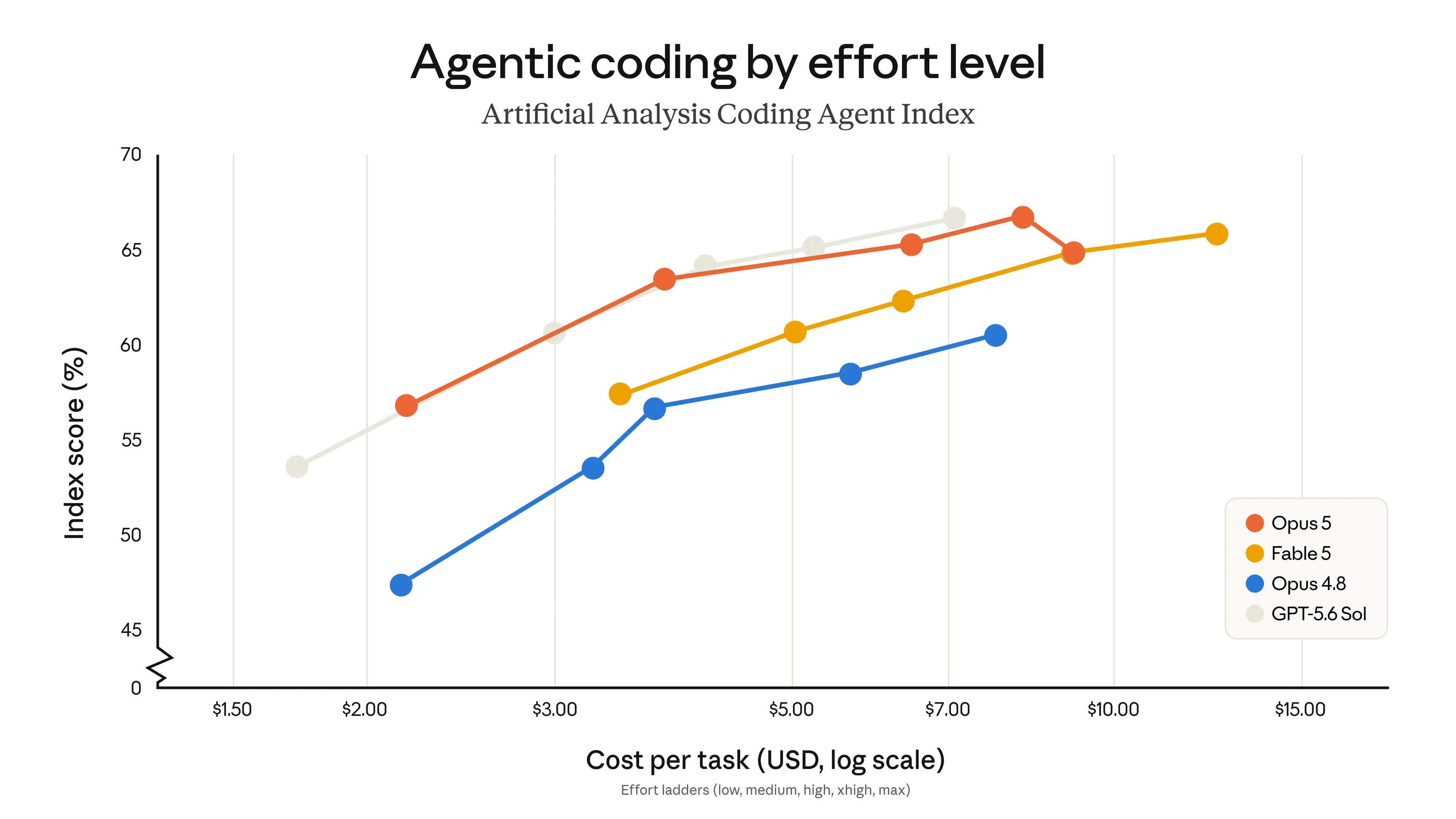
So the rumors were right, Opus 5 was indeed being polished up for release. Huge improvements in GDPval-AA v2 too -- great for some of the knowledge work-based agentic workloads I run.
Also glad they still kepy Fable 5 on "credits only" access. I think we're going to start seeing model providers gate top-of-the-line models behind pay-as-you-go API rates/credits while subsidizing other models on monthly subscriptions.
It's still available on at least some subs, they emailed me recently notifying me that I still have access.
Fable 5 is still included in Max subscriptions!
Max is an individual subscription though and does not come with the guarantees that team or enterprise do?
Doesn't team bill API rates?
And Teams Premium was previously needed for any claude-code at all.
[flagged]
Also the cost per task. It appears to be significantly cheaper, cheaper than sonnet!
The numbers from Anthropic seem heavily cherry-picked, Artificial Analysis has Opus 5 at 1.25x the cost of Sonnet and 2x the cost of GPT 5.6 and K3.
https://artificialanalysis.ai/?cost=cost-per-task
I can't help but read these comments in the voice of a TV commercial....
Ask your doctor if Opus 5 is right for you. Side effects include occasional hallucination, security breaches and unwanted React apps. Some developers have reported receiving entire apps from untrained executives who may or may not know what they’re doing.
Stop using Opus immediately if you experience signs of dizziness or vomiting.
Opus 5…the people’s favorite.
Spot on! Comment of the month, I'd say.
I don't understand how the data retention works. My company has an enterprise license with no data retention but if I ask Claude about past conversations, it remembers. So surely the information is being stored somewhere
You most likely are referring to the local jsonl files where claude has your sessions etc stored.
It could just be the memory features.
In my enterprise-seated account I see slightly different options available (vs. my personal account) in the Capabilities section:
The first option was defaulted to on, if I recall.Likely in memory files stored locally
> Updated over 2 weeks ago
I hope we get clarification on this, I can't find anything claiming that it is compatible with ZDR.
Maybe I’m misunderstanding you, but if you scroll to the bottom of their [1] link to the Opus 5 announcement, under “Getting started,” it explicitly says:
> Consistent with prior Opus models, Opus 5 does not have data retention requirements for general access.
It's in the article.
do you mean, that organizations now have access to Fable-ish pelican drawing?
insane pricing:
" Claude Opus 5 is available today on all platforms, priced at $5 per million input tokens and $25 per million output tokens (the same as Opus 4.8)"
[dead]