NotJustBikes just put out a video about this issue - https://www.youtube.com/watch?v=--832LV9a3I
A couple years ago he also made a video about these trucks more broadly - https://www.youtube.com/watch?v=jN7mSXMruEo
What's truly maddening is how many of these vehicles which _do not_ meet European safety standards are _already_ in Europe. Walk around Hilversum in the Netherlands and you will see plenty of Dodge Rams (mostly 1500's, but there's even a 2500 Dually usually parked on the sidewalk ("pavement "for Brits) where my kids used to go to school). They're imported under "Individual Vehicle Approval" rules, exempting them from type safety requirements, and on top of that are almost always registered as "business vehicles" (you can tell from the V plate) which means they pay an absolute pittance in tax.
I moved here to get away from American kindercrushers (among other reasons) and I am profoundly concerned that Europe is being invaded by these machines.
(Edit) Worth noting is that a lot of Dutch street design is based on the idea that people _can_ share space with cars in dense, low speed environments, but that assumption flies out the window when the vehicles are so large you can't even see a kid walking or biking to school.
Further edit - source - https://www.motorfinanceonline.com/news/dodge-ram-registrati... 5,000 Dodge Rams imported in to Europe in 2023 alone.
>EU vehicle safety regulations have supported a 36% reduction in European road deaths since 2010. By contrast, road deaths in the US over the same period increased 30%, with pedestrian deaths up 80% and cyclist deaths up 50%
I didn't know this, but it is absolutely crazy. Every EU politician who tries to subvert car safety should be dismissed and tried for endangering public safety.
> Every EU politician who tries to subvert car safety should be dismissed and tried for endangering public safety.
The problem is coming from the other side, the Americans are threatening to start a new trade war if the EU doesn't permit their murdermobiles on the European roads.
IMO pedestrian safety should still come above all else, but this is not an initiative coming from some EU representatives who want to own a Cybertruck. Blocking these cars can have impact on the war against Ukraine and the prices of fuel and other import products on the short term.
As an European, I'd rather have a trade war, than bend 90 degrees.
But the EU commission will bend and sell us out, the same way it's selling european privacy to security and data companies lobbying it (just check how many times Thorn, Palantir et al have met with EU officials, lobbying is recorded and publicly accessible).
It's a tactic, agree to the deal, the US ignores us. Allow the deal to get destroyed in parliament and the courts and it has no effect. The deal was a means by which to get enough time to figure out the correct response. We've been doing this kind of thing for decades.
This is the way. The current US administration is a 2 year old with ADHD and shiny distractions abound. Agree to deals and let him claim wins, and then bury it in bureaucracy and common sense.
This is, essentially, how the US government survived Trump 1.0, and is why Trump 2.0 has been so concerned with gutting bureaucracy and placing vapid yes-men in the cabinet, but they can't really do that in Europe.
It's one of the few times where EU bureaucracy is a huge advantage.
While this is true, be ware of lobbying using it for other means.
I mean, the commission said it "intends to accept". Given the EC's legendary lightning-fast speed, that presumably puts the timeline long after ol' minihands is out of office, and thus irrelevant.
Even when the EC actually _wants_ to do something, it typically struggles to get it done in under a decade.
> The EC is not that slow when it comes to the American trade wars. The timeline suddenly shrinks to months instead of years because this stuff could majorly disrupt the economy (and safety) across the European continent.
I dunno, like the last "deal" basically makes a load of promises that the EU has no legislative ability to enforce. So it's basically just performative.
And honestly, given that the US is gonna sell out Ukraine, then this (and most other) trade deals should be ripped up. This would hurt my country (and me) a lot, but it's probably still the right thing to do, as TACO is definitely a possibility if the US markets crash.
Since when was Thorn in the same sentence as Palantir?
That's why you'll always be europoor.
The problem with accepting yet another blackmail (or else trade war, or else NATO doesn't really exist anymore) is just a slippery slope. Not the first request that was made like this, not the last.
>lobbying is recorded and publicly accessible
As in the meeting dates or the actual talks? Mind dropping a link?
I see, interesting, thank you. Yeah, sadly this could be just transparency theater, glad it's there, it's a start.
Trade wars work both ways. So far the US export market is not doing so great. All those tariffs are raising the cost of exported goods as well. And those were already too expensive before the tariffs. If the US wants more US cars on EU roads, it needs to start making better cars. It's that simple. But in the EU, cars have to compete with domestic cheap cars and imported Korean and Chinese cars. It's a level playing field. Hence not a lot of US cars on the roads. A few Teslas (made in the EU mostly), a few Fords (some made on the VW platform), and a sprinkling of niche imports for things like muscle cars and pickup trucks. They are quite rare but you see one or two once in a while.
Maybe the legislation allowing their import should take their special status in to account.
I would suggest mandatory semi (or full) trailer truck drivers' license required for anyone who operates these. In addition, they should be indicated as a new category of "recreational trucks", with harsh penalties specific to them especially regarding road accidents.
For example, if found guilty of reckless driving, or causing accidents, the vehicle would be permanently confiscated. (On top of personal fines, loss of license etc as already sentenced by law.) Perhaps the law enforcement could then be given access to such confiscated vehicles, creating also some incentive to enforce the law.
> Perhaps the law enforcement could then be given access to such confiscated vehicles
That is… not how we do things around here. It sounds like a baked-in conflict of interest and a wonderful way of making them chase the money instead of doing their policing job.
Fuck it. Let the Americans start another trade war then. This nonsense has been going on long enough, if times need to get tough so be it then, start earlier rather than in 5 years when these misery machines are everywhere and the car arms race is in full effect.
It’s tough when there’s a war going on and the EU countries don’t really want to pay the true cost for their defense.
We spend multitudes of times more than our only realistic threat
I don't think Europe spends more on war machinery than the USA.
> Of course Europe should step up in being more independent defense-wise, but you'd be a fool if you think the US does not enjoy and leverage the current status provides.
> it's a lie to suggest that the EU does not spend enough for defense.
Which is it? Is Europe spending enough, or does American have influence because Europe is still cripplingly dependent on the US?
I wouldn’t argue that the US isn’t abusing that dependence at the moment.
What I would argue is that the US spent 20 years telling Europe to get its act together, and finally in the last 3 years that has started to change, but notably that was years after NATO was publicly declared braindead. So it was pretty irresponsible of the Europeans to leave themselves beholden to the US for so long.
Only about a third of European defense spending goes to the US. Europes struggles to ramp up production have been an ongoing story for many years now.
There is still about a trillion dollars of NATO defense spending to replace if Europe does not want to be reliant on America. Doable, but spending a third of that on American equipment wouldn’t help matters.
Perhaps if Europeans got an earlier start, instead of ignoring nearly two decades of warnings and a clearly deteriorating security situation, they wouldn’t need to care so much about US policy. Better late than never.
https://economist.com/europe/2025/12/01/europe-is-going-on-a... from The Economist
No they did not. Just a handful of countries are spending close to 5% of their GDP on defense, the rest are doing everything in their power to pay as little as possible.
A correct statement would be that the Europe didn't want to pay for US equipment for its own defense.
The US has previously discouraged Europe from building out its own defense industry, the current situation is due to that a dovish view of Russia therefore less of a need to spend money on equipment and troops for a land war.
Not only defense may I add.
The European countries are already paying more than the US, both in therms of money and lives.
The World Bank and IMF are providing loans to Ukraine, tied to economic reforms as usual (removal of workers protection etc). It’s not like there is an actual dependency on any purported nicety of the US.
Not to mention it's going to be the EU that will partially bear the cost of rebuilding Ukraine after war and Trump will not even let them have a say in how the land should be split.
> threatening to start a new trade war if the EU doesn't permit their murdermobiles on the European roads
The strange part is that those car can be sold in the EU markets already. They just have to comply with the same pollution and safety standards as other cars. What would justify an exception?
Decisions are still made by our local polititians, not by Americans, who should take responsibility for those, especially in such a serious situation as this.
Pressure from Americans - who have no say in how we live in Europe -, remote or suspected, transient consequences on costs and conflics, all have lower, much lower priorities than keeping the population safe and healthy. Dead people need no cheap fuel, need no prompt conflict resolution, need no short term tariff settlements, and do not care what Americans think. Dead people are just dead! EU polititians should let people stay alive foremost of all! The rest come aftre that.
And all because these stupid huge trucks. Not even close in importance! Does not worth it.
So let the trade war begin.
Any EU politician that bend over to those threats should never be elected to anything again.
As an American, I have plenty of disappointment in government right now with my own. But it's also incredibly disappointing how many other world leaders are letting Trump roll over them.
The trade wars go both ways. Certainly it can be a bit of a collective action problem when it comes to individual countries that are smaller than the US, but the EU as a whole should be able to negotiate on even-enough footing with the US on these kinds of issues.
Any war goes both ways, but that's not the point. The point is: can you win a war against your adversary? Can the UK win a trade war against the US for example?
The thing is, nobody else wants trade wars. Both sides of a trade war lose in a system of otherwise free commerce, the "winning" party is the party that is willing to sacrifice the most to make a point. Everyone but maybe the super wealthy are worse off. Americans are paying the price for their government's idiotic tariff game, but the real cost will come over the following years, and in some cases decades.
The EU is trying to minimize the damage for its constituents, they're not interested in a stupid power play. Threats of reciprocating in trade wars are meaningless if the leadership you're threatening doesn't care if their people starve.
Playing tough doesn't matter anyway, the American voting public will just blame the EU for all the bad things that happen if the EU's actions do have an impact, laugh at the EU if a diplomatic solution is found, and the American leadership will repeat whatever the last guy to verbally jerk off Trump said for at least the coming three years.
In a way, it's kind of impressive. The EU was not ready for America to devolve into this level of clown politics this fast, and that left them unprepared.
> with pedestrian deaths up 80% and cyclist deaths up 50%
https://www.youtube.com/watch?v=LC9a3GR1HJY&t=371s
> I said there was no way this truck would pass a pedestrian impact safety standard. Now, I wasn't wrong that the truck won't pass a pedestrian impact safety standard, it won't! And that's why they can't sell it in Europe. [...] But I didn't realise that America has no pedestrian impact standards. [...] America actually allows companies to self-certify a variety of aspects of safety.
See also: Boeing. It is the exact same kind of fuck-up. Regulators should not be in bed with the industries they regulate. That's a hard problem to solve, because where if not in industry would you get the expertise. But these kind of revolving door arrangements are extremely problematic.
And that is not counting in the fact that there far more pedestrians on the street in EU than in the USA. If there were the same amount of pedestrians in the USA as in the EU the statistics would be even worse.
When there are more obstacles and hazards on the road drivers tend to slow down and pay attention. Pedestrian deaths in my city peaked in 2025, but they didn't happen in the walkable central areas of the city where pedestrians are common, they happened out in the 'burbs where the roads are wide and pedestrians are few.
The general problem is the US are a bully and Europe just caves, always. We should put up a serious fight. Block all US imports, starting with tech, and see what happens. Who cares if we sell less champagne??!?
It’s not about champagne. It’s about us not making anything like the Patriot air defense system. Or us not having the capabilities to command our disparate militaries cohesively without US involvement in NATO. The whole Western order has been built on the premise of US being the corner stone that ties everything together.
Thank God the French have always been suspicious about it since the Suez crisis, hence we _do_ have at least some independent capabilities.
For those who don't know, the French (and British) instigated the Suez crisis. It was a highly illegal attempt at regime change in Egypt and the US along with the USSR and United Nations rightfully pressured the French to stop. Bizarre example to illustrate the need for military independence.
The problem with your perspective is that citizens can still tell right from wrong. And the public is much less Machiavellian than those in charge. The people can change how their leaders act, but won't when they believe any attempt to steer towards pro-social geopolitics is pointless.
I should also point out that some countries are much more bellicose than others, in direct contradiction with your nihilist view.
This is entirely true, but it's still good that as a result of this, the French prioritised independent defence policies for the last 60+ years.
It’s not an example, it’s a timeline.
SAMP/T is quite good.
> Who cares if we sell less champagne??!?
Nobody, but it seems a lot of people care if we sell less german cars.
Interestingly, everyone is willing to sacrifice someone else’s livelihood.
> Who cares if we sell less champagne??!?
Those whos relatives freeze when their country can no longer get LNG imports
The US is underwriting European security (and by extension various European welfare states).
Do you really want to block the import of arms and financial aid to Ukraine?
If Europeans were serious about their sovereignty they’d have made very different choices up until now.
It isn’t right that America has so much power in this circumstance, but going back decades the US has been asking for Europe to take defense seriously.
> It isn’t right that America has so much power in this circumstance, but going back decades the US has been asking for Europe to take defense seriously.
Funny because the last time I believe that it was the US that requested help in Iraq and Afghanistan and not the other way around.
Europe should certainly increase its defense spending (and actual capabilities). But the reason NATO exists isn't just to please Europe. The US have a direct interest in containing Russia; I don't think they can afford to simply stop caring about the rest of the world. And I'd be willing to test that theory.
> I don't think they can afford to simply stop caring about the rest of the world.
It seems that the policy of the current US government is to split the world between themselves, Russia and China. And I guess that's a legitimate policy, even though I think it's both impossible and incredibly misguided.
> Do you really want to block the import of arms and financial aid to Ukraine?
Umm... yes? Since this whole debacle started, the EU has been shooting itself in the foot with all the sanctions that hurts its industries.
On the other hand, the US did the smart thing and did not give out weapons for free, it charged for them.
In the end, the US will be the winner of this war and Europe will come out of it incredibly weak economically. And it will have to turn to the US for help. Again.
> I didn't know this, but it is absolutely crazy.
It's crazy because the numbers don't line up with the theory. If you look at US traffic deaths by year, they were basically flat in terms of vehicle miles traveled between 2010 and 2019 and then took a big jump from COVID which is only now starting to come back down.
Meanwhile in Europe road fatalities were also fairly flat up until 2019, and then went down significantly from COVID.
Now we have to guess why the responses to COVID had the opposite effect in each place, but it's pretty obvious that the difference was a primarily result of COVID rather than differences in vehicle safety regulations, unless the vehicle safety regulations all changed in 2020 and everyone immediately replaced the installed base of cars everywhere overnight.
2020 wasn't just the start of Covid, but also the start of BLM. The narrative I always see from the American right is that BLM caused many police forces across the US to radically reduce traffic enforcement, since: 1. traffic offenders are disproportionately black, 2. stops for minor traffic offences can sometimes spiral into violence in various ways, and some viral ones have involved absurdly bad use of force decisions by officers involved, and 3. no force wants to take the blame for another George Floyd
Per this narrative, a significant antisocial tranche of the public has responded to the effective suspension of traffic law in the way that you would expect them to, and that is why road deaths are up.
It’s likely it can be studied - but anyone interested in studying it likely already has a conclusion they want to reach one way or another.
The timing lines up but that's more of a vibes argument.
The majority of traffic stops in the US are, cop parks on the side of the highway somewhere the speed limit is lower than the speed people drive there, every car on the highway is doing 70 in a 55, whoever drives past gets a ticket and the government fills their coffers but the speed everybody actually drives on that stretch of highway remains 70.
Now suppose the cops stop doing that for the stated reason. If you then drive past them at 110 instead of 70, are they still going to not pull you over? Good luck with that. Even if they're actually trying to minimize traffic stops, that one's the one that makes the cut.
So then what happens if they stop doing the usual ones? People are then going to drive 70 in a 55 because they can get away with it, but that's what they were doing to begin with. You could argue that the fatality rate would be higher at 70 than 55, but then why would that change relative to the baseline where that was what was already happening?
So the argument would have to be that idiots had the impression that they could do 110 without getting pulled over, even if that wasn't true, and then did that and managed to make contact with an overpass before driving past a cop. Which doesn't seem as plausible, because speeds like that on empty desert highways shouldn't have raised the fatality rate that much (e.g. it's not that high on the autobahn in Germany), and speeds like that in traffic where there are other cars traveling significantly slower will trigger a visceral feeling of danger in nearly all humans unless they're on drugs or have significant mental health issues, and in those cases they wouldn't have been deterred by the prospect of traffic enforcement anyway. Which is why people drive somewhat over the speed limit even when that could get them a ticket -- because it doesn't feel dangerous -- but also why they don't drive a lot faster than the other cars -- because that does. Traffic enforcement or not.
Moreover, regardless of how much of a contribution was made by that vs. COVID, the numbers still don't line up with it being vehicle safety regulations.
I would guess that what matters most is stops for driving disqualified/uninsured/unregistered, DUI, running lights, and failing to yield (especially at crosswalks), and perhaps for speeding on non-highway roads where it has more of a safety impact. As you say, in the USA as in virtually every culture, almost everyone speeds in some contexts, and especially on big, multilane, motor-vehicle-only roads; enforcement of speed limits in that context is likely one of the lowest impact things police can do, but I think it's a massive error to treat "traffic stops" as a category as equivalent to that sort of enforcement specifically.
Why do you think COVID is relevant aside from being a placeholder for the year 2020?
COVID happened in the year of the discontinuity and caused major changes to commuting behavior as a result of remote work, people afraid of infection avoided mass transit, many people moved out of cities or lost their jobs, people bought cars who didn't used to drive and now there are more new/inexperienced drivers with cars (and it's easier to get a license in the US than Europe), etc.
Also, the numbers for at least the US are apparently just wrong:
https://en.wikipedia.org/wiki/Motor_vehicle_fatality_rate_in...
1.27 fatalities per 100M VMT in 2023 (the latest year with data), 1.11 in 2010, that's a difference of 14%, not 30%. Even the peak during COVID was only 24% above 2010. The only way I can see to get 30% is to use the during-COVID number for only the total number of motor vehicle fatalities without accounting for population growth or vehicle miles traveled, which is not a great metric for making comparisons.
Even that is still wrong because you'd have to use the high water mark during COVID and not the more recent numbers which are starting to come back down.
Because a lot of people stopped driving and leaving their home so much during that time.
Cybertrucks init (/s)
Keep in mind that the US stats are derived from cities that are designed around personal automobile transportation, so they're likely muted.
Europe on the other hand has a much higher level of intermingling between pedestrians and vehicles. This puts pedestrians more often in harms way, and likely will lead to out-sized dangers that aren't seen as frequently in the USA. Pedestrian safety is a key requirement for European car safety.
If the EU is politically forced into accepting the US standards: The slack will need to be picked up by European insurance companies, who should charge extreme premiums for unsafe designs, effectively blocking the sale of the vehicles from dangerous, young, or casual drivers and limiting those designs to those who truly need them (which I suspect is very few.)
This should also go a long way in addressing inexpensive Chinese vehicles that ape the American designs. Since that is more likely going to be what is on the roads.
>>If the EU is politically forced into accepting the US standards: The slack will need to be picked up by European insurance companies, who should charge extreme premiums for unsafe designs, effectively blocking the sale of the vehicles from dangerous, young, or casual drivers and limiting those designs to those who truly need them (which I suspect is very few.)
That only works if there are big penalties for killing people with your car. As it is as long as you are not drunk and have your license you get away with a minor slap on the wrist. You pay if you damage someone's else car but if you kill them then there is usually no financial responsibility and thus no reason to rise insurance premiums.
I'm with you regarding the argument, but want to nitpick:
"dismissing" a politician sounds like an easy fix but we probably don't want hyper-polarized dismissal wars where politicians are "shot down" immediately after being elected. That's why there are other mechanisms such as not re-electing, public shaming, transparency fora etc. ... we need to work on strengthening those, the accountability and transparency.
They need to prop up dying German car companies, and are OK with using European lives as collateral.
As much as German car companies suck it's not them that are road killers
Among other issues, Volkswagen killed roughly 1200 people by cheating on their emissions tests.
https://lae.mit.edu/2024/06/28/study-quantifies-premature-de...
Besides the whataboutism, this is 1200 premature deaths (of mostly frail people). As much as I'm sensible to the topic of air pollution, putting that number closer to the number of, I dunno, premature deaths attributable to Coal power plants will give a more realistic view of the problem
I don't know man. Most big SUVs on EU roads are German. Same goes for "sport" cars. While American trucks are terrible the crazies in BMWs and Mercedes SUVs with huge engines have more impact (as they are more of them).
EU regulators bent over to German companies allowing those cars on the road without additional restrictions. We all pay for that.
True but the problem with modern American trucks is that they have a high front (which means low frontal visibility)
That's the biggest issue now differentiating them
Even an older American truck is less dangerous than the modern generation
So why would they allow easy imports of US cars?
>They need to prop up dying German car companies
Germany isn't the only economy dependent on the legacy auto sector. France, Italy, Romania, Czechia, Slovakia and Belgium also have a lot of jobs, or had, in the auto industry, before the mass layoff of the last 2-3 years.
True, France does too of course, but Germany has been particularly stubborn. There's infighting within Europe, for that matter - note Polestar opposing Merz's attempts to weaken Europe's phase out of combustion vehicles. https://www.msn.com/en-gb/news/newsbirmingham/volvo-and-pole...
I doubt the average citizen in the Netherlands can afford EVs at current EU prices either.
And at the rate car prices are increasing for no good reason, I doubt the average EU citizen will be able to afford a car in the future.
The EU does need to find a middle ground between mandatory safety features that are unaffordable and free for all pedestrian killing machines.
And protectionism ain't it. It will only increase the prices for domestic cars until the likes of VW have to close up shop because no one can afford what they're peddling any more.
Maybe Europe should allow cheap BYD's to be imported for the poor eastern Europeans them.
Fossil fuels need to be eliminated. Europe is the fastest warming continent.
I think Eastern Europe can afford EVs now. 20,000 euros for the Twingo, 15,000 euros for Dacia Spring. This is cheaper than most petrol cars.
Not to take away from your argument, but German grocery prices are actually famously low. I know of eastern Europeans in border places who prefer shopping in Germany for that reason.
Yes, but in France Renault just made a new Twingo, to be electric, for 20,000 euro, and they're starting to make electric sports cars (A290, future electric A110), so I wouldn't call that 'legacy auto'.
At the risk of sounding contrarian, do we have any idea what the drivers of this are? Is this actually about car design, or is it other bits?
Just as a starter for ten, is that 30% increase distributed around the US or concentrated in certain states? I can't imagine we've seen the same increase in New York than in rural Alabama (and if that's the case, how much of it is really attributable to car designs)?
> Every EU politician who tries to subvert car safety should be dismissed and tried for endangering public safety.
Yeah, so that would be rampantly anti-Democratic authoritarianism... Peaceful transfer of power is pretty much at the core of why democracy works in the first place, and once you start engaging in political persecution because you don't like some trade-off involving safety ... yeah, that's no longer a democracy but something else.
Dismissing a politician because you don't like them is the entire point of elections.
Yes, and? Are they tried for making politician decisions someone (e.g. the next people in power) didn't like? This doesn't engage at all with what I talked about, and I already explicitly acknowledged that peaceful transition of power is important. What is the point of this comment? Why rebuke something I never even remotely said?
This was all an EU tactic, we do it a lot. Agree to the deal, Trump shuts up and ignores us, destroy the deal in the courts, no real effect of the deal.
You can't really compare the two. Vehicle safety regulations might not be able to make up for the USA having stroads and in general bad design. For the same reasons trying to move safety standards over could make things even worse than the USA due to them not fitting the conditions.
If this were comparing absolute numbers I'd agree. But this is only the relative change over a few years, the road design hasn't seriously changed in that time. So those differences should affect these numbers directly.
My point was that the corresponding worse American performance might not be so much a difference in car safety regulations, but of basic road design. In other words, the same EU vehicle regulations could have a lesser benefit in the USA.
Many places in Europe has bad design as well. This is not a uniquely american thing.
What you are saying is true, but it isn't the whole truth.
In Europe, some stroads exist. The rest are streets or roads.
In the US, some streets exist. The rest are stroads or roads.
Do you actually think that is the case? Because you have big streets and cars, small cars and actual safety standards would make it less safe?
That's the most American sentiment I've heard today
No, you got it backwards. So I guess you need to update your idea of American sentiment, for one (since I'm American). Narrower, more winding roads, with proper highways separated, make everything safer. Safety standards bolted on to America's stroad mess can't improve it much.
Whether they like it or not, American cars have become a lot more European over the years. I wish I had figures to back it up but from my own anecdotal experience when we traveled to the US when I was young almost every car was different and, for me at least, this made it feel strange and exciting.
Taking my own kids back there this year, most of the normal cars were common, or at most variations of the ones from Europe. Even many of the vans and work vehicles are now common European shapes, occasionally with a different badge. Trucks and full size SUVs were the last hold outs of US specific models.
Which makes me wonder, are the pedestrian deaths really heavily weighted towards these models?
For what it's worth we hired a full sized SUV. There was one point where I was about to drive out of our Villa's driveway when my partner shouted "wait!" There was a 8ish year old kid walking down the sidewalk towards where I was about to cross it who was completely invisible from the driving position. It was actually safer to forward park that thing because the visibility in the reversing camera was much better than driving forward.
I not really talking about general styling, I'm talking about the specific models being available. A lot of this might better be described as the world becoming globalised rather than the US cars becoming more European. But the end result is the same, many of the best selling US cars must meet or exceed European safety standards.
At a rough count a list of the best selling 25 cars in the US, 16 of them are available to buy in the UK that I know of (including cars like the Jeep Wrangler which are obviously American classics).
Most of the different is Trucks and full-size SUVs. And a couple of Chevy's which gave up on the UK market a few years ago. So either pedestrian fatalities are concentrated in those areas or there are other factors at play (road design, driver training, enforcement of rules etc).
As an American who sometimes travels to Europe and sees and rents cars there, my experience has not matched with yours.
Fat A-pillars is a noticeable problem on modern cars for sure. But the thing with A-pillars is that you can see around them if you use sufficient care to move your head. It is impossible to lift your head high enough to see a small child walking past a vehicle where the bonnet (hood if you prefer) is at an adult males chest height.
Yes. Congratulations, it appears you can read.
> Every EU politician who tries to subvert car safety should be dismissed and tried for endangering public safety.
No. Every EU politician who doesn't support BANNING all cars should be dismissed and tried and executed! Look, I'm even tougher on pedestrian safety than you are!
I second that!
I think it's hard to say for sure that it's only the safety regulations on the car that that have resulted in these reductions, and by contrast those increases in the US. There are so many other things not related to the regulations on the car. My guess for example is that us have a lot less bike roads than europe does and traffic rules are not affected by the regulations on the cars and so on. for sure European European car regulations are probably better than American ones from a safety perspective. but I think it's hard to to say that without them we would have an increase, it would have a smaller reduction.
Numbers of km driven in the US has increased by circa 10% [1] over that period while decreased in the EU by circa 10% [2]. Add to that in european cities the multiplication of bike lanes, and the permanent manufactured congestion of certain cities. There are many reasons that can explain the movement, and car design is probably a small factor among many small factors.
[1] https://www.bts.gov/content/us-vehicle-kilometers-0
[2] https://www.odyssee-mure.eu/publications/efficiency-by-secto...
> car design is probably a small factor
That probably is doing a lot of work here. A truck with a driver sitting so high above the street they can't physically see a child or bicycle in front of them is just an inherent risk to pedestrians and cyclists, no matter how you twist it. And don't even get me started on Cybertrucks, which are pretty much designed to cause accidents with casualties.
Even if the causal link is more complex than the numbers make it seem, acting like putting heavier and bigger vehicles with less restrictions on streets won't cause accidents is just plain dishonest.
> acting like putting heavier and bigger vehicles with less restrictions on streets won't cause accidents is just plain dishonest
Implying that I said it has no impact is plain dishonest
I kind of agree but this is missing a big part in my opinion. How can we quantify the penalty faced by consumers in EU with to increased costs due to regulation?
There might be certain number of deaths we can accept for increased cost but how is it so obvious that this tradeoff was worth it?
What if cars got 2x costlier in EU due to the regulations to give you a .01% increased chance in safety?
Edit: here are some back of envelope numbers from chatgpt
A single, ordinary car ride carries an extremely small chance of death:
USA: ~1 in 7.7 million
EU: ~1 in 20 million
Its not super clear that optimising these numbers is obviously worth the increased costs.
Edit2: people can make the choice to buy Volvo cars that are ~40% safer. Why isn't every car buyer buying only Volvo?
The assumption you have to make is that regulation would make it much cheaper to buy a safe car than just buying Volvo. It is somewhat true but not sure on the extent.
I think that's a little bit of a weird way to look at the probabilities. Sure, for a one-off activity I might look at 1 in 7,700,000 and decide that's an acceptable risk. But many people in the US take several car rides per day.
At, say, 4 rides per day, that's about a 1 in 5300 chance of death over a single year. That's still small, but not that small. Someone in a decent-sized town or city could expect to lose someone they know once every few years with those odds.
We know what the rate of deaths are: 1 in 8000; roughly 40,000 over 320,000,000.
Slightly less than the rate of suicide; and slightly more than half the number of fentanyl deaths. And a smaller fraction of medical mistake deaths. (Of course, none of the risk is evenly distributed.)
As a systemic problem, I’m not convinced that cars are the worst. Or outside what we accept in several areas.
The non-even distribution is a key part of it. Fentanyl deaths don’t affect me if I don’t drug, and if 80% (made up number as example) of car fatalities involve drunk driving, it also factors out for most people.
If cars had a random chance to simply explode equivalent to the mortality rate in crashes, people would treat them Very Differently.
I think if you want to make this argument you can go look at the stats. Look at the relative cost of vehicles in the EU over the past 25 years, compare to the cost of vehicles in the US over the past 25 years.
Obviously the lack of difference there wouldn't prove much (if I had to bet I'd bet cars in the US have gotten way more expensive faster than in the EU, just from labor costs), but the lack of a major difference would complicate the theory that new regulations in the past 15 years have massively improved costs, absent a theory that some other thing the EU is doing but the US is not doing is also kicking in to similarly counteract that.
The numbers exist, this isn't in the abstract. Just a question of doing the legwork
I think we should not compare EU vs US costs but rather predict what would be the decrease in costs (relative to EU itself) due to reduced regulations in EU.
Huh, but this is a terrible comparison.. the cars in both unions have been made the same, of course they cost similarly. In other words the US buyers partially pay for the R&D cost to keep to EU standards. And the US population also get the EU regulated-safety requirements (although only partially, since the US also allows Cybertrucks to drive around).
A comparison would be comparing a car that can ensure the survival of their passengers, proven with test crashes, vs e.g. Chinese-made cara for the local market that have terrible crumpling when crash-tested..
> the cars in both unions have been made the same, of course they cost similarly
I'm really not sure what you mean, many of the most popular cars in the EU aren't even sold in the US (Renault, Dacia, Opel, Peugeot/Citroën although they have taken quite a hit in the last few years) and they are generally cheaper than US cars.
And quite a few US cars aren't available in the EU either (although they can sometimes be imported privately, which bypasses the regulations somewhat) which is the very topic we're discussing.
As for Chinese cars, the recent ones are performing adequately in crash-tests.
A bit off-topic, but lots of the top ranked Euro NCAP crash tests have been chinese-built cars for a few years now. Their industry has evolved insanely fast, that perception of low standards is long gone.
Zero pedestrian or cyclist deaths are acceptable just for someone to get a cheaper (or much worse, larger) car. Zero.
There is a vast number of reasons why we need and must reduce private car modality share as much as possible. Making cars more expensive is a feature, not a bug.
The problem is that we make more expensive and more dangerous cars. Cheaper cars from the past were safer for pedestrians and cyclists because they had better visibility, were lower, slower and narrower. It's all for vanity and profit over lives and safe cities.
Is it ever acceptable to have pedestrian or cyclist deaths to have buses, trains, ambulances, fire trucks?
And most city buses have much better overview of their environments than a random american truck. The bus driver is sitting low down with big windows in all directions and will see cyclists and pedestrians on their side or kids walking in front.
I am not american. I’m from Sweden. The point is it it is silly to claim the goal is zero accients since the only way to achieve that is by removing cars. We all agree they are useful. The goal should be to have as few accidents as possible.
A bus is more dangerous than walking. But great that you agree with me the goal is not zero accidents at any cost. It is to balance the benefits of cars (like ambulances etc) with the risks.
Easy to fix. Ban bikes and start throwing people caught riding a bike into jail.
> Exiting your car anywhere except in parking lots and private property should be prohibited!
Not a bad idea, actually. It might make cities more liveable compared to the European status quo of anti-human cities. A bit too extreme before we get self-driving cars.
To get to zero you must eliminate cars completely and I don't buy into that kind of logic.
It’s not some mystical thing, but a matter of smart urban design. Oslo and Helsinki have managed to achieve zero road deaths in a year without eliminating vehicles. You don’t need to accept a certain amount of deaths as some sort inevitability or a necessary sacrifice.
That's not what GP said. Zero deaths caused by cheap/large vehicles.
You can eliminate deaths by that cause by eliminating those types of vehicles, not by eliminating all cars.
Not saying that's feasible, but let's not argue against something that nobody said in the first place.
The Americans didn’t get cheap cars, they just got very large cars which is obviously detrimental to anyone but perhaps the driver.
The specific regulations here
> EU officials must revisit the hastily agreed trade deal with the US, where the EU stated that it “intends to accept” lower US vehicle standards, say cities – including Paris, Brussels and Amsterdam, and more than 75 civil society organisations. In a letter to European lawmakers, the signatories warn that aligning European standards with laxer rules in the US would undermine the EU’s global leadership in road safety, public health, climate policy and competitiveness.
They point to many things and not only the size of cars - like fewer approvals, lower pollution controls, fewer safety measures.
Some of them increase utility (like people might prefer bigger cars) and others decrease cost.
yes i'm questioning the extent of the externalities
> penalty faced by consumers in EU with to increased costs due to regulation?
The question works both ways. How can we quantify the penalty faced by consumers in the US due to lax regulation? How much is each toddler ran over worth, exactly?
With the huge hoods these things have the driver has a hard time seeing what is right in front of them, and when they hit a pedestrian (kid or adult) they are much more likely to die.
https://www.carscoops.com/2024/12/suvs-and-pickup-trucks-2-3...
That’s the same flawed reasoning Kirk flaunted when discussing gun laws. It ultimately proved to be wrong; as in it’s all fine and “Vulcanian Logical” until you or your close ones become the statistic
Making cars 2x as expensive would massively improve safety simply by reducing the number of cars. And it would make cities much nicer places to exist in general.
The problem with these sorts of things is that they discriminate against lower-income folks. In cities with good public transit and affordable housing (such that people can live near their jobs) this is maybe not such a problem, but that unfortunately describes precious little of the US. I bet it could work in many places in the EU, though.
I'm coming around to the idea that the high income folks are actually the problem.
Things are a problem because we say they're a problem. But who's doing the saying? Not the low income folks, they have much more pressing problems they'd rather talk about.
Seems like eliminating the high income folks from the discourse would result in a redirection of focus toward more serious issues.
A better solution would be to make taxes and parking cost relative to vehicle size/weight. Want a big SUV? Pay 4x the taxes and hefty parking fees. Drive a small, electric commuter vehicle? Half the tax, reduced parking.
Why not just ban cars in the cities instead? The problem is those who need cars the most are those who can't afford to live in the city centers, so it often ends up being an extra tax in the less affluent.
That doesn't align with my experience. I grew up in Belgium, in a place where you'd be lucky to have a bus an hour. The closest place to get groceries, by foot, was half an hour away, most of it 5% uphill on the way back.
If you need a car, then you need it for everything. You need to be able to fit the two kids you picked at school, the gear for the sport activity you'll drop them at, the mom you picked at the train station after work, and the weekly groceries you picked from the supermarket on your way back. From experience, you aren't doing all of that in a Hyundai i10.
Now I live in the Randstad. Groceries get delivered, mom rides the bus for 8 minutes to come back home, and I pick the kid by bike. The car is optional and pure convenience, so I can get away with a small one.
For some reason we decided to put a great deal of jobs in the city centers. Commuting to the edge of a city and then taking public transport to office doesn't really work, unless massive amounts of money are pumped into trains, busses and trams.
There's this weird perception that Europe has excellent public transport, while in reality it only works, sort of, in a few larger cities. Everywhere else functioning in society really requires a car or assumes that you're living within biking distance of work and daycare.
> How can we quantify the penalty faced by consumers in EU with to increased costs due to regulation?
I really hate that everything has to be seen from the consumers' lens, especially the consumer of luxury goods (I'm talking SUVs and the like, cheap cars exist in Europe).
What if we didn't just look at it from the POV from people who buy or want cars? I don't own a car, nor do I plan to. I have to pay for roads, which I understand to an extent. But why should my life be at risk from people wanting to buy SUVs cheaper?
Edit: Also, looking at "cars" without distinction really just obfuscates the real issue. The most dangerous cars (for pedestrians) are the biggest (and sometimes the fastest) ones. Plus most pedestrians die in cities, not on a Highway. So yeah, if you want to drive an SUV in a dense city, then I'm all for making it 10x more expensive for you, because it makes no sense (to me) and puts me in danger :)
I agree with everything you said but
> But why should my life be at risk from people wanting to buy SUVs cheaper?
What if the risk is not that much greater? That's what I'm questioning.
what if reducing the size of a ball point pen by half reduces the rate of death by ball point pens by 50%.
Makes sense. And I'm glad I don't have to make that choice. But as mentioned in my edit, I think that the "low hanging fruit" are still plentiful, so we won't have to think about this for a while (talking about pedestrian deaths).
Making cars more expensive disincentives car use, which is a good thing.
The fewer cars, the better.
Those numbers are for occupants. Not bystanders. And also do not include the injury adjusted lifetime rates as they say a lot more.
I'm not going to argue the cost numbers are they are so far out of the ballpark it's not even funny.
> What if cars got 2x costlier in EU due to the regulations to give you a .01% increased chance in safety?
Ah, yes, the old "what if [totally absurd scenario]" argument. That's not what anyone is talking about.
Why isn't everyone buying Volvo cars if they are 40% more safe?
Part of the issue is that larger vehicles are “safer” for the person driving them, so long as their crash partner is smaller. Larger vehicles are more likely to “win” crashes versus smaller vehicles and pedestrians, at the expense of being more likely to be involved in crashes and more likely to cause fatalities when they do.
It’s not just about how safe it is for the driver or passengers of the vehicle, it’s about the impact of those design choices on the safety of everyone else on the road.
It's worth the cost if it's your child or relative being killed by a car, these regulations don't make a car 2x costlier than the USA so it's ludicrous to start with that assumption.
Volvo cars are 40% safer. Then why don't people buy only those cars and choose to buy more unsafe cars at the same price?
Could be people don’t want marginal increase in safety by paying more?
I once rented a small Kia (cheapest car I could get), drove from Houston to New Orleans and back. Apart from my eye balls popping at the sight of all the weapons on people and in shops, seeing some of the most obese people ever in my life (even in commercials it's ok to be obese), the 3x portions of all the food, and the variety of [drive-through-x for x in [ATM, pharmacy, funeral, etc]], I was in constant fear of someone not noticing my tiny Kia and driving over me.
I was stopped by police while taking a walk and shouted at and treated like a criminal when walking in to a Wendy's drive through (even though only the drive through was open at that hour!) But, other than that, the people were incredibly kind! The culture shock though... It is very hard to imagine if you've never been there. I think as someone from western Europe I have more in common with people from Thailand.
Cars are really a must-have in the US, biking is just a hobby. It's more the other way around here. Everybody is a "cyclist" (not even a word we use here) some of the time. It means "carists" have respect and understanding of how it is on a bike, and drive carefully around people on bikes (in general, there are always exceptions). Our infrastructure and law demands it (ie, a car-owner is always financially responsible in an accident with a pedestrian or person on a bike here, insurance for this is mandatory).
Here people in massive US sized cars are really seen as anti-social, in general I'd say. Hope it stays that way. For now I think some of those cars can't even fit into city-center parking garages here (ie [0], btw if you look around there you see separated bike lanes, crossings where pedestrians always have priority (ignoring that is instant fine), very narrow lanes for cars. Go forward in time and you see they added "statues" that look like they are about to cross the street to make drivers aware of this.)
> I was stopped by police while taking a walk and shouted at and treated like a criminal when walking in to a Wendy's drive through
I live in a very bike friendly country, so culturally closer to Europe in terms of transport, but if you walked into a drive through you may well be stopped by police.
Drive throughs have long since stopped serving pedestrians.
Generally anyone trying this is inebriated.
As a kid I used to skate (roller blade?) through our local MC Donalds drive through, did give the personnel a little chuckle every time we did it.
I worked at the local McD as a teenager and it was always funny to see a horse ordering something (the camera does not pick up the rider). Ours was near the end of a trail often used by people on horseback.
And since horse riders are legally equivalent to vehicles it's pretty much a "fine as long as you don't shit in the driveway" situation.
The “cars only in the drive thru” was mainly driven by insurance requirements; cars aren’t expecting pedestrians there.
>Drive throughs have long since stopped serving pedestrians.
That's a social class and location based. The average overpaid techie on HN who lives in the kind of place where all the houses are a million bucks and everyone buys their trophy wife a 4Runner because that's what you need for one kid then yeah, the drive through won't serve you as a walk up.
The Popeyes in Camden NJ don't care if you ride an elephant through the drive through.
>Drive throughs have long since stopped serving pedestrians.
You quoted me but I was commenting on my country, an egalitarian country in the Pacific.
> as someone from western Europe I have more in common with people from Thailand
As someone with experience in the US, Europe and Thailand, I feel qualified to say: nope, you most definitely do not, at least not on that basis.
Actually, truck culture is one of the points on which Thailand and the USA share a lot of values. That notwithstanding, I’m afraid you’re stuck with your New World cousins just as they are stuck with you, there’s nobody closer.
I think the point was not about truck culture, but anti-social behaviours
Was my experience too. Chunks of US is functionally unusable without car. Intersections with literally no accommodation for pedestrians - presumably everyone either has a car or has evolved the ability to teleport
It's odd, on one side the USA is very car-centric, and western Europe is very bike centric, and then stuck in-between is the UK which has no idea which one it is.
Local governments here try to encourage cycling by putting in as many dedicated bike lanes as they can, but they never seem to get much use (where I live they're used almost exclusively by bike delivery people and a few people like myself).
The roads can be lethal and many drivers have a great deal of animosity towards cyclists (probably helped to no good degree by the likes of people like Jeremy Clarkson / Top Gear which spent a decade joking about and belittling cyclists).
> western Europe is very bike centric
Bike usage is relatively low, hardly comparable to the amount of cars. Maybe more popular than USA, but definitely far from it being bike-centric. Just a handful of cities (such as Amsterdam) have more people commuting via bicycles than cars.
Right?! Also on many online forums. I get why and how, but it remains pretty weird to see/read from a country where everyone is "a cyclist". It just comes across as very low IQ. It's like making fun of people that have breakfast or something.
I think people look down on cyclists on British roads.
Everybody I see driving around me seems in a rush, act as if the roads are exclusively for cars (despite the Highway Code reiterating recently that the pecking order is most to least vulnerable), and get annoyed at some perceived hold up should they be unable to overtake (a minority of the time).
Sometimes I think it might even be as simple as an anti-fitness / jealousy thing. I'm abused more often when I'm running and cycling than any other point in my day. Anecdotally I've heard that the abuse and animosity is even worse for women doing both of these activities, than what I've experienced.
> Local governments here try to encourage cycling by putting in as many dedicated bike lanes as they can, but they never seem to get much use
Might be a regional or urban/rural thing? In Ireland bike lanes in central and near-central Dublin are often very heavily used these days, especially since covid (to the point that I think they're going to have to rethink traffic control for some of them), but bike lanes in outer suburbs seem to be mostly empty.
It's definitely regional. London has an enormous amount of cyclists whenever I've visited (good rental schemes and useful for the many tourists they have).
In Leeds, not so much. Not many tourists, the bike lanes aren't universal enough to convince some people who don't want to ever be on the roads, and there's a very car-heavy culture, even in city centers.
It's only pretty recent (post-covid) that it's really taken off in Dublin; I think it was the installation of semi-segregated bike lanes (separated from the road by flexible bollards or similar) that made people comfortable enough with it for numbers to really increase.
"The roads can be lethal and many drivers have a great deal of animosity towards cyclists" --- which is why bike lanes don't get much use: sooner or later you will have to share the road with cars for a while, and I personally don't feel safe at all doing that.
It varies massively from place to place.
Where I live in London, and in many other cities, cycling to get around is massively popular and growing fast.
But other towns and cities are much more like you describe.
Anecdotally this seems like somewhat of a demographic thing and places that skew younger, university educated[/ing], and dare I say left wing tend toward much higher rates of cycling vs other forms of transport.
I've noticed London is a huge outlier when I visit. I haven't seen the same level of cycling elsewhere in the country. I would hazard a guess it's to do with the amount of rental bikes, how they're setup, and the huge amount of tourists who are unlikely to be bringing their car on holiday. It's nice to see.
I'm from Leeds, and while the council has been putting in (some decent, some bad) bike lanes across the city center, I rarely see other cyclists on them. Just the odd commuter and tons of delivery cyclists.
I'd agree on all your points.
> (some decent, some bad) bike lanes across the city center
Looking at cities like London or Paris there are two thresholds which need to be reached: 1. the infrastructure needs to be consistent and safe-feeling enough that the average resident doesn't feel like they're going to risk their lives at any point; and 2. the infrastructure needs to be widespread enough that they can do the things they need without having to think about it too much. "Surveys show that the lack of safe and contiguous infrastructure is a primary reason why most people don't ride more" (https://momentummag.com/biking-work-barrier-americans/)
That's pretty visible in Paris: there have been rental bikes since 2007, and they've been pretty popular and expanding, but it's as the infrastructure expansions of the bike plans started connecting properly that cycling really exploded.
A hodge-podge of disconnected bits is never going to succeed, because it fails on both safety and utility.
There are others, Cambridge for one is very big on bikes.
I think it's worth pointing out that a lot of the things you mentioned are specific to the Netherlands.
Perhaps. But I also found it of note that while traveling Vietnam, many hotels had bikes for rent (about 2 usd a day [2010 so ymmv] or sometimes for free) to go places. And it would generally be a nice way to get around. Although the situation is very different there I have to admit.
Most northern US cities have bike share programs.
> (even in commercials it's ok to be obese),
To be fair, you can really lay that particular one at the feet of the demographics in this comment section far more justifiably than you can blame the obese people you saw in the deep south for it.
I got grilled by cops in LA once for walking on the sidewalk. Apparently nobody does that there.
US car regulations are weirdly inconsistent. Sometimes they are incredibly strict. You can't have a convex left side mirror and the right one has to carry a stupid warning label. Importing non-antique foreign cars is practically impossible. But then, some obviously unsafe features, such as indicators in the same color as the rear lights, are perfectly legal.
> such as indicators in the same color as the rear lights, are perfectly legal.
I saw some of those on some US army vehicles on the German autobahn. And what perfectly illustrated their danger was when they almost got rear-ended while entering the left-lane in front of a passing Audi at mild autobahn speed.
Had it been a yellow blinking light, the left-lane driver would have been better alerted to the fact that someone was about to go left. Instead, it was a muted blinking red, at the same intensity as the car's tired red back lights, that looked like nothing more than a defective back light.
Such a stupidly dumb design.
The non-convex side mirror almost got me into an accident the first rental car I drove in the US. I was expecting to see more of the road than I did.
such as indicators in the same color as the rear lights, are perfectly legal.
Less lights is less cost. On European streets the easiest way to detect an American-designed car is that they only have one reverse light, the bare minimum. Only suitable as an indicator to the driver behind you. Ever considered trying to reverse into a parking spot without any streetlight nearby? Reversing blind is awesome!
In any European car you get two lights, not in the center but in the corners so you can actually see stuff in your side mirrors while parking.
For a long time many German made car like from Audi, Seat, VW, BMW hat just one reverse light. On the left side is the fog light and on the right side is the reversing light.
Of course now it’s basically a non-issue as all new cars have a night-vision camera when in reverse.
>on European streets the easiest way to detect an American-designed car is that they only have one reverse light, the bare minimum. Only suitable as an indicator to the driver behind you. Ever considered trying to reverse into a parking spot without any streetlight nearby? Reversing blind is awesome!
A bunch of Japanese compacts and subcompacts do it too and it was basically unheard of on any vehicle from any continent until the last 15yr or so when backup cameras proliferated.
Confirmation bias is a hell of a drug.
I think this is rooted in the common law. That means: literally every single one of the "stupid" security measures is most likely caused by some court case. This seems ridiculous, in particular when contrasted with the German TÜV system, which is very strict.
These regulations are very odd as the third/center break-light is a US thing that come into Europe.
I think the indicator color laxness is dumb, but I don't really get when people are so up in arms about it (and yes, I've heard Alec from Technology Connections rant about this many times, and usually agree with the things he says). I have literally never been confused by this. A blinking red light is very different from a solid red light, at least to my eyes.
Blinking vs. solid also works for the colorblind, right?
It's got to be a nightmare to drive these large American cars in Europe. The streets really aren't the most accommodating for them. I rented a Mercedes V-class minivan for my family and friends to drive to a wedding in the UK and that was such a pain in London. I've never driven such a large vehicle in London before and I probably never will again. Should've just taken the train out to some far off spot before renting the car.
We also had a wedding to go to in France where we drove a Citroen C4. To be honest, if these weddings weren't so far from railway stations and we didn't have to transport so many people together I'd never have done it. And both these cars were tiny compared to the GMC Sierras or Cadillac Escalades you see on San Francisco streets.
I can only conclude that anyone who drives an American-size vehicle in these places is a masochist. It cannot be fun. No, not even to ride in while someone else drives.
The way these imported cars are parked and driven don't really seem to indicate any masochism. The drivers mostly seem to make their oversized car everyone else's problem, not taking lanes too seriously, double parking by default, and of course blocking both the road and the sidewalk with the overhang of their trucks.
There are a few such imported cars in my neighborhood and seeing them makes me grateful that I have an underground parking spot.
They're not the only ones to double park, but the only ones to exclusively double park.
This is not masochism. This is rectified pure egoism and dominance. Usurping the public space and pushing others aside, making one's ego everyone's problem.
Chances are you landed at Heathrow or Gatwick, and thus would rent a car and be on a motorway straight away, no need to go to London.
Why were you even driving in London?
They did not have this kind of vehicle available there. I had to use Hertz "Dream Collection" and go to a location where an appropriate vehicle was available.
> I can only conclude that anyone who drives an American-size vehicle in these places is a masochist. It cannot be fun.
US soldiers/DOD etc PCS'd to EU manage (not always well).
And, us EUians get the advantage of seeing just how disgracefully oversized US cars and trucks are.
Aside: No yellow indicators? I'd rather US red ones than the 1"x3" mini-yellow-indicators that are becoming more common.
Some municipalities are also working to enforce a limit on the size of cars that can get into the city. Good luck diriving those American cars in Europe.
But still, I wish they would ban them.
Europeans need to just stall for may be 1 or 2 years. The current admin is honestly going to collapse when the rather ill president won't be able to govern anymore, which given recent reporting, is rather soon.
Nothing indicates that the replacement is any slight bit more competent than the senile fool in command right now.
You think JD Vance is equally incompetent as Trump?
I don't know, seems like Vance hates Europe even more, especially since they're regulating his benefactor's tech investments.
Dutch car taxes are based on CO2 emissions and weight, these 'cars' from the US will be pricing themselves out of market anyway.
> Yet, EU vehicle safety regulations have supported a 36% reduction in European road deaths since 2010. By contrast, road deaths in the US over the same period increased 30%, with pedestrian deaths up 80% and cyclist deaths up 50%.
WOW! That's massive
The F150 has an EV variant that will probably be affordable by Dutch road standards, given the general price of the average EV.
It's time to also take into account area when it comes to vehicle tax in my opinion, even European "cars" (SUVs) are bulging out of normal parking spaces these days.
>It's time to also take into account area when it comes to vehicle tax in my opinion, even European "cars" (SUVs) are bulging out of normal parking spaces these days.
Man, everything old is new again. Remember when shortsighted idiots killed compact pickups and balooned SUVs with the CAFE footpring rule?
What you're advocating for sounds like it's end up being a punitive tax on minivans.
I'm hardly alone in this. This year my government already proposed including size in road taxes: https://archive.is/HGoSB (NL, use your favourite translation service)
The CAFE footprint rule killed compact cars because huge cars were permitted to be exempt. I don't see why we'd need another such exemption, other than the business vehicle exemptions we already have (otherwise vans and trucks would be impossible to afford for anyone).
As for a punitive tax on minivans: if those minivans take up more space on the road/parking spaces/public spaces, I don't see why not. The impact doesn't need to be high enough to kill minivans in general, just enough not to drive an 80% minivan to work every day.
> The F150 has an EV variant that will probably be affordable by Dutch road standards, given the general price of the average EV.
The government is ramping up the tax rates for EVs. They will pay road tax based on their weight in a few years.
In France those asshole put those cars on a company books to avoid paying the CO2 overcharge and the VAT.
The Dutch ones do the exact same..
The government fixed it this year: https://www.belastingdienst.nl/wps/wcm/connect/nl/bpm/conten...
> Dutch car taxes are based on CO2 emissions and weight, these 'cars' from the US will be pricing themselves out of market anyway.
Look at the license plates of these "tokkie tanks": they all start with a "V" (https://www.anwb.nl/auto/autokosten/grijs-kenteken) meaning the owner pays reduced tax.
For reference: A RAM 1500 would pay 383 Euro in Utrecht as a person and 183 as a business (quarterly). And as a bonus you pay no BPM (aquisition tax) as a business, which is in the 12000-15000 (15k) range. The BPM hole has been fixed as of 2025 but there are enough already on the road.
I personally like the wanktank since it's more internationial.
You cannot use a "grijs" plate as a personal vehicle unless you pay "bijtelling" which starts at 500km yearly for private usage, but I guess the milage administration will be on the same order as the driving style.
Road deaths are up in the US mostly because traffic laws arent enforced in the US. Surely the massive trucks have an effect, but literally everyone breaking the speed limit and running reds definitely has a bigger effect.
Having visited the US recently I was shocked how tall the cars could be. They were essentially trucks/lorries with civilian drivers. There should be a special category of licence for those who want to do it. Or just bundle them in with the class of driver that drives a high/heavy load.
Wait until you learn a 16 year old with a still-wet license can drive a bus-sized RV in most states.
"Yet, EU vehicle safety regulations have supported a 36% reduction in European road deaths since 2010. By contrast, road deaths in the US over the same period increased 30%"
I thought this stark difference might be partially explained by US population increasing more quickly than EU. However it turns out in the 2010-2024 period, US population increased by +10% while EU27 pop increased +2%. So although there is a minor 8% difference, this is far, very far, from explaining the stark difference even if we compared per capita. The EU is certainly doing something right here.
There's a lot going on there, and it's not just vehicle design. Many countries have brought in reduced speed limits in urban areas, usually 30km/h, for instance. Your chances of dying if hit by a car at 30km/h are dramatically lower than 60km/h. Many countries also took the opportunity of COVID (roads not busy, construction industries in need of life-support) to improve cycling infrastructure. And rush-hour traffic is usually not as bad as it was, due to WFH.
In Ireland, public transport usage now is also much bigger share of commutes than pre-covid, particularly in Dublin, though I'm not sure if that's due to local factors or if it's replicated across Europe.
I wish we'd look at traffic speeds rather than speed limits since compliance varies widely depending upon the country and speed limit but I suspect that data isn't as available.
Decreasing limits to 30km/h in urban areas generally didn't actually change _mean_ traffic speed very much; urban traffic is on average pretty slow anyway.
Quite the opposite: Given how few people actually walk in the US these numbers are even crazier...
Does road death mean car accident death or pedestrians or both?
Shrodingers dead person. You don't actually know until you know what policy position you're gonna use the dead guy to advance.
Usually road deaths is all deaths and pedestrians get split out as a sub category. Primary sources and academic papers are typicaly good. Analysis thereof almost always has a policy it's trying to advance and will frequently mix and match to that end. Internet comments are worse still.
Minor nitpick, it seems the report is dealing mainly with the period up until 2020, not 2024. Not sure if it makes a significant difference for your numbers, but maybe adjust them?
See page 12 on https://etsc.eu/wp-content/uploads/15-PIN-annual-report-FINA...
Compelling arguments, particularly regarding the proliferation of oversized American trucks - such as the Tesla Cybertruck monstrosity - which are predominantly used in urban areas and designed less for practicality and more to assert dominance on the road, at the expense of other users.
Adopting such standards in Europe risks accelerating the "bulkinzation" and "truckification" of our roads. This would not only strain already limited space for essential transportation and parking, but also severely increase risks to pedestrian and standard vehicle safety, and in general bring a more hostile road/societal environment a la American "predator capitalism" exemplified.
Agree with your points. Trucks are a tragedy of the commons kindof thing. I just dislike that you’re singling out Cybertruck. It’s not bigger than the Doge Ram, F150 or a Hummer.
Big trucks happen to be a popular market in the US. If you build cars in the US, you’ll have to serve that market. Even more so if your goal is to prove that an EV can be anything that an ICE can be, and more.
I used to have no worries about my kids playing in the street here (Norway), but I've noticed a few of these big trucks lately – I cannot understand how their drivers can be able to see a five year old running around it?
The five year old just needs to stay at least 2.5m [1] away from the driver and there aren't any problems!
[1]: Based on the chart in this old meme https://old.reddit.com/r/fuckcars/comments/140dgn8/many_popu...
They don't. In the US, most children killed by cars had even been run over in the family's own driveway — because the SUV/truck had poor visibility.
They can't.
The article says road deaths in USA are up 30% over last 15 years and links to https://www.transportation.gov/sites/dot.gov/files/2024-02/2.... That doc talks a lot about initiatives but what is the normal American's sense of what's going on on the street?
I'm an American that doesn't drive. I've lived across multiple states across multiple coasts, so I can speak a bit to the issues here as someone that is primarily a pedestrian. There's a bunch of different things that add up into an absolute mess.
The first thing and the most obvious is that for 99% of people, you need a car to live. I've been able to work around that issue, but you simply cannot exist anywhere without a car. Our public transit networks are terrible, our roads are terrible and our commutes are even worse. Half-hour to an hour commutes are normalized among a lot of people. I don't see a need to hammer this point any further as I'm sure almost everyone who has tangential knowledge of the US knows.
The more insidious problem is that Americans are also incredibly afraid and incredibly self-serving, and our law system is set up to benefit that. Drivers can very easily get away with vehicular manslaughter because our system is tilted in favor of drivers. This is why we see larger and larger cars, because people want to protect themselves at the cost of everyone else. And if they do hit a kid or murder a pedestrian it was an accident and not their fault. This is also why Americans drive like absolute maniacs. Our police also rarely enforce traffic laws and drivers have only gotten worse as a result.
So we have a bunch of people that should not be allowed to drive on the road because they have to drive, where they rarely get punished for breaking the law and where the law is set up to benefit them when they do break it. This has been a universal constant across every state I've lived in, though notably Virginia was worse than both Texas and Washington in terms of drivers.
European living in the US here. Around my mostly suburban area, I see mainly SUVs and crossovers with a few vans and pickups sprinkled in. Outside the urban areas, pickups and other monsters like nine seaters seem more common.
I also see a lot - and I mean a lot - of people holding a phone while driving, even in dense city traffic. Add to that non-walkable streets in some places and unsafe rules like legal right turns on a red light. Cyclists often have to squeeze into a narrow bike lane that is level with the car lanes instead of raised onto the sidewalk. That adds up to a much higher amount of latent dangers than in Europe.
There's something you can learn from the broad scale, but SF has pretty decent tracking and perhaps there's something you can learn from looking at one city too. SF has a Collisions Report[0] and also traffic citations data is open data[1] so you can see how enforcement has changed. Subjectively, I notice a lot more red-light running, and objectively the red-light camera near my apartment illuminates the ceiling of my home office every day.
I'm now a father so one cannot discount the amount to which my tolerance of bad actors has changed, but my experience has been that the lack of enforcement for violations (right-turn red lights in SF are rarely obeyed) is definitely taken advantage of by many drivers. However, the collisions report does make it somewhat clear that a non-trivial amount of the new fatalities are due to new traffic modalities: people now have the stand up OneWheels, and there are many more food delivery drivers on e-bikes.
But one gratifying thing is that the newer parts of town where people are having children have a lot more safety construction. I was walking home from the gym here in Mission Bay when I saw a group of kids between 6 and 12 on their little scooters.
[0] https://www.visionzerosf.org/wp-content/uploads/2023/05/San-...
[1] https://www.sfchronicle.com/bayarea/article/car-traffic-pede...
Lack of enforcement of existing laws is a huge contributing factor, and discussing why enforcement has dropped causes political strife.
We had the political will to solve it around schoolbusses so we could enforce more, but we don’t.
I dunno about the last 15 years, but my sense is there is a fairly widespread perception that drivers have become more reckless and oblivious since COVID. This isn't just about car standards (although there is probably a connection terms of things like touchscreens becoming more and more prevalent in cars) but it's a thing.
People driving "Brodozers(tm)" can't see shit near the vehicle due to both the big hood and being super high up, while the gigantic, flat front grille kills people rather than crumpling them over the hood.
And while I call them "Brodozers" to be derogatory, a significant number of really tiny females are driving them as well in the name of "safety". And they REALLY can't see anything over the hood.
The combination of gigantic blind spots and complete energy transfer is good at killing unarmored people.
I hope large cars will get good safety systems. Powerful image of a very tragic case from 2023 (Actually European car in Europe):
https://images.sanoma-sndp.fi/98ad49728452bf5d3e1c9d1d90d899...
Images like that evoke feelings but you have to evaluate each on what would have occurred with other vehicles - even a bike hitting a child at speed is likely to be tragic.
Sure - but the point is everything is tradeoffs and we're working on what tradeoffs to focus on. A train hitting someone imparts way more force than a bike, but that doesn't necessarily mean we ban all trains.
And if the incidents of vehicle/pedestrian collisions are directly attributable to reduced visibility, then they should be resolved (the "school bus arm" in North America). But if the collisions would have occurred even with a perfect visibility bike, then changing the vehicles won't solve the desired issue.
For example, there is no way to have any vehicle traveling safely through a school yard at 70 miles per hour; no change to the vehicle makes that work. You have to separate or reduce speeds to crawling.
Americans want big cars.
American regulations created a dichotomy where there's no middle ground. Big car or sour cream dollop with no space and no power.
Americans want big because big means "safety". An SUV feels safer next to the semi than a Smart car. They also want big to haul the occasional furniture between moves, go on the occasional road trip, bring all the gear when camping, or bring back a massive shopping haul.
American housing is way less dense outside the cities. There's no reason for a compact car if you live in the burbs apart from gas mileage.
At the same time, more and more people want to build bike lanes and people infra near roads. "Strong Towns" movement, etc.
We're putting more bicyclists on the roads next to big cars now.
That is not the only reason for a big car. You have to find special forward facing child seats to put 3 wide in a Tesla model 3 rear row, then do yoga to try to insert the children into them. To run the child seats facing backwards as long as possible, you need to be something like 5’4” or less to be comfortable with 2 seats in the back. That’s pretty standard in the “normal” sized car market, having a SUV or a minivan makes sense considering that.
I know. Sold my Tesla, now drive a Land Cruiser. A small car is just an exercise in pain when you have kids and need a car to get everywhere. If I had safe bike lanes to get the kids to school and practice and the grocery store, I’d just have an urban arrow… but I’m not contending with the aforementioned kindercrushers that aren’t looking for cyclists and risking my kids with the way our streets are designed. I would happily support changes that fix this, but this is the world we’re in as parents.
I once had a Volvo wagon with a rear-facing third row, but I don't think anything like that has been made for over 30 years.
You're right though, if we hadn't moved to the Netherlands, we'd have bought something like that too, to make sure we'd win in any crash. Luckily we do, indeed, use an Urban Arrow instead.
Ironically I can hold more kids on the Urban Arrow than I could in my last car - 4 small kids can ride on the bike (3 in bucket, one on a seat on the back), plus the rider of course.
Mercedes Benz still makes cars with rear-facing third row seating https://www.youtube.com/watch?v=bYF8dEQlaEU&t=743s
The death of it has more to do with the death of station wagons than safety (I imagine sitting backwards is actually MORE safe)
There’s a reason minivans are “mom wagons” and it’s mainly on kid access.
And even a minivan is quite large (usually SUV size without the height).
The answer you get will depend on how much a person has to travel or has traveled in the US. If someone lives, works, and never travels outside (for example) a 100 KM radius then what they do every day will play a big part. Frequent road travel for work, family, or other reasons probably will look towards the smallest or most efficiant car that can fit their need.
The average weather pattern of the region a person lives in plays a part, the amount of public transportation avaliable plays a part, how densely packed cities near you are plays a part. What car is avaliable is obviously a big part. All that stuff will be probably be considered before the "overall safety" of the car you want (and can afford) to get.
The people who can afford to think about safety will most likely be considering "passanger safety" rather than at the societial level. The more big cars around them the more someone concerned about safety will feel the need to own and drive in a big car. Sometimes you need the bigger car for the larger range a bigger gas tank allows. There are still places where you can find around 400 km between gas stations, especially if you are driving outside normal buisness hours.
One topic for the American car market has been how the "mid-sized" or "mid-range value" car space has been vanishing. That the options are increasingly moving towards either minimal passanger/storage Eco-Cars or the larger Trucks and SUVs. That plays a part, the used car market plays a part, and other world events play a part.
So at least from one point of view here all that leads to a lot of topics like this where there are people who have only lived in the US (and often not even moved around to other parts of the US) pushing their world view on others. You also have people who "have been to the US" claiming qualified expertiese based off their point(s) of reference, valid or not. The "US needs better public transportation" crowd will usually come out as well with sometimes more militant views against car use and ownership.
But all this circles back to the idea that the "normal American" has time to think about this or try to act on any of this. Some do, some don't, most won't really think about this unless a headline prompts something from their brain. The hard thing for the "normal European" to understand is the economics of distance and scale at play in the US given just how much space between cities and towns there can be.
People can blame the "American Dream" or the auto-industry, or whatever else you might want to imagine has contributed to the damage done in the last century of road construction and sprawl. The end result is that most Americans don't have a choice but to own a car, and may be far too tired to be trusted at the wheel of a vehicle. Multiple people driving less than a few miles to work may be involved in an accident with someone who had driven hundreds. Miles driven in a year is part of insurance calculations for a reason.
This was much more comment than I intended to give.
This whole discussion is weird. The ETSC-linked sources do not make any statements regarding vehicle size or US American car standards. It just claims that European standards 'supported' fewer deaths.
I am European, I don't think big trucks are particularly well supported by our road systems but I don't think we need to look at American car standards to get the next 10x reduction in traffic-related deaths.
IMHO it is not explainable how in 2025 there are still cars sold without LIDAR-based anti-collision systems, how are these still extra? Systems to warn of objects in the blind spot areas are available yet not mandatory.
This reads like the classic western world strawman to me. Instead of looking at how to improve things we just make sure things are not getting worse. By burning a strawman, in this case trucks from the US. Which are best described as a niche market over here, but now that we have a newly defined enemy, we do not have to confront our shitty carmakers about technological advancements.
These people do not care about human lives, they care about politics.
You can take one sides complaints about “trucks” or “immigrants”, swap the word, and sell it directly to the other side.
It’s 95% a political football; the other 5% is people actually concerned about the issue.
One of the points was that European manufacturers will start making more cars in US purely because it is cheaper to do so due to the lower bar. Why would we want that? Our market is quite big anyway and this agreement is an attempt to shoulder their way into the market without the sacrifices that local manufacturers are subjected to. Besides cars from US can already be bought and imported.
Obviously. Have you seen the Cybertruck? But I guess this is the price of the US remaining in NATO.
I would guess it is a tariff thing rather than NATO. Is anyone in Europe really believing the USA still has our back?
Definitely no. At least not where I am from. America is just as bad s China, Russia or all the other freaks terrorising our world.
Edit:// I also don't know when this believe ever should have existed. Or why it would have existed in the first place
The US has been like that for a long time. But Western European and American interests were well aligned for a couple decades. First the whole WW2 business. Then Western Europe needed funds for rebuilding and a strong deterance against further expansion of the Soviet Union, while the US felt threatened by the idea of communism. Then in the early 90s we had a couple years where we had common ground in commercializing and integrating post-Soviet states.
During the Bush and Obama eras Europe was at least important as a staging ground for war in the Middle East, but the US wants to get away from putting boots on the ground there.
But now most of the common ground is gone, and the gloves are coming off
A few? NATO has 29 European member countries. It's larger than the European Union.
How you feel makes sense though. The US does not and has never had Switzerland's back (and vice-versa).
[flagged]
Not even a fifth. However other than the cold trading war with the US we haven't been in any war situation for a while.
And we don't exactly need military against you guys. We attack with rolex and suited super rich
Edit:// if Russia is such an easy problem? How comes orange man did nothing so far even thought he spends days talking about how he did?
We are also actually the main sponsor for America by capita. (As in owning state papers and your dept) So essentially we finance you guys to do the dirty stuff!?
It is a tariff thing.
Nobody's under any illusion that this was a good decision, including the people that made this decision. It was just a means to an end, the end being lowering tarrifs on the EU.
There's still quite a few steps between the current state and the dominance of US cars on European streets. It's still an empty promise from the EU side.
> Is anyone in Europe really believing the USA still has our back?
Can't speak for my whole country, but the opinion among the people in my age group at least is that the US would expect a ROI on military interventions in Europe
Maybe. Maybe not. The uncertainty has value in and of itself, assuming Russia et al. experience the same uncertainty.
> Is anyone in Europe really believing the USA still has our back?
Pretty much every government unfortunately.
Are you German by change? There is barely any America positive sentiment in our media anymore as far as I can tell, since the last time orange man won (which been a while).
From the media I can see it's only Germany who has a really weird relationship with the US. Switzerland, Italy, France, .. are pretty clear in what they think and how they will act.
No I'm French, and we always had mixed feelings with the Americans. But for anyone following the topic, it's pretty clear that most other European governments are still pretty convinced that they just need to brace for the next three years and appease Trump.
See the debates about how the European funds (ReArm Europe) should be spent, and whether or not it should be allowed to be used to buy US equipment. Or the recent procurement of additional F35 (at least Belgium, Netherlands, Italy and Germany have ordered more).
Also, none of the re-arming plans seem to consider the assumption that the US logistics (airlift & tankers) could not be relied on.
I think they're just looking 3 years ahead.
The cybertruck is not approved in Europe. Some people manage to use individual loopholes to import them but Tesla doesn't sell them here.
Guaranteed new deaths everyday instead of possibly, maybe, USA president will not back out from a conflict on a whim or by getting offended and go full sulky kid due to some remarks on his patheticly idiotic personality (I hope he will never get here, I do not want to be carpet bombed because of a comment).
I'd say keep everyday life better and buy some stupid US military airplanes instead, to keep this deteriorated stupid smug child satisfied!
The EU representatives shall remain adults!!
It's interesting that Americans seems to justify the purchase because of personal safety, leading to preference for larger cars.
This is fine in isolation but at scale it leads to a race where everyone, especially pedestrians, loses.
I think it's more of a comfort thing than a safety thing in many cases. Definitely in my case.
If you've never experienced it, I think you should at least understand what you are up against. Most people aren't buying these things to be evil to each other in some big dick safety war. Go visit an FCA dealership and see for yourself. Have a sales guy drive you down the freeway in that Ram 1500 Lonestar Edition. Observe how quiet your conversation can be at 80mph. It might change your perspective a bit.
> Have a sales guy drive you down the freeway in that Ram 1500 Lonestar Edition. Observe how quiet your conversation can be at 80mph.
I have been driven in luxury murdertrucks before, but none have come close in terms of sound isolation to German executive sedans from a similar price bracket
> Have a sales guy drive you down the freeway in that Ram 1500 Lonestar Edition. Observe how quiet your conversation can be at 80mph.
I feel the same way about a similarly priced Mercedes, or a similarly priced Chinese Volvo too
> Observe how quiet your conversation can be at 80mph. It might change your perspective a bit.
Take a train some time. It might change yours.
Trains do even better in pedestrian collisions.
But pedestrians can be at fault there, they’re not allowed to be with cars.
Tragedy of commons.
Yes, it's infuriating.
The extra dumb thing about it is that I don't believe the numbers in the US really even strongly support that preference. Yes, you're less likely to die in a big SUV than in a sedan if you get into a crash, but the difference isn't that large, and the risk of death in general is low enough that it's not worth worrying about.
I drive a sedan, but I'm only really worried about getting killed by one of these monster vehicles when I'm out walking, as a pedestrian, or while I'm on a bicycle.
conservation of momentum disagrees with your feelings
Tesla's losing the sales war against Renault in France and UK thanks to Renault's R5.
European consumers want livable cities with smaller (and more affordable) cars. Thanks.
[flagged]
You'r giving sales number, that doesn't means that it's what people are looking for, it's a representation of what manufacturer provides. Most people buy laptops with copilot AI, that doesn't mean they want it.
If there is a significant mismatch between what people are looking for and what manufacturers provide, why would some other manufacturer not jump in to capture the underserved demand? It doesn't seem like there's only a very small number of car (or laptop) manufacturers.
Good question to ask manufacturers.
Nobody mentioned headlights standard in US.
It literally lets manufactures go as bright as they want, any direction they want, mounted at any height.
EU headlights are not perfect and still can blind, but nothing as bad as bypassing Dodge Ram headlamp being higher than regular car side mirror. Tesla Model 3 and Y headlamps are just engineering failure, spreading light 180 degree and being super bright.
"Yet, EU vehicle safety regulations have supported a 36% reduction in European road deaths since 2010. By contrast, road deaths in the US over the same period increased 30%, with pedestrian deaths up 80% and cyclist deaths up 50%." They seem to think that the two are correlated, they are definitely not. The US is like the wild west compared to the EU, especially as it pertains to traffic. Americans take laws as mere suggestions, where in Europe the law is the law and you follow the rules, especially in Germany / Austria / Switzerland. We also allow people to drive on the roads with super old, broke down, and unserviced cars with missing bumpers or things clearly falling off, like its no big deal. Again, they are grasping at straws suggesting their auto build quality has lowered their death rate while increasing ours, its ridiculous.
This depends upon the discretion of the patrol officer. One can certainly get citations for crossing lines, failing to maintain a vehicle, and so on. The issue is, those tickets are not as lucrative for the municipality as drug enforcement. Typically, those laws are enforced to allow an officer to search a vehicle for contraband and/or apprehend someone who was suspected of a more serious offense.
It is crazy and sad. I spend a lot of time on a bike on public roads and those are absolutely scary. In general my impression is that the older the car the safer it is for everyone around. People in modern cars go too fast too easily, see less (huge pillars in front). They are also wider so when passing it's more difficult for them to go around or fit in between whatever they think they need to fit which is sadly often you and the line on the road.
The safest areas are the ones where people can't afford modern cars yet and with no tourists that rent them. It's sad state of affairs, the space is shrinking every year.
Who is the beneficiary from this?
I don't think its EU citizens, because:
    * roads will be damaged faster
    * risk of hitting and killing more people
    * because roads damaged more tax money spent on fixing them
    * more CO2
Just come to Amsterdam and see if you can drive those cars in the middle of Amsterdam. Even trams from 2 opposite direction share same line in some areas.
The EU was bending over backwards for Russia until they invaded a neighboring country for being too friendly to them. The fact that relationships aren't good there is entirely on Russia.
Build good relationships with Russia? That's a call to Russia, not the EU! First and foremost, Russia has to stop going to war with its neighbours. In any case, Europe doesn't need Russian gas for much longer.
You think EU should go back to building good relationships with Russia when there is an ongoing war of aggression started by them? If you really believe that and you're an EU citizen I can't help viewing you as traitorous to very foundational values the EU was created for. Absolutely disgusting.
[flagged]
[flagged]
Gerhard Schröder was no planted agent, he acted out of a belief in what he did. The german left have always had a strong connection to russia.
I live in northeast Germany and the cost of living increase and industrial cost of the nord stream & oil pipeline changeover has been immense.
I am not advocating a "friendly" relationship w russia but it's also wrong to over simplify the relationships. The nord stream sabotage was a HUGE gut punch for former east german states.
And yet NATO expands most readily when Russia invades another country. I wonder why nations might want in that alliance? You're just repeating Russia's justifications for their actions, which have never made sense.
NATO expansion was because countries begged to become members of NATO, out of fear of Russia invading them. The only reason Russia minds NATO expansion is that it prevents them from starting easy wars.
You forgot the bio weapon labs! /s
> I think EU should go back to build good relationships with Russia
Kinda hard with someone trying to expand, starting wars and engaging with genocide. Literally.
Being accommodating to Russia is how we got here.
> I think EU should go back to build good relationships with Russia
This is horribly naïve at best. You're suggesting building good relationships with a country waging a war of aggression with a neighbour it shares with the EU. A country that's committing genocide against that neighbour. A country that has been rather consistently stepping up its attacks against European infrastructure over the past several years.
I'm not saying that you are an idiot. But I am saying that you would have to be an idiot to sincerely believe what you just said.
I think this is just not true. You can already easily import, register and drive all of these cars in the EU.
There’s simply approximately zero demand for F150s in the EU regardless of if Ford sells them directly or not.
Why don't US car companies just improve their safety standards?
"When Congress passes new emission standards, [Honda] hires 50 more engineers and GM hires 50 more lawyers."
The quote is attributed to Soichiro Honda, in the book Driving Honda: Inside the World's Most Innovative Car Company by Jeffrey Rothfeder
Why solve hard problems when you can just lobby your way out of it?
Companies must grow fast and large at all costs due to shareholder pressure, competitiveness and many other factors. This means that short-term profits naturally have priority. It makes much sense, from a short-term profits perspective, to instead lobby politicians and lawyer up - it's the path of least resistance in the current economic reality
Expensive
Gasoline cars will be banned in 2035 and there ought to be some kind of on ramp so these giant American trucks probably won't meet emission limits anyway, right?
This is not directly related to Gasoline cars. See Cybertruck.
Sales of that have been low, I understand.
US pedestrian deaths increased almost 100% the last decade or so... and the Cybertruck is the most hilarious car, a representation of bad US car standards.
With its pointy edges, even in a very slow accident hitting a pedestrian, the outcome will make any Tarantino movie look soft, in terms of blood being spilled around.
Don't even get me started on those huge American cars, they are the absolute terror in terms of pedestrian safety.
As an American living in the Netherlands with a larger family (especially by EU standards, with 4 children!), I think I see a slightly different perspective.
Here, owning a car is extremely expensive - perhaps one of the most expensive in Europe. This price goes up considerably when you get a larger vehicle, both because fuel costs are very high but also because you are taxed quarterly for CO2/weight of the vehicle.
With a larger family, you are squeezed into an uncomfortable position since you are outside of the <= 2 child norm. Many 7+ seater vehicles (French cars, etc) are extremely impractical to the point of me thinking that they are not actually designed for more than 5 seats in use, as there is comically low cargo room and the 3rd row is extremely cramped (try fitting a stroller or anything besides people...ha!).
I ended up picking up a Chrysler Town & Country import from the USA for my family, because it was the only vehicle that I could find for a reasonable price that checked all of the boxes, and am paying dearly for it (400+ euros every quarter just to have the privilege of registering it!).
Before you say anything about us having a "kindercrusher" we also have 2 bakfiets cargo bikes and use them regularly, but public transit and bikes don't scale well to large families for anything more than a short distance ride (school, groceries, etc).
Large families are being squeezed out of existence here.
I can agree with the most of this, but the large families being pushed out of existence is plainly wrong. How much the school is costing you? Healthcare? How much do you save by being able to cycle with 4 kids to short distances, where most of your daily travel comprised of?
Sure, car ownership is expensive here, but this is necessary to discourage car-centric culture.
Oh, I would have bought a VW transporter in your case, but that's a personal preference matter.
> I can agree with the most of this, but the large families being pushed out of existence is plainly wrong. How much the school is costing you? Healthcare? How much do you save by being able to cycle with 4 kids to short distances, where most of your daily travel comprised of?
Oh I love cycling. I know it's hard to find even remotely comparable cycling-friendly locations in the States, even if growing up (also in a large family) we were fortunate enough to live walking distance to schools in a suburban area.
But for education and health, health care isn't "free" in the Netherlands. We pay hundreds per month for the whole family for health insurance on top of the high taxes that support the "system". Public education is also tax-supported in the USA for K-12, although indeed higher education is more expensive.
I'm more referencing policy that is intentionally "squeezing" everything to make it all smaller and more frugal in a way that makes a <5 family size far more practical. It is not the same in the States.
Yeah I totally see that. What I struggle with with a single child is to be able to work full time for example. You are expected to work part time, but then how do you sustain your income, with multiple children. The problem will be bigger once they grow up though. It's really tough to find housing, to rent or to buy, for the youth. I'm working on getting a second house somewhere else so my child can use the house here when they grow up. Can't imagine the stress of raising 4 children.
It’s certainly different in the US; 4 kids would likely unlock a large number of government assistance programs even if you’re relatively well compensated, and put you on state health insurance.
Incidental costs go up but not terribly so. And vehicles get cheaper per person the more people you have unlike many transit packages.
I feel like a vw transporter 7 seater would suit your use case, maybe a vw caddy if you want something physically smaller.
I looked at transporters, they are about the same size (although less space in the "trunk"/back) but much more expensive to purchase. Almost exclusively diesels are available (with some rare exceptions), and their taxes are even higher than mine! Don't get me started on the VW Multivan or similar - beautiful cars, but extremely expensive.
VW Caddy we looked at and almost bought, but we had many bad encounters with dealers and instead bought from the private market.
The Kia Carnival was our weapon of choice in the USA, but that’s partially because at five kids (we’re winning!) you really want that eighth seat, and the Chrysler fold in floor (really nice) isn’t available on the hybrid.
From there you have to go to transit van or other commercial offering, but then nobody cares about you anymore because they assume you’re a private bus.
We just did this in the States. Family of 5 with a malamute that likes to road trip to places and do active things (read as, we need luggage space). In the "not crazy expensive" range was some mini vans, and suburban sized vehicles. Ended up with a Ford excursion max.
Anyone seen the recent Mercedes SUVs? They are just huge, so European manufacturers are to blame as well.
Even Volvo has made the newer XC models have a much more obstructive, flat, high bonnet. I drove one as a rental and it was disconcerting how little you could see. You can't see anything in front of the car, whereas the old style was still a (stupid, IMO) crossover, but the front was basically like a normal car-shaped car with a down-sloped front.
I don't know why anyone who isn't a complete psycho would actually prefer being more limited in forward vision (though I imagine it allowed more space for dual-motor engines).
Honestly if I were the government, I'd require a downward sightline such that you can see, with your own two eyes, a child of a certain height standing against the front bumper. No visibility, no sales, no imports, no excuses. Let the car manufacturers figure out how to build a car that meets it or settle for "only" being able to sell car-shaped estate cars.
Yeah the GLS is almost the size of an Escalade now. I honestly don't understand why SUVs are outselling wagons at such an insane rate. Heavier, uglier, worse aerodynamics with the same practicality and a worse ride because they need to make up for the higher center of gravity with a stiffer suspension. I see no positives, other than better ground clearance, which, let's be honest, most people never need because they only ever drive on paved roads. Easier to run over children and bikes though, if that's your thing.
I drive a 2014 Ford Fiesta. Every car feels huge in comparison. I had a Nissan Qashqai parked next to my car, it looked like a tank. I had a look inside, it didn't seem particularly spacious.
Same when I flew to Bilbao. I booked late, the only rentals left were in the luxury segment. I drove off in a mild-hybrid Lexus NX, where I struggled to fit the luggage that fit reasonably well in the boot of my car on the way to Schiphol.
Yeah, it’s a big topic in France too. I just saw the current pinacle of this stupidity: a camera in the grille at the front of a Peugeot car.
Despite all the bs you’ll read here, Europeans also want bigger cars. For me the proof is that poor people car brands like Dacia no longer sell sedans.
I think the reason you don’t see many big cars is that we are generally so poor that we can’t afford what we would like to buy. At least where I live… Also our streets are old and narrow which makes it impractical.
Cars are so expensive I'm happy if somebody brings cheaper cars to Europe. EU regulation is probably a factor in making cars too expensive and it's time to stop and think, how to find a better balance.
Cars being expensive reduces car use, which is a good thing.
A topical piece from the BBC… https://www.bbc.co.uk/news/articles/cy7vdvl2531o
IMHO - not “would risk”, but “will definitely increase road deaths”.
What rhymes with US is boycott, not adopt. Ah, but what else can a vassal state and "freeloaders" do, right? Gunboat diplomacy works, albeit in a different way.
Those same standards also risk US lives, but apparently it's OK to risk random strangers' lives for your own profit there.
First they have to fit on our roads, and medieval streets, where even "tiny" European cars can be a challege do drive.
"EU vehicle safety regulations have supported a 36% reduction in European road deaths since 2010. By contrast, road deaths in the US over the same period increased 30%, with pedestrian deaths up 80% and cyclist deaths up 50%."
Everyone rightfully highlights this striking statistic. But I notice a sleight of hand ("have supported" = correlation) and would like to see a breakdown of the factors that may have contributed to this divergence.
Honestly US standards can go to hell. I absolutely abhor these monstrosities. They should be outright banned except if specific need can be shown. They are dangerous, take up way too much space, and excessively damage the road.
Your freedom to do stuff stops where my freedom to walk & cycle around without undue fear of death begins.
Attributing "monstrosities" only to the US as a "US standards" doesn't make sense since the consumer trend towards bigger cars is global. It's a consumer trend, not a standard.
In NL, for example, I see plenty of large EU cars driving around with only a very occasional US "monstrosity" like a pickup truck, and I don't even live in the city.
For the pollution side, just align with the Californa Auto standards which would be more in line with EU standards
Do these laws do anything to limit the sales of these gas-guzzlers in California then?
It’s all patchwork . Robotaxis are coming anyways . That safety framework will be totally different.
It makes sense in US but not in Europe where public transport infra is good. There are so many places where robotaxis would just be stuck on narrow European roads. Why would I even use a robotaxi when I can get one with the actual person who understands roads better.
And then you can get back more European lives by accepting US self driving.
This isn't about self driving standards.
Has anyone found petitions against this that we can sign?
Regarding the giant trucks specific: one pragmatic lever we could pull here is just m parking enforcement. The EU says we have to allow sale of dangerous vehicles to keep Trump happy. But cities can just say "you can't park there mate" (where "there" means, for example, the Paris metropolitan area). They are already too big for existing parking spaces. We can forbid construction of larger spaces and require privately-owned car parks to enforce size limits.
This has got to be propaganda from big auto. No one would benefit from more regulation as much as they would
"EU vehicle safety regulations have supported a 36% reduction in European road deaths since 2010. By contrast, road deaths in the US over the same period increased 30%, with pedestrian deaths up 80% and cyclist deaths up 50%."
Of course, we are talking about two completely different sets of traffic cultures here (urban design, laws etc.) but I wouldn't be surprised if this gets accepted fully as part of a trade deal. EU isn't a strong negotiator, caves easily under American pressure and Trump has a firm hand and knows how to get the best deal for himself.
The only place on the entire continent where I've seen American cars being driven is the Netherlands and they stick out like a sore thumb. They are too big, too loud, too heavy, emit massively more CO2, usually don't have good acceleration (which you need into/out of roundabouts). Just not a good fit for European roads and streets. God forbid you crash into a pedestrian or a cyclists, you kill them instantly. They are built like a tank whereas European cars will self-destroy to preserve pedestrian life.
> EU isn't a strong negotiator
The EU is a strong negotiator, we just prefer that everyone works with the carrot because the stick is uncivilised and hurts a lot.
I mean, I think in EC-speak, "intends to accept" means "no way in a million years", in any case. In general, if they say they'll definitely do something, that means "within 20 years, assuming it's convenient". Anything less than that, not happening.
"Since 2010, EU cardeaths decreased with -36%, US cardeaths increased by +30%"
What a time to be alive!
(For Europeans)
Well not for long, if the US pressures Europe to go back on these
There are several "American" cars interesting for our market they talk about when they talk about importing American cars (ex. Toyotas) it's usually not the kind of car you Americans think about, and not much to worry for us ...
Did I hear that right, dream car vs. asshole bucket?
What has this got to do with "hacking"?
If Paris, Brussels and Amsterdam don’t like it they can probably do something about it
Every euro city seems to be able to set their own regulation on car exhausts
So why not limit the sizes of cars or prohibit specific cars into the city?
I’m frankly surprised Amsterdam didn’t ban some of these huge machines yet
I detest how each city has different rules on exhausts but it might be the only way
All the cities you listed end up using the common EU standards for deciding emissions requirements, they just draw a different line as to what is allowed and from when. So maybe in one European city you need at least Euro 4 Petrol since 2024 and in another it was Euro 3 by 2025, but all you need to know as an owner or driver is that you're driving say a Euro 6 Petrol car or that the second hand car you just bought your teenage daughter is only Euro 4.
France has a layer where they translate from the Euro standards to their own system, but that's no different from having to mentally translate temperature units or distances.
But you do need a different sticker for each country
Do you? Can you list say, three European countries for which you need a different sticker?
There are 27 EU countries, so if it's "a different sticker for each country" that seems easy enough, except, all the ones I thought of do not require stickers so...
yet another idiotic EU nanny-state bedwetting episode.
EU leaders are bankrupting their continent, lying to their citizens, marching into a war they'll NEVER win... but pedantic auto safety standards - this is important? this is news?
europe deserves it's little seat @ the kid's table.
[dead]
No
[flagged]
It's not protectionism when all you require is that products which compete should be held to the same standards. Or do you mean that it's fine for US companies to undercut other companies by lowering standards and costs, and only enforcing the standards on said competing companies?
It is how Europe plays the protectionism game, see their protectionist moves against stuff coming from Africa (agricultural but not only).
Come on, please reply to the questions. How is it protectionism to hold the competitors to the same standards? Please explain.
Wow, that's a false equivalency if ever there was one. Stricter safety standards != starting a trade war because of "hurr durr trade deficit".
See how Europe has been using the same “but standards!” to protect its agricultural industry from African agricultural imports.
[flagged]
Free trade. Any products that fulfil local safety standards should be allowed to be sold. Just because USA doesn't want to make cars that fulfil European standard does not mean they should be able to get away with those.
If the US can build safer cars for everyone, the EU will have no objections.
[flagged]
EU legislation requires a number of design considerations for pedestrian and cyclist collisions, like specific energy absorption requirements for front-impact and side-impact protection, restrictions on sharp corners/steep angles that could concentrate impact forces, minimum clearance around hard internal structures, mandatory ADAS (automated emergency braking, lane departure warnings) etc. Not saying that US cars are "not safe" in a binary fashion but for the most part these things are either optional or unregulated in the US.
The two ton deadly weapon is definitely the one at fault, not the person just living life.
There is no nice things about cars.
You know what else will be braindead in your nice world? The child who runs out in front of a car after a rigid tight-angled metal corner drives into their skull. These regulations aren't about blame or "drivers/pedestrians/cyclists should be more aware!", they're about reducing or avoiding as much harm as possible when things don't go to plan and an accident happens.
Did you even read the article?
Can you share your sources or data where it says US is safer in terms of road safety.?
Sure you can. I'm not even sure why I need to support this statement. You can have any kind of trade you want.
In the longer term, these sorts of things are governed more by demand than anything else. Sure, some governments might sometimes enact protectionist policies, but if most people in a country think the cars made by their domestic car companies are garbage, they're going to end up with a government that allows cars from other countries in.
This is nothing to do with trade.
If region X happily produces and sells rotten meat, no other region is obligated to trade with them. But region X might choose to import non-rotten meat if they want.
Because of safety standards? It’s the whole point of the article.
You can absolutely have unidirectional trade, countries produce a different array of goods and these are not bartering deals.
If the EU cars aren't "safe enough" for the US then sure. Some of it is political silly buggers and protectionism but at the end of the day countries (or unions of countries) can set their own rules.
If the US wants to sell cars to the EU, they can. Plenty of countries export cars to the EU just fine. It's not the EU's fault that American car manufacturers make dangerous vehicles. It's also not American car manufacturer's fault that European cities and roads are often smaller and Europeans have less appetite for road deaths. But it is their fault if they want to export to that market without making any effort to design suitable cars for it. American exporters aren't granted a God-given right to inflict American standards in the rest of the world.
How are US made vehicles dangerous?
If they don't meet EU safety standards, they are, by definition, legally unsafe for sale in the EU.
Front sightlines are a common example given for larger pickups and SUVs. Pedestrian outcomes in collisions are also given more weight in the EU standards (which is why you can't buy a Cybertruck).
American semi trucks are also generally considered unsafe for that reason plus overall length - nearly all EU and UK HGVs are cabover models.
There's no rule againt US-made vehicles. It's just that many vehicle models that happen to be made and sold in the US don't meet safety requirements in other places.
You can well argue that EU vehicle standards are excessively strict (many EU residents may agree or disagree on various aspects), but coming at it from "very unfair trade, it's a huge deficit, sad!" angle seems more like simping for car manufacturers then reasonable public safety policy tuning.
"It feels very much an anti-US rule to me."
It isn't. Quite the opposite. It's about a level playing field. There are standards for allowing products to market, some of them are more costly to implement. US car makers want to sell at lower standards than competitors, that's not a level playing field.
It feels very much like a self-inflicted problem that manufacturers made by lobbying for domestic rules that they knew to be incompatible with foreign markets, followed by inability to innovate sufficiently to supply both markets economically.
I have no sympathy with this plight. They should take responsibility for their past choices. They have agency, they're not victims.
It's not even that you can't see big pickups in the EU, there are plenty of Hiluxen and even Chinese brands like Maxus (SAIC) could figure out how make an EU-compliant vehicle (much as I think even such models are undesirable to share roads with).
It's also not there are no US imports - there are, when the models comply with local regulation.
As would accepting any car standards.
Let's not pretend we care while motorbikes are still legal in Europe...
Reject US car imports, instead let China flood the EU and UK with cheap and dangerous cars like BYD, Maxxus, Jaecoo, Chery etc.
It seems myopic for this group to go after American vehicles and the size of their market share in the EU and UK, whilst China guts our car market with a thousand cuts from the other side.
I could not find one negative article about China on their website, maybe it's not an area of focus for them (or they're bought out already)
https://etsc.eu/?s=china&submit=
As a Brit I am less worried about my VW Passat blowing up or having some wiretap back to Beijing, or locking me out of the car when the firmware defaults back to Mandarin.
I am not an expert on car safety standards in either US or EU. Nitpicking this quote: “ Europe currently has mandatory requirements for life-saving technologies, such as pedestrian protection, automated emergency braking and lane-keeping assistance”
My cheap, Chevy Trax has some of these features. Lane keeping assistance is there. It will tell me if there is a pedestrian in front of me. If it sees someone’s brake lights then it will flash a red light on the windshield to warn me that I am too close.
It doesn’t have emergency braking but my Wife’s 2019 Honda Odyssey had all those things except the pedestrian protection. All US vehicles.
What standards are we really talking about?
This is one of these articles that feels more like clickbait and judging on the emotional responses I see in this comment section it worked. The top comment is railing against Dodge Rams which wasn’t mentioned in the article.
One of these features is "Active Hood" or "Pop Up Hood" which uses pyrotechnic to pop the hood of the car in case of a frontal collision with a pedestrian, thus making the front hood of the car acting as some kind of stiff airbag for the pedestrian. This helps reducing the risk of life-threatening injuries. https://www.youtube.com/watch?v=q4zfwUL3joI
NotJustBikes on youtube has a video listing more of these features which don't exist in cars sold in the US: https://www.youtube.com/watch?v=--832LV9a3I
NotJustBikes cover's this in the latest video, starting here:
https://youtu.be/--832LV9a3I?si=HpfmA8mFIsJJ_Uhp&t=333
Of course, I think if a company is targeting both markets, you may benefit from some features.
And it's not just about you, but the other people driving around you who pose a danger to you.
That’s why the US vehicles focus on occupant safety since the US does not have a pedestrian centric culture - it is now built around cars. Some places in small pockets are trying to change that but it’s slow and unlikely to be widespread. Other roadway safety features for pedestrians by cities or counties have been enacted. But these lessons are learned in blood. Recently there was a case a couple years ago in a beach town in Florida where a girl died crossing A1A. That town put in a bunch of safety devices after aggressively lobbying the State. But the vehicles weren’t modified.
[1] https://www.clickorlando.com/news/local/2020/02/26/driver-wh...
[2] https://www.wesh.com/article/calls-for-crosswalk-changes-aft...
The US, at least at the state level, has often adopted standards far earlier than Europe. Seat belts, the latch system (called ISOFix in Europe) for car seats, and airbags come to mind.
Agreed that this feels like click/rage bait mostly against US pickup trucks, which many people in the States express frustration with too!
>EU vehicle safety regulations have supported a 36% reduction in European road deaths since 2010. By contrast, road deaths in the US over the same period increased 30%, with pedestrian deaths up 80% and cyclist deaths up 50%
There might be something in those stats other than anecdotal vibes.
Devils advocate
How do we really know that? If people walk more and drive less one could argue that road deaths go down too. US has a lot more cars and roads than EU. And we have this massive Interstate system.
Have you verified your numbers? With some basic searching I found that the amount of cars registered in the EU seems to be comparable (if not slightly more than) than the USA, while the total length of public roads in the USA is about 10% more than that one of the EU. Keep in mind that in the EU you have a lot of European routes which can stretch vast amount of distances over several countries, similar to the US' interstate system. The biggest factor I can think of is the lack of sidewalks and bike lanes in the US on many roads, additionally there's a disregard of bicyclists by car users, which negatively encourages these two to be as prevalent on the roads as compared to in the EU, since everyone is incentivized to just get a car anyway.
You might want to double check your own numbers. EU having “comparable or slightly more” cars than the US depends entirely on whether you count the EU as a single bloc or as individual nations. Per capita car ownership is still higher in the US. Road length is also not the relevant metric. What matters is road design, lane width, speed environment, lighting, and pedestrian exposure.
Pointing to “a lot of European routes” does not explain why US pedestrian deaths climbed 80 percent in 15 years while EU rates fell. Road geometry, car size, and enforcement patterns do. Sidewalks and bike lanes are part of the story but not the whole story.
If we are trading verification requests, the burden applies both ways.
>How do we really know that?
As the Devils advocate, the burden is upon you to propose a viable alternative.
Merely asking "what if it's not that" is called sowing doubt, a practice that aims to undermine trust in established information.
Suggest a viable reason for any of the below figures, and then others can chime in with their criticisms of your rationale.
USA car fatalities over the last 15 years:
- 30% increase in road deaths
- 80% increase in pedestrian fatalities by car
- 50% increase in cyclist fatalities by car
nope, and arguing the point was anticipated. You've still not presented anything.
You're free to suggest an alternative concept, and that would be discussed because this is a forum, and not a place to play transparent political games.
It is strange that road deaths have been compared in the past, but protection from air pollution has been discussed since 2026. It is noteworthy that, according to IQAir, the air in the United States is less polluted than in most EU countries.
Yes but that is due to the vastly different population density.
The USA has 34 people per square km while Germany has 234. So pollution per capita would be a better metric.
The air you breathe is the same regardless of how many people stand next to you also breathing it.
Actually if you're standing next to people the air you breathe in also has some of their exhaust gases in it, in this case slightly elevated CO2. If there's a dozen people in a small meeting room with the windows closed and no AC the air quality is significantly worse in that room than it would be say, stood on the roof... unless you're in the middle of a major city where maybe the air on the roof is full of exhaust from motor vehicles, hence legislation to restrict vehicle exhaust.
But only if they stand.
If they start driving, the situation changes dramatically!
Air in populated cities or air in general? Air quality seems a bit harder to compare across countries than road deaths, considering the US has so much sparsely populated land.
The average air quality in all of the US is not as bad as in some European countries?
[flagged]
You compare a continent to countries? Without any corrections for density or anything? And you ask me about my comprehension skills?
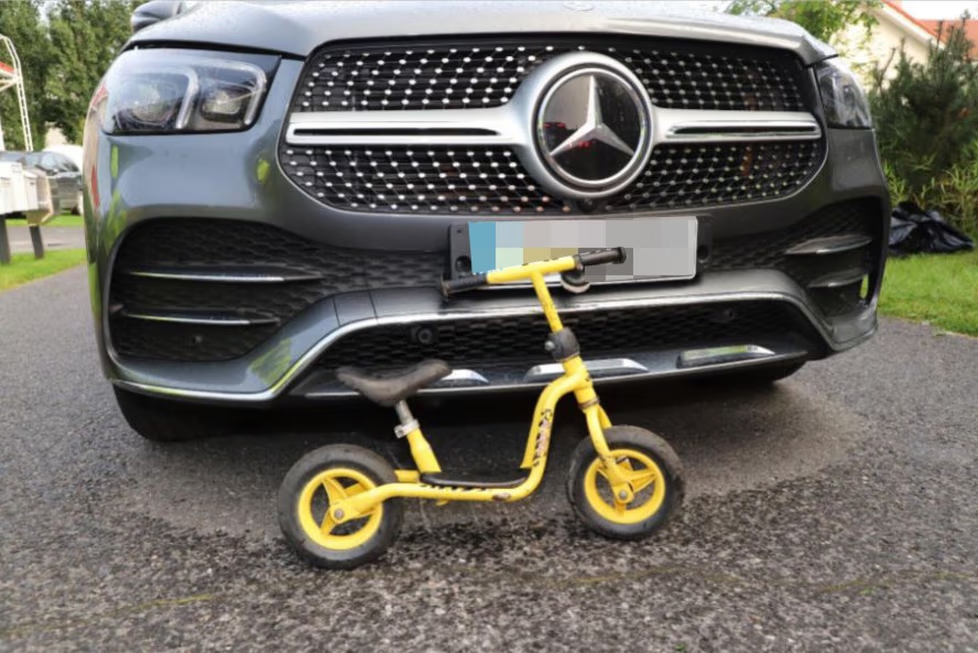
> "Individual Vehicle Approval" rules, exempting them from type safety requirements
These rules need to start discriminating between "safe for the passenger who bought it" and "safe for everyone else sharing the public space". Let people easily import some old Model T or a cute kei truck but not something that will kill someone else's kids who they can't see.
I'll always catch hate for saying this, but the quickest way to get people into small more efficient vehicles is to eliminate public roads and make the fuckers pay whatever the market rate is for their super-sized diesel coal rolling environmental destruction machine to be on a road.
They'd quickly find out when they're not being subsidized by the general public and people actually have to pay their way to use their vehicles through tolls to people amortizing their road maintenance costs, that the smaller more pedestrian safe cars are the ones that make sense to operate.
Vehicle tax in the Netherlands is already weight-based. This is why the tax rate for EVs is higher than gas cars. The thing is that if you live in Hilversum and are able to import a car from the US, you don't mind the higher tax to begin with
Agreed, tax based on damage to road, and then tax fuel the amount it costs to clean up the pollution the fuel causes, and then use the money to clean up the pollution it causes. Then who cares if you fly your private jet, or giant car, you just pay for it.
Side effects include: reduced pollution, and cheaper ways to clean up pollution
I don't disagree that large cars create externalities, but what proportion of costs scale with axle weight?
In the UK the most recent budget allocates £1.6 billion for maintenance. According to statista £13 billion was spent on roads last year.
https://www.statista.com/statistics/298675/united-kingdom-uk...
"The thing is that if you live in Hilversum and are able to import a car from the US, you don't mind the higher tax to begin with"
That can be fixed. Starting with removing business tax exemptions for such cars.
This is why they’re registered as business vehicles. Also the roads aren’t tolled, oddly.
How much higher? My impression is that passenger vehicles are absolutely subsidizing the trucks and buses so overall tax is mostly moot.
I think those Dodge Rams are on a different tax rate for commercial vehicles.
Why on earth you would want a pickup truck instead of a van is beyond me. This ain't Oklahoma.
Would be great if that was the case in the UK. Currently road tax, or Vehicle Excise Duty is related to CO2 emissions. Road upkeep is from general taxation. Road tax was abolished in 1937, I like to remind motorists of this fact when they say "cyclist should pay road tax". Although EVs now have to pay 3p per mile from 2028, which is a big change. Yeah the super-sized vehicles might pay more in fuel tax and have a higher VED rate, but nowhere near enough.
> TLDR, UK road users pay for far more than the road network.
Right, but driving has far more externalities than just the cost of the roads. For example:
> Results suggest that each kilometer driven by car incurs an external cost of €0.11, while cycling and walking represent benefits of €0.18 and €0.37 per kilometer. Extrapolated to the total number of passenger kilometers driven, cycled or walked in the European Union, the cost of automobility is about €500 billion per year. Due to positive health effects, cycling is an external benefit worth €24 billion per year and walking €66 billion per year.
From "The Social Cost of Automobility, Cycling and Walking in the European Union", https://www.sciencedirect.com/science/article/abs/pii/S09218... (which I heard about from a CityNerd video https://www.youtube.com/watch?v=qp75-46PnMY )
> Although EVs now have to pay 3p per mile from 2028, which is a big change.
This is interesting, how is this accomplished?
Over here there was some proposal some years ago to move to a per-mile taxation, with higher tax in congested areas. All managed by some kind of GPS device in each car. There was much opposition as people didn't want the government spying on them via this GPS device, so the plan was eventually dropped.
A simpler approach would be to just record the mileage during annual inspections, but hey why make it simple when you can have some public-private grift making zillions on selling these GPS devices and running the infrastructure for them..
Part of me has also been thinking "let people drive their imported huge trucks but with the understanding that if they kill someone in an accident its not just an accident, its a murder charge for willingly driving such a dangerous vehicle on public roads".
You'd be surprised to see people can't be classified meaningfully based on how much their car weighs.
That’s putting unnecessary burden on the victim.
If you want a silly huge car you should pay silly huge fees for it. You must compensate the public for your nuisance vehicle.
Yeah there are always levels of risk we as a society have chosen to allow. My thinking was along the lines of how to self-regulate these imports of cars that do not follow the common safety standards our society has chosen if they are forced upon us by trade agreements or well-intentioned loopholes.
("murder" is a bit an extreme reaction but the more realistic idea may be to make harsher judgements the more pointlessly large and dangerous the vehicle is)
Manslaughter would be more relevant than murder, but it's very rarely used as juries are very forgiving of drivers. Personally, I'd like any careless/dangerous driving charge to make use of a driving test examiner as an expert opinion and to declare whether the driving would be an instant fail on a driving test. Rather than the driving test being used as the minimum required competence for drivers, it often seems to be used as the pinnacle of most drivers' expertise.
Also, it's very rarely an "accident" with a road traffic collision - that implies that there was no fault involved with the collision and "just one of those things that happens". (I would consider an accident more like a tree suddenly falling or an undiagnosed medical condition).
Of course such laws are ridiculous, but it does lead to an interesting thought experiment.
One of the principles of Libertarianism is equivalent compensation for damages. What is a fair compensation if someone causes death? A life for a life? Code of Hammurabi? Such laws have existed before, but there is indeed no apatite for that in modern times.
So if the government is going to be arbiter of fair compensation, the best it can do is to prevent harm from happening as much as possible. Claim that as a society we did our best to prevent the death, and assign victims and token amount of money. But this also means that not doing everything you can to prevent deaths goes against Liberatarian principles, because you allow for more unfair compensation.
I share your feeling. However
> pay whatever the market rate
would only work if there is a market. And infrastructures like roads are a natural monopoly[0], so there could be no market.
[0] https://en.wikipedia.org/wiki/Natural_monopoly
Heavy semi-trailer trucks disproportionally damage the roads, if they'll pay a fair share groceries could become unaffordable.
Even though it may change with technological developments, are you aware that EVs are the heaviest vehicles on the market, by somewhere around 140% the weight of ICE vehicle equivalents?
Do you understand why this isn't a workable solution for everyone, and likely not even for the last 10% of your journey?
Where I presently live in the U.S., the fuel taxes and registration fees pay both for the roads and produce excess revenue used to pay for public transit.
Larger vehicles use more fuel; they’re more often diesels which attract a higher tax; and they pay increased registration fees and tolls.
Total tax on diesel fuel is about 71¢ a gallon (about .16€/L). When they fill up their F-350s, which get around 12mpg (20L/100km), they’re paying $21 in road tax, or about 6¢ per mile (.3€/km).
In larger cities, there are often even more tolls/fees like in NYC which are raised whenever they need more money to pay for public transit.
1. I'm not a driver, much less in a country with toll roads. But is it common to have per-vehicle customized toll prices? I would expect to pay a fixed per-car, per-use fee.
2. How is this dependent on privatization? Every car is registered. So it seems pretty easy to enforce taxes on cars. And to do so based on model, weight, whatever you want.
In other words, from what I can tell, making people pay their fair share seems simpler in a public system, if anything. It certainly doesn't require privatization.
FWIW I have little skin in the game, as I said, not a driver, so I would probably benefit both by having to pay less tax and by reducing overall car usage.
Which, for the purposes of this topic, means a flat toll. Because we're talking (for the most part) about passenger cars.
Doesn't work in France with its huge number of toll roads, and in the UK where fuel duty is the largest single part of the price of fuel, it more than covers the cost of public roads, yet people still drive everywhere in increasingly large vehicles. It's not gonna reduce driving, though I do agree it should not be subsidized.
The reason why British people are able to afford large and expensive vehicles is the heavy reliance on credit. 84% of new cars were bought on finance in 2024[1]
[1] https://assets.publishing.service.gov.uk/media/6781339100e3d...
Road damage is exponential with weight, so heavy vehicles are still heavily subsidized in France even if the total revenue is correct.
There was an interesting court case where only giving tolls to 18 wheeler was problematic but the equivalent fee for cars would have literally worked out to under 1 cent.
You're getting downvoted because good enough quality roads are so cheap that market rate wouldn't really do anything. The government needs to be in the road business so it can stick its thumb on the scale.
"... because good enough quality roads are so cheap ..."
If there is only one thing you take away from this discussion I hope it is:
Roadbuilding is fantastically, stupefyinlgy expensive. One can hardly believe just how expensive a safe, standards-based, high quality, durable stretch of asphalt is.
You know how you drive somewhere and then there are some cones set up and a lane of traffic is blocked off while two or three machines and a handful of guys repave a short section and then 20 seconds later the cones end and you're back up to full speed ? You just drove past millions of dollars of budget.
The roads where I live are paid for with a plate fee of $10 a year for cars and a higher one for trucks.
The state also sends a certain amount of fuel taxes to local governments in accordance with how many miles are travelled in an area.
New construction must privately pay to build the roads and then transfer ownership to the government. So the cost really is private. By far the most expensive part of maintaining roads is replacing bridges. Hence why so many bridges have rules about weight limits for trucks.
I suppose if you really wanted a user fee on roads you could have a system of tolls on bridges, intersections and interchanges, but that would be really unpopular.
There are many easier ways to effect this social change, if you’re willing to do basic legislation around the vehicle itself.
The easiest way to decrease unnecessary oversized vehicles, frankly, is to require them be painted pink and flowery. Many men in America pick big vehicles as they're perceived as masculine, and a basic paint job to attack this psychological would probably work.
Less jokingly, add mechanical speed limits to them. Big heavy vehicles are extremely dangerous, but that danger is closely related to speed.
Other options include adding excessive cameras and radar equipment, so the front of the vehicle isn’t a blind spot. Cars have plenty of cameras and mirrors already, so it’s not novel to drivers. It’s a missed opportunity already since this could really be implemented by major manufacturers within a year.
The danger is not just related to speed, it’s about them being sp large that you can’t physically see the old lady or child walking right in front of it
When I drive a pickup it’s typically for work purposes. I would not care one whit if it had pink flowers and neither would anyone else. If anything it would make it higher visibility.
As far as a speed limit… what governed speed are you proposing? Being in a pickup pulling a trailer already makes you a cop magnet, and I never go even 1 MPH over the limit. It’s already expensive enough fuel economy wise and they aren’t exactly vehicles with fast acceleration.
Incidentally of people I know who have died in vehicle accidents recently (last 5 years) all of them were because they got hit by a large commercial truck (typically 35 tonnes). One died when he crashed his motorcycle. That’s it.
> The easiest way to decrease unnecessary oversized vehicles
Remove/modify the laws that caused such vehicles.
Yes, they should, but there are a couple of things to consider here. In most countries we are talking about very low numbers of cars that are exempted. You can see this as a safety valve of sorts: provide some leeway to ensure you don't give the automotive lobby reason to push back too hard against regulation. Because the automotive lobby is insanely powerful and you need them on your side in order to ratchet up regulations. (And I'm not just talking about those that represent the industry).
What you really care about is that we are able to tighten regulations for 99.9% of cars. That's what is going to make a difference. Not running after the 0.1%. It just isn't worth the effort.
And we do this for new cars. We constantly ratchet up the safety requirements. Ensuring we slowly make the overall fleet safer. Not only do the Euro NCAP rules get stricter over time (hence "ratchet"), but the "NCAP star rating" is being tilted towards what are now termed as "Vulnerable Road Users". (Note that the percentage weights haven't changed that much but the rules that decide the number of stars have).
(The reason we now have the concept of Vulnerable Road Users rather than just pedestrians is so we can broaden the scope to include cyclists)
Note that the 99.9% / 0.1% figures are _guesses_ and that they are most likely way too conservative. I was not able to find exact official figures on exactly how many excempted cars are have valid registration. But I could find some numbers on the specific class that large US pickup trucks belong to. And when you compare these to total automobile sales, these numbers are trivial. That's 0.076% of EU car sales that year, and 0.057% of European car sales.
It would be thoroughly pointless to focus on them.
I think it’s bold to assume that car manufacturers are happy importing X,000 cars a year. Their ultimate objective is to sell as many cars as humanly possible. A “release valve” for the automotive lobby is just a way for them to infiltrate a region so they can entrench themselves into citizens psyche by using manipulative marketing tactics, building a coalition from within. I am from the US and I don’t think Europe should allow the import of any large non commercial vehicles
But this isn’t what is happening.
Look at the numbers. What would you expect if Individual Vehicle Approvals represented an actual bridgehead for manufacturers? You’d expect noticeable growth over the past decades. But it is still a rounding error.
If this were a strategy to make Europe soften regulation, it hasn’t worked. Rather, the opposite is true. The ratcheting of regulation is actually so stringent manufacturers have to worry about cars sitting unsold for too long. Right now there are a lot of unsold cars in Europe that come 2026 will be unsellable. Because they won’t meet requirements. And these are cars that meet 2025 regulations. Not pickups from the US that have to be approved individually.
Yeah, I don't think the "release valve" is the correct metaphor. This is more like a crack around a door frame that you can get a lever into in order to eventually pry it open.
Why do they need to do this? Is this a real problem in Europe? Are lots of people being killed by these imported trucks?
As the article states, US pedestrian deaths are UP 80% since 2010, while EU deaths are DOWN.
You can’t probably blame 100% of that difference on the design standards of US vehicles. But probably a high proportion of them!
A 2025 GMC Sierra 2500 is a way bigger vehicle than a 1995 Ford Bronco. 7,417 lbs vs. 4,616 lbs. and hood height of 6.6 feet vs. about 3.7 feet. And the "light trucks" category has risen to 65% of the market from 36% of the market back then. There are a lot more of them, and they're a lot bigger.
Do Europeans not have smartphones?
So what? You can already go on mobile.de and buy all of these US vehicles today from specialist importers.
Approximately nobody wants these cars in Europe! Everyone who wants one and can afford one already owns one, there’s no lack of supply.
Implicitly you appear to be saying that we need to reach that point before action is taken?
We need to have a reason to take aution before we take action, sure.
This is an incredibly niche product in Europe, so far I’ve seen no evidence that the current state of affairs isn’t perfectly fine.
No need to fix things that aren’t broken, or don’t even look to be trending in that direction.
The difference is visibility, with a van you can often see as close as 1,5 m in front of you due to the short hood. The problem is a lot of the newer trucks and SUVs are so tall that a full child (or 5) just disappear in front the car.
For the UK it is a problem that many of our roads were built for a horse and cart. People like the aesthetics of these narrow, hedge-lined roads, so they won't change. An F150 or Ram is a very large vehicle to be putting down these roads.
It is fine as long as people are good at reversing...
Afaik the payout is determined by your insurance, not the opposing party if you are not the cause. They will usually just stick to the standards set by the companies and not argue.
They are all business vehicles as the premiums would be so insane no person would pay it (which is a hint why they should not be in the road). The problem comes when the crash out costs the business and then you get nothing due to type of insurance (pretty much we pay nothing you pay everything yourself), or the ability of companies to fight endless court battles which your insurance likely does not cover.
My way of middle fingering them is reporting them every time they are either on the curb when there is a parking spot (not legal, blocking pedestrian access is only partially legal when there is no parking pace nearby and you leave enough space), or when they overextend onto the road which is a judgement call and up to the enforcing officer.
You also need to keep notice of people trying to get the municipality to widen parking spots and block that.
As far as I'm aware, having any wheel on the footpath is illegal except in areas specifically signposted for it, but my experience has been that handhaving just didn't care
https://www.parkeerbord.nl/wetgeving/is-parkeren-op-de-stoep...
This spot used to drive me absolutely insane when walking to school with my kids - the gemeente even added marked parking spots and drivers just stole the footpath anyway, so we had to walk in the street, and the gemeente straight refused to issue tickets. The guy on the phone told me "it's not causing any trouble" because hey, it's not like _he's_ ever had to push a pram in the street.
https://maps.app.goo.gl/YD5w84R19TGQgPX78
I have - or rather had, died - an uncle who had a very effective way of dealing with this. He just walked over the cars.
RIP Cor H., one of a kind. I'm pretty sure the fact that in that neighborhood even now people are religiously parking on the street and never on the sidewalk is a remnant of his presence in this world.
I might have it wrong in the inside/outside city limits with respect to parking on the curb as there are differences. There are also municipal rules but in general they are only for very specific locations afaik.
If you get injured because the municipality refused to act they are on the hook. Thell them you want it on paper they say they will do nothing to prevent this and you want them telling you specifically you have to walk on the street because they do not act on illegally parked cars.
Edit: where I live I have the option of specifically reporting a dangerous situation which in your case I would: near school zones with children involved it always is in my opinion but who am I to judge. It also helps if more people complain. We have a load of parking tourists here since the municipality mode the payed zones so more traffic and more annoyances. My first messages got impolitely unanswered but after a year of complaining by pretty much everyone they finally start doing things.
To be fair, parking illegally and/or disrespectfully is not a problem with the vehicle type but with the driver and lack of local enforcement. People also block footpaths, roads and parking spots in Polos and similar smaller vehicles, and plenty of workers cause issues with their regular european cans and pickup trucks. A favorite of mine being small roads with perpendicular parking spots, with an extended Mercedes Sprinter parked so that both footpath and road is restricted.
Our regular local European vehicles are often larger, they're just safer. So no, nothing specific to the use of imported vehicles.
For example, a Mercedes Sprinter in the standard long box configuration (as is used by local grocery delivery services, plumbers and the likes where I live) is 7.4 meters long , way longer than even the longest American pickup trucks (for some of them, several meters longer!), and is just as wide as them.
In custom box or pickup bed configuration (used by e.g., gardeners), these vehicles get wider (and sharper).
> To be fair, parking illegally and/or disrespectfully is not a problem with the vehicle type but with the driver and lack of local enforcement.
For cars that can be sold without having to get special approval, the obnoxious drivers are a minority (well, maybe BMWs excluded ;-P).
But what driving/parking manners would you expect from someone who went out of their way and paid extra to get e.g. a Ram or an F-150? They're almost guaranteed to disregard any inconvenience they cause with their driving.
it's just a lot easier to park illegally (space wise) when your vehicle is huge / larger than the usual parking spaces. on my usual bike route there's at least one spot where people often park huge vehicles partway over the bike lane, forcing me to divert into oncoming vehicular traffic. small cars fit, broad cars don't. by law, they're plain not allowed to park there, but when you call the drivers out on it, they usually just argue that it's not their fault if the parking spots are too narrow.
The issue you're running into is that you're a crazy extremist and so the parking ticket people who are accountable to a government that has to at least pretend to care about public opinion aren't going to enforce the rules the way crazy extremists like you want, they're gonna enforce the rules in the way some approximation of the general public wants.
The government doesn't want to have it's agents doing "aha, gotcha" stuff on technicalities and the strict letter of the law except where doing so aligns with broader public support because doing so without that support will not endear the government to the people. Reporting a Superduty for parking like an ass in the same way that a bunch of other people are parked like an ass because you don't like the Superduty isn't gonna change the enforcement calculus.
> he problem comes when the crash out costs the business and then you get nothing due to type of insurance (pretty much we pay nothing you pay everything yourself), or the ability of companies to fight endless court battles which your insurance likely does not cover.
Business automobile insurance doesn't work any differently than consumer automobile insurance. Liability payouts don't usually (ever?) have deductibles. I was recently sideswiped by a guy driving a massive pickup truck for work and their insurance paid me promptly and fairly without any fuss at all. At least the state liability insurance laws I am familiar with do not change just because you're a business.
Absolutely the same with RAMs in Germany. Big toys for rich guys to compensate something small. Takes at least 2 parking spots and doesn’t fit anyway.
On other hand the RAMs are not relevant for the average citizen. Crazy fuel consumption is a showstopper. And the ones with some extra cash will continue to import with German „Individual Vehicle Approval“ equivalent. In my eyes it’s another useless European regulation. Let poor people import cheap Toyotas from overseas.
They're relevant for the average citizen because they're killing average citizens.
A Ram was certainly relevant for this dead woman - https://www.rtl.nl/nieuws/binnenland/artikel/5521908/rouveen...
Would be the end different if it was another oversized car like X7, G-Klasse or Cayenne?
Edit: I am really curious why there is no real vehicle physical size tax in Germany. Let’s take reference as VW Golf. Smaller cars cost less, bigger more. I agree to pay more, but current insanity with RAMs and vans should be somehow regulated.
A lot could probably be done with a simple "a person 1.80m in length must be able to see a 50cm high object 1 metre in front of the car" or something like that. Just making up numbers here and don't know what would be reasonable, but it seems this doesn't need to be that hard?
Weight also matters of course. Hopefully this relatively simple ruling will fix some of that too.
Tanks are famously dangerous to be anywhere other than directly in front of. The angular front blind spot isn't terrible, but from the front corners on back they're massive hazards to the point where infantry gets trained on it so they don't get run over.
Speaking or fun over, whoever made that illustration should be run over by a tank. Fix the size of the goddamn kid or fix the distance and change the size of the kid. Having both variables move serves to only add confusion and annoyance.
> an M1 Abrams tank has less blind spots
Absolutely not. You can't even turn around in the driver position of a tank.
It seems this could be largely mitigated with relatively simple lidar.
Yes. Just take a look at this picture of the accident. You can instantly see where the proportions go wrong. Not survivable, even at low speeds.
https://cldnr.prod.webx.talpa.digital/talpa-network/image/fe...
A lot of German SUVs are heavier than full sized American pickup trucks, even when they look much smaller.
> The monstrously large (5.8 meters) G63 6x6 is considerably rarer (i have never seen one in person).
Those kinds of exotic variants are for the Dubais of the world, for rich Arabs to power up and down sand dunes, not for the Autobahn and narrow medieval streets. I’ve only seen it at a motorshow.
> Would be the end different if it was another oversized car like X7, G-Klasse or Cayenne?
For one, typical pickup trucks seems to have much worse forward visibility than most SUVs. To the point that even an M1 tank sees forward better:
* https://carbuzz.com/news/the-abrams-m1-tank-has-better-visib...
> I moved here to get away from American kindercrushers (among other reasons) and I am profoundly concerned that Europe is being invaded by these machines.
I'm European and I'll go one step further: I'm profoundly concerned that the majority of people in Europe seem happy to imitate all the bad things that the US has, but fiercly reject all the good things that the US has.
I assure you I am asking in good faith - but as an American who recently visited Denmark & Norway, I am dying to know what those 'good things' are (only thing I can think of is good Mexican food, but thats not American)
One I can think of is that setting up your own company is a pain in the ass, and working as a contractor almost never worth it. I'm in Spain, but I think it applies to many Euro countries, which actually is another one, the exact laws and paperwork are entirely different for each country, though that's not something people actually reject, it's just the nature of having many countries with many different languages.
> setting up your own company is a pain in the ass,
Depends on the country. Here in the UK you can do it from a website, takes 20 minutes.
I responded to the person you're talking to, have a look at what I wrote.
Good things of American culture?
So, understand that the things I'm about to mention are not universally true for all Americans, obviously. For any feature, there's a statistical distribution over the population of individuals. I'm not saying that "All Americans are more X than all Europeans". I'm saying that "The average American is more X than the average European, even if that difference is dwarfed by the standard deviation within which each of those populations".
Here's some that come to mind:
1- positivity. Americans seem to have more of a can do attitude, Europeans start out with the negative belief that attempts will fail and things don't change.
2- friendliness. I lived 1 year in Chicago and in that one year I was approached on the street 3 times by random people who just said "hi, how are you doing? Nice day". In the 10 years I lived in London that happened exactly zero times.
3- shared identity. In Europe there's endless "cultural bickering" between neighboring countries over their miniscule, irrelevant differences. I don't perceive this across American states. The one thing that all Europeans agree on is that we're happy we're not American. How pathetic is that.
4- emphasis of freedom and free speech.
5- work culture (partially). I'm not going to say that I want Europe to emulate American work culture whole sale, because in America there's more abuse from employers and that's a negative aspect. At the same time, one thing I think is great is that in the US it seems that some significant fraction of people actually believe in the jobs they do. In Europe people say that, but we all know it's fake, we're just here for the paycheck. This might just be American positivity spilling into work life.
These are all things I've heard Europeans explicitly point to as undesirable:
1- American positivity is fake
2- American friendliness is fake
3- American shared identity is actually lack of identity
4- The concept of Freedom is American propaganda
5- enjoying your job is Stockholm syndrome from being abused by your employer.
I appreciate this response, it actually matches some things I've heard from European coworkers regarding Americans being more positive and friendly. I also think you did a great job capturing the fact there's honest and dishonest versions of these qualities and both can be true depending on the circumstance. Thanks for the thoughtful reply!
This seems to be concerning but as a Dutch person who has lived in the UK for a long time the relatively recent home-grown 'fatbike' issue seems to be a much more pressing problem for Dutch road safety than this and isn't being dealt with effectively as far as I understand.
Having said that I think these American pick-ups (and large SUV's, they are part of the same problem) are a common sight here as well and should not be allowed on the road (unless maybe you can show you need one for work or business).
I see those in Sweden as well. But I also know that people are stupid. And I rather have a stupid person on a stupid bike than a stupid person in an SUV. Especially since in an accident, they will lose in any case because most are likely not street legal.
> This seems to be concerning but as a Dutch person who has lived in the UK for a long time the relatively recent home-grown 'fatbike' issue seems to be a much more pressing problem for Dutch road safety than this and isn't being dealt with effectively as far as I understand.
This is the appeal to worse problems fallacy. Both are problems, both need to be addressed.
What's wrong with fatbikes? They look stupid for sure, but otherwise?
They are routinely modified to exceed legal speed limits and owned by 10 year old or younger kids. Going nearly 30mph on a footpath whilst holding a mobile phone. I think they are also unregistered.
Major problem in the U.S. too.
Easily modified to go as fast as 50 MPH on a chassis not designed for it. Drivers aren’t licenced and often are young kids. No registration. No insurance. No training. Very hazardous to pedestrians.
Yes- in the Netherlands the term 'fatbike' is pretty much synonymous with the battery powered bikes only (I presume elsewhere this may be different). They are mini motorcycles really- but exempt from all the rules and regulations that would apply to regular motorcycles.
This morning in Amsterdam a dog got struck and was killed by one of these vehicles, happend right in front of me. Poor doggo
What idiot would drive one of these in Amsterdam to begin with? It just doesn't fit the way traffic is organized there.
Here's an example of driving "standard" historic UK rural roads:
https://ichef.bbci.co.uk/news/800/cpsprodpb/b2ad/live/a20a6d...
from: 'Carspreading' is on the rise - and not everyone is happy about it - https://www.bbc.com/news/articles/cy7vdvl2531o
Throws in the term "Chelsea Tractor", in Australia in the 1980's they were called Toorak Tractors or simply Yank Tanks.
> "Chelsea Tractor" is more of a dig at people Range Rovers for the looks and it never been using off-road.
People in London bought 4x4s (in part) so they could still comfortably travel down roads covered in highly aggressive speed bumps. The joke is that we made London roads miserable to drive in a sensible small car (even at safe and legal speeds, I usually have to stop on approaching some of this stuff in a bog standard A1).
There are plenty of factors at play, but sometimes incentives are obvious
> I don't see the issue with the driving standards in the photo. Road is quite wide too, and those yellow lines suggest some town area.
It isn't the Rural Roads in the UK. Also the cars in the photo are kinda normal sized. The Volkwagen people carrier thing in the photo isn't that wide actually.
It doesn't, but people do it.
Here's one in Utrecht https://urbanists.social/@Fuzzbizz/109608802470660144
There are much more dangerous vehicles around on European roads, such as most buses, trams and lorries.
A Mercedes Vito, despite being nearly 1m shorter and normal car width, has 4-5x the carry capacity and a 3x longer bed than the RAM. These cars are just for show, you can probably find a Kei truck with similar capacity.
They're starting to become more common in Spain too, even in villages/towns where they definitely don't fit. Through the years I've seen two of them stuck because they tried to fit into small village roads where hardly normal passenger cars can fit.
I saw a Ferrari trying to navigate speed bumps and a roundabout once.
People are strange.
In Amsterdam I got called by a friend if I could please drive a car out of a garage. I thought it was a pretty strange request. Turned out this was in a building on Stadhouderskade, an underground garage. Some guy had driven his Ferrari down into the garage, parked it, had his meeting and on the way out realized he couldn't turn it around but he did not dare to make the trip backwards... I said sure, got in reversed it up the ramp and he was pretty happy, then asked if I wasn't nervous.
"Not my car" :)
[dead]
That is a lot of Dodge Rams. It's a ponderous trend, it'd be interesting to see what is the driver. Is it a particular demographic, or subculture?
My mom who is originally from Bergschenhoek claims her elder brother taught her to drive, in a Dodge truck, probably post WW2 in a model like this one: https://en.wikipedia.org/wiki/Dodge_T-,_V-,_W-Series
I don't know whether there are hordes of bejaarden buying Dodges for nostalgic reasons, but that would mean the Dodge brand has some insane staying power. My guess would be that is absurd and unlikely.
I really dig your deadpan sprinkling of Nederlands. Some words have that etymological acuity that makes them irresistible to just deploy. I was always amazed by how many Yiddish and French words there are in Hollands.
> Walk around Hilversum in the Netherlands and you will see plenty of Dodge Rams
Which confirms the old adage: "Money does not come with taste".
It should be illegal, but I do think you might just be living close to some people who really love trucks. 5k is not a lot across Europe, popular models sell 10x that.
They are heavily clustered around US military bases. If you life near one you will see a lot if oversized US vehicles, in most of the rest of Europe you can go months or years without seeing one
> They are heavily clustered around US military bases.
They’re clustered around areas of idiots with means. I’m nowhere near a us military base but there’s a bunch of these where I live, including two or three owned at houses I pass by on my way to work.
Honestly, local governments should just grow a pair and say no to this kind of shit.
If the US government wants to give its soldiers perks, they can rent or loan them a local car. Probably cheaper all round than flying/shipping in their financed Dodge RAM anyway.
Then again, American personnel being arseholes to the locals is well established from Okinawa to Croughton so it's probably endorsed as a power thing.
These American trucks are driven by Dutch or by eastern Europeans (e.g. from construction industry)? The Dutch cycling culture and urban planning are adorable, but we are terrible selfish assholes especially regarding the cars.
i'm always suprised by the amount of SUVs on Dutch highways. in that regard you are not that different to us Germans.
You know before everything was an SUV, rollover protection (and the associated lack of visibility) was much less important. The SUVs are just as much of a problem as the trucks, but get far less attention.
> […] and on top of that are almost always registered as "business vehicles" (you can tell from the V plate) which means they pay an absolute pittance in tax.
In Ontario, Canada, (AIUI) you have to get a commercial car plate for pickup trucks.
* https://en.wikipedia.org/wiki/Vehicle_registration_plates_of...
If you want personal / non-commercial plates you have to get inspections done:
* https://forms.mgcs.gov.on.ca/en/dataset/on00719
Monster trucks are becoming increasingly popular in Australia too
I've seen that movie!
And don't even mention the Cybertrucks cruising around who knows where. Granted, I've not seen any parked at the Albert Heijn quite yet.
Luckily I haven't seen a single Cybertruck in the north/north-east of Spain. Pretty sure I'd call the police if I saw one as they're clearly illegal here.
Modern US trucks are an absolute atrocity. I am the demographic that thinks they look cool and might one day have bought one should I end up with more money than I knew what to do with if I hadn't learned that they're death traps.
The tall grill means impact to pedestrians, bicyclists and motorcycles is basically instant death as their head - the only thing above the grill - gets whiplashed onto the rigid tip of the hood. On a normal vehicle you get your legs swiped and rotate your whole body onto an intentionally flexible area of the hood for a much gentler impact.
The visibility from the driver seat is not only much worse than our actual semis, but also worse than actual tanks. You could have half a kindergarten and a small vehicle in front of your car without knowing.
As for the tax, eh - tbf these vehicles are mostly used for business purposes by sole proprietors and the likes, and while they're stupid vehicles they do still do the job. A fully decked Iveco Daily or Mercedes Sprinter is also expensive with little registration tax. Registration tax is a weird (and arguably stupid) system, this isn't really an outlier in that regard.
I roll my eyes more when I see a sports car attempted registered as a van.
Living in the US, what I find even more wild is just how many people purchase them here who have zero need to own a truck that size. It's got to be the most absurd parts of our modern cultural identity.
Even if the owner is using it as a rugged machine for hauling tools and supplies back and forth, they make for terrible work vehicles. A bed that's advertised as 6 foot actually measures about 5' 7" if you're lucky and the wheel wells eat into it so much that loading anything wider than maybe 4' just feels stupid. Nothing about it feels convenient or helpful when compared to a proper work van or a small flatbed. It's basically just a comfy exoskeleton for the driver to pickup groceries.
Meanwhile, I'm driving from site to site with a 4-cylinder hatchback full of tools in custom boxes I made getting twice the gas mileage. It gets some funny looks, but it gets the job done, which is more than I can say for most of the not-a-scratch-on-them trucks I see on the road, here.
I do empathize with those picking the vehicle not on practicality but cool factor - considering how common and accepted gadget cravings are in other areas, I would find it unfair to attack that aspect. I'm currently using ~5GB out of my laptops 64GB of RAM, pretty sure I could start a small fire with my flashlight, and my motorcycle has off-road suspension in a country where the most demanding obstacle is a curb. Other things would objectively fit my needs better while costing less, but be less fun - and fun can be hard to find these days.
As you say, they are absolutely terrible for work use as well - Japanese kei trucks famously have larger beds than some common US pickup trucks, and the size of the custom beds we use in the EU makes the US ones look like absolute kids toys - but that too I wouldn't mind too much if they were just forced to be safe and with decent emissions so the idiocy mainly affected the driver and their wallets.
I'm not too impressed with your vehicle only getting twice the gas mileage though. I'd expect more than that. :P
> I'm not too impressed with your vehicle only getting twice the gas mileage though. I'd expect more than that. :P
I'm going to blame the ham radio antennas and bike rack ;)
But in all seriousness, I was getting slightly better mileage when the car was new 6 years ago. It has declined a bit, despite my regular maintenance, but I'm still very pleased with it. It might be more than twice the mileage of the average truck on the road, to be honest, but I find it hard to get a clear number. I think some truck owners embellish the mileage they actually get, as does the dealer sticker on the new vehicles for sale since those numbers assume perfect terrain with no traffic, last I checked. Then I hop into a co-worker's 2020 truck and realize he's getting 12mpg on a good day and nearly have a heart attack.
My vehicle gets between 45 and 55mpg on average, depending if I'm on the highway a lot or more urban environments.
American pickups are very practical for what they are designed for. Your 4 cylinder hatchback is not going to pull a 20,000lb trailer up a steep grade, or haul enough lumber to frame in a house, or a 7,000lb bed full of gravel. While there are very visible idiots in the USA that drive big trucks for aesthetic reasons, there are also plenty of farmers, contractors, etc. that need them as a practical tool to haul heavy loads. For them, it’s not an oversized car but a smaller and more economical alternative to a large commercial truck.
> An f150 can do none of these things
So? I gave specs for a typical 1 ton truck. A 1/2 ton F150 is smaller, cheaper, and more efficient. It depends on what you need.
A panel van is more useful for some things, a truck for others- it depends on what you’re doing. You’re not going to fill your panel van with manure or gravel and then transport it across a muddy field without getting stuck. I grew up in a rural area of the USA where everyone owned trucks they needed and used for work, most were old and rusty and they all also owned a regular passenger car they used when they weren’t hauling something heavy… people were poor and did not waste fuel driving a truck except when it was essential- not a fashion statement, just a tool.
My family owned a 3/4 ton truck that we needed for hauling our boat and livestock, but we drove an old Volvo at other times. My dad built the home I grew up in, and he had to transport all of the materials to build it himself.
I think the hate on here is coming mostly from a place of ignorance about what life in rural America is like, which is what full sized American trucks are engineered and perfectly suited for. Where transporting thousands of pounds of materials across a muddy field in 4WD isn’t something you do once a year but often twice a day just to survive.
(In the context of the discussion about these vehicles in the EU)
In the EU, neither would any American pickup truck: If registered as a normal class B vehicle, the total gross vehicle weight would be limited to 3500 kg (7700 lbs), and it would at most be permitted to tow 3500 kg (7700 lbs) with full independent trailer brakes, 750 kg (1650 lbs) without. You can add roughly 1000 kg if you tow a semitrailer, but getting the vehicle certified with a fifth wheel would probably be infeasible.
It doesn't make sense as a class C truck here (special driver's license, tachograph requirements for commercial use). It's way less nimble than our Scania/Volvo trucks (their turning radii are way tighter, and and have much smaller footprint for a given capacity), and is obviously a lot less capable than a vehicle that can be build from small utility up to the ~100k lbs range.
At the same time, if a farmer is outside the scope of a regular personal vehicle, they're most likely going to use their go-to tractor (e.g., Lamborghini, John Deere) which can haul anything anywhere, otherwise if they really need to haul they'll be reaching for a Scania/Volvo.
(It is common to register smaller, 7500 kg class C vehicles, but that's usually stuff like large Mercedes Sprinter vans, often built up as specialized service vehicles - think sewer inspection and repair.)
In the context of the US: It might seem like the best choice given the common options there, but I think the issue is with the options and perceived utility. It's the same with large trucks: The common ones in the EU are much more powerful, rated to haul more, are more comfortable, safer, have much smaller footprint for the given load and turns on a dime compared to US options.
It's almost impossible to navigate parking garages if two such trucks park opposite each other. Or if one parks on an end that people need to navigate around.
People spend insane amounts of money buying these monstrosities too. It seems as a society we've normalized spending a year's salary on a vehicle, or rather getting a 7-year loan and making crazy monthly payments. I don't understand it. My then normal-sized, now smallish, 13-year old car, that I paid off 11 years ago, still runs great and I can park it easily.
> People spend insane amounts of money buying these monstrosities too
This is also another part of the whole truck-craze in the US that I do not understand. An F150, for example, starts around $40,000 USD for base models, not including taxes and hidden fees. I purchased my car (an HEV, mind you) back in 2019 for just over half that price, spend about $500 annually on regular maintenance that I'm not able to do myself to keep things tip top, and spend about half as much in fuel as my coworkers who travel about the same amount as me for our jobs. Accounting regularly double-checks that I turned in all my fuel receipts because they still don't quite grasp that my car gets far, far better gas mileage.
All that said, these guys make about the same money I do, some a little less since they're newbies, which is to say we are all very underpaid for what we do, wealthy by no standards. And yet, they made these massive purchases while struggling to pay bills or complaining that fuel is too expensive at the pump, etc. These are the same people who buy two paychecks worth of fireworks every July 4th just to watch it all burn in 15 minutes.
Makes me think part of our cultural identity includes regularly acting against our own interests.
> Modern US trucks are an absolute atrocity
This.
I'm living in EU, thinking about getting some pickup. Just want to try this kind of vehicle (and I would love to transport my motorcycle, building materials etc). But I want something small - it looks like almost non-existent market here (there are cars like older f150, s10, etc - but very, very limited offers). Everyone gets the big modern trucks, that are unusable in our tight spaces.
> I would love to transport my motorcycle, building materials etc
Just get a Renault Traffic or equivalent. I don't see any advantage pickup trucks would have against a white van when transporting anything.
I just don't want white (or any other color) van. Let's say - I have some idea for s10 in my head to make it interesting. No way to make Traffic or other Partner interesting car. It'll just look like DHL services in the end anyway.
I want it with all the pros and cons, just to try it.
If you really want an open bed, the pickup configuration of any fiat ducato, toyota dyna, mercedes vito or sprinter, etc., will work and have much more space. All 3 sides fold down, and you can even get power tilt or a small crane if you want. The dyna is like a scaled up kei-car.
There's plenty of variation as they're all custom, and as they are work vehicles there should be plenty of cheap used ones on the market. The bed is also just a plate bolted to a steel frame so you can do whatever you want with it easily - adding custom boxes underneath, built-in ramps, changing the floor, whatever. They're also available with tall roofs with openable soft cover.
But as others suggest, used closed vans are also cheap and quite spacious, and on the big end you have the usual choice of a long-body sprinter which could probably fit 3 motorcycles inside with space to spare, with a much lower ramp height needed to get them in/out. Look around - it might not be as sexy, but there's definitely something that fits your need.
I would love to transport my motorcycle, building materials
Something like a Peugeot Partner (just to name something) + a trailer does all of that. With the added benefit that without the trailer attached it's a fairly normal size.
Loading a motorcycle in a pickup bed is always a delicate task unless you have dedicated equipment.
Even when I had a pickup truck, I ended up getting a trailer for my motorcycle. In the end, I've got tired of having my luggage getting wet (no such thing as a fail proof bed cover) and replaced the truck with a more sensible minivan.
My uncle got a Hilux for his gardening business. Seems to work well for driving around lawnmowers and other stuff, also for towing the large self-driving lawnmovers and other heavy equipment.
> The visibility from the driver seat is not only much worse than our actual semis, but also worse than actual tanks. You could have half a kindergarten and a small vehicle in front of your car without knowing.
Yeah, mentioned in a comment, driving a Ford Expedition on holiday in the US I almost hit a hit walking down the sidewalk.
It literally had better visibility going backwards in the rear view camera than it did going forwards.
> The tall grill means impact to pedestrians, bicyclists and motorcycles is basically instant death as their head - the only thing above the grill - gets whiplashed onto the rigid tip of the hood. On a normal vehicle you get your legs swiped and rotate your whole body onto an intentionally flexible area of the hood for a much gentler impact.
What's infuriating is the EuroNCAP safety tests refuse to acknowledge this. SUVs get the same bonnet impact test as small cars do and end up scoring highly due to have a large bonnet surface area despite the fact that actual impacts with pedestrians does not happen like that with SUVs.
And then (wrong) smug wanks on the internet talk about how much safer their SUVs are for pedestrians than small cars based on quoting NCAP scores.
You have clearly never sat in the cab of a semi let alone a tank.
The pass side blind spot is massive, even in a day cab with no trailer attached. You can hide an entire minivan in there. Even something like a modern F550 is worlds better.
This isn't to say that modern pickups don't have huge blind spots, they very obviously do, only that your comparison is hyperbolic and unserious.
> they pay an absolute pittance in tax
What would be the appropriate tax for them to pay? I suppose it’s based on weight?
tax should be applied to things we want less of:
- low visibility of little people directly in front of the car: huge tax
- low visibility in the rear: tax (yes, rear camera = no tax)
- too big to comfortably fit a standard parking space: tax
- too big to fit a standard parking space at all: huge tax
- too heavy: tax
- way too heavy: huge tax
- not fuel efficient: tax
- emits lots of dark/smelly/toxic smoke: tax/tax more/huge tax
etc.
Aren’t “bad fuel efficiency” and “can’t park in town” already their own priced-in disadvantages?
Fuel consumption itself is already taxed at the pump.
And I think “too heavy” already means higher tax in NL.
The weird thing is that the EU is really not shy about banning things, and yet here we are in a thread about American Monster Trucks taking over Amsterdam.
> Aren’t “bad fuel efficiency” and “can’t park in town” already their own priced-in disadvantages?
> Fuel consumption itself is already taxed at the pump.
yes to both, but that doesn't mean that extra incentives for high efficiency and extra discouragement nudges for low efficiency shouldn't be present. they're orthogonal features of the economy.
> And I think “too heavy” already means higher tax in NL.
looks like not high enough, judging by this whole thread :)
> The weird thing is that the EU is really not shy about banning things
yes, but it's also known for not moving fast, as all large committees are - and when they finally move, the policy response can be deployed for a market which doesn't exist anymore.
> but that assumption flies out the window when the vehicles are so large you can't even see a kid walking or biking to school
Is this even true with current models? Surely they have a plenty of cameras and will automatically detect children on the way.
Does there exist any evidence to suggest that these cars are particularly dangerous when driven on European roads? Just because traffic in the US is unsafe, does not inherently mean that these cars will be terribly dangerous in Europe.
[dead]
[dead]
[flagged]
The reasoning is these trucks make no practical or economic sense in Europe. They are not allowed to be sold, because they are dangerous to bystanders, are polluting and oversized. Only through some loophole quite a few have been imported, which is very frustrating to all of us that are intimidated and appalled by seeing these on our roads.
These trucs signal that the driver does not care about other people, environment, climate, etc. Because they are dangerous, obnoxious and polluting. And instead of calling these things trucks, I think Kindercrusher is a perfectly apt description.
> Okay. But you've posted 12 times already in this thread that isn't even an hour old, mostly emotions and hyperbolics as quoted above. Kindercrushers?
FWIW, I am not him but I could have written exactly the same, just changing the location. Yes, we do tend to care when selfish arseholes ruin it for everyone, and put other people’s lives at risk for no good reason. And kindercrusher is a perfectly good description of these things.
I have two young children and they are endangered by vehicles like this so I agree that I do have emotions regarding this.
[flagged]
Most people with bikes also own cars.
Don't fall into the algorithmically generated "it's them v us"
It isn't algorithmically generated. I used to spend a lot of time in cyclist circles both IRL and online and there is a very vocal minority of cyclists that basically hate cars and motorists. The stereotype exists for a reason.
I am not interested. I've heard many of these arguments before and I made up my mind years ago.
I know very well that commuting by bicycle in urban areas is often better. I often was quicker through the traffic on my bike than anything else. However it doesn't mean it is better for society. People have different wants and/or needs.
Cycling isn't for everyone and it has some significant downsides. e.g.
- I've been injured as a result of a hit and run and I as a result I have a permanent weakness in my right shoulder.
- I've had my bicycles stolen and/or vandalised.
- I've had to endure very harsh conditions to get home e.g Once I was so cold I thought I was going to threw up, I had appropriate clothing on but I was a little ill and that and the cold almost caused me to faint (I was ~25 at the time).
As for public transport. I generally dislike public transport. In the UK the public transport is often late, crowded, dirty (sometimes extremely dirty), potentially dangerous (I've been assaulted and have been witness to them). I spent a good 15 years using public transport and passing my driving license and getting a car was a godsend.
> He's not a recreational cyclist (light road bike, lycra - sports/racing), he's a utility cyclist (big heavy upright bike, regular clothes - take kids to school, commute, do grocery runs).
There is no problem with recreational cyclists as they do it because they enjoy it. I am one.
I have an issue with many of the political/activist cyclists that are very obnoxious about their dislike of cars. I don't want anything to do with them.
I also don't like "utility cyclists", because it makes it sound like cycling is a chore when it is quite enjoyable, cheap and relatively safe activity that almost anyone can enjoy.
Watch his video. Pick 2-3 at random, be a grown up and ignore the tone of voice and the snarkiness, and see what his points are.
They're very solid.
Try something like this:
https://www.youtube.com/watch?v=CTV-wwszGw8
https://www.youtube.com/watch?v=ORzNZUeUHAM
No. This has existed well before social media.
I have met these people in person. I have gone to their protests (e.g. Critical Mass). These people exist and they believe what they say.
He’s a prominent urbanism commentator- what would the conflict even be?
<facepalm>. This sort of breathless rhetoric from people like you are is exactly why it's a difficult to solve social/political problem rather than a mundane technical optimization issue. They basically banned flip up headlights without any fanfare 30yr ago and it garnered a little complaining from the aesthetics crowd. Those sorts of things can't be done anymore because your ilk has poisoned the well of public policy and discourse.
The common man hears your sort of rhetoric, knows he can't reasonably be an expert in the subject matter and the nuances of the statistics, but he can pattern match on how you're saying what you're saying and it matches up with a whole bunch of crap that's been bad for him.
Any car shape can be styled well and sold to the public. This ought to be a mundane technical issue. But you people have made this a political football and in doing so made the problem much harder.
I really hate the modern high hood truck styling. But I hate it a little less knowing it's followed the problem people to Europe.
So tired of current trend in Europe, the Goverment should solve every issue & every day everyone wants a new rule.
We have now so many rules either they are not enforced or they are making everythingn slow or expensive.
Now to solve those issues, they will call for new legislations, but again they will be enforced only for the first 2 weeks. And then again a call for new rules will be made.
Take for instance FAT bikes in Netherlands, these are e-bikes with big wheel that young kids like. They drive like madman, harrass women in parks & everybody wants to ban them. But there is already enough legislation to take care of these kids, they are just not enforcing them. And probably rightly so, because they have bigger issues to deal with.
Not everything can be solved with a pill.
Opening that video, American-style pickup trucks are about 40% more likely to kill a pedestrian 100% more likely to kill a child (the video argues that this mostly stems from the shape of the front). These cars also get into more crashes
Honestly, banning these things seems sensible when the only thing going for them for most buyers is seemingly an appreciation of their style
Yeah there is always a reason for a rule that makes sense, but there is also a price for making a new rule everytime something doesnt work.
A fat bike is a bike with >3.8" tires and is not necessarily an e-bike nor an issue. Some people use them in the snow, sand or trail without issues to anyone and I have occasionally also used mine in the city because it was more comfortable to ride at slow speed than my road bike and stops on a dime thanks to the available grip.
There are a number of trendy aliexpress quality e-bikes that are also using fat tires and are ridden by idiots but the problem is not fat bikes per se. The problem is idiots on unrestricted/modded e-bikes. Ban fat bikes and they will use unrestricted e-bikes with different tires and the problem will be the same.
Yeah that's kind of the point, new rules will often not solve things, but will just move the issue. The underlying issue with certain groups in society & not enforcing will remain.
Note that the term fatbike means a mountain bike in America but essentially a small electric motorcycle in the Netherlands, UK, etc
Not the UK, here fatbikes are mountain bikes just with wider tyres.
Something like a Trek Farely or Canyon Dude.
They may also be assisted e-bike but not exclusively.
> We have now so many rules either they are not enforced or they are making everythingn slow or expensive.
What exactly is so slow or expensive that you're prevented to do because of some regulation or law?
In theory many laws are based on good ideas, but in practice they dont or only partially accomplish what they set out to do. Few examples:
- Bureaucracy around clinical trials The old Clinical Trials Directive (2001/20/EC) was meant to harmonise standards, but in practice it led to lots of extra admin and different interpretations in each country, which made multi-country trials slow and expensive. EUR-Lex You can see the effect in the numbers: Europe’s share of commercial clinical trials fell from ~22% in 2013 to about 12% in 2023, even while global trial numbers increased by ~38%.
- Medical Device Regulation (MDR & IVDR) bottleneck Meant for safety, but has meant delays and uncertainty for new devices and even risks of shortages of older ones, which clearly affects innovation. * https://www.meddeviceonline.com/doc/we-re-heading-toward-a-b...
- Data protection (GDPR) and health/science data Complexity and fragmentation of implementation can definitely slow things down, especially for big pan-European projects or AI/“big data” medicine. In theory it's good, but researcher or not being helped on how they can compete worldwide while being GDPR compliant, meaning EU will get behind & certain research is done elsewhere
Many more examples in other fields then medicine. And there are clearly a lot of good laws, but our idea of running a country is just adding lots of new rules every year is just faulty.